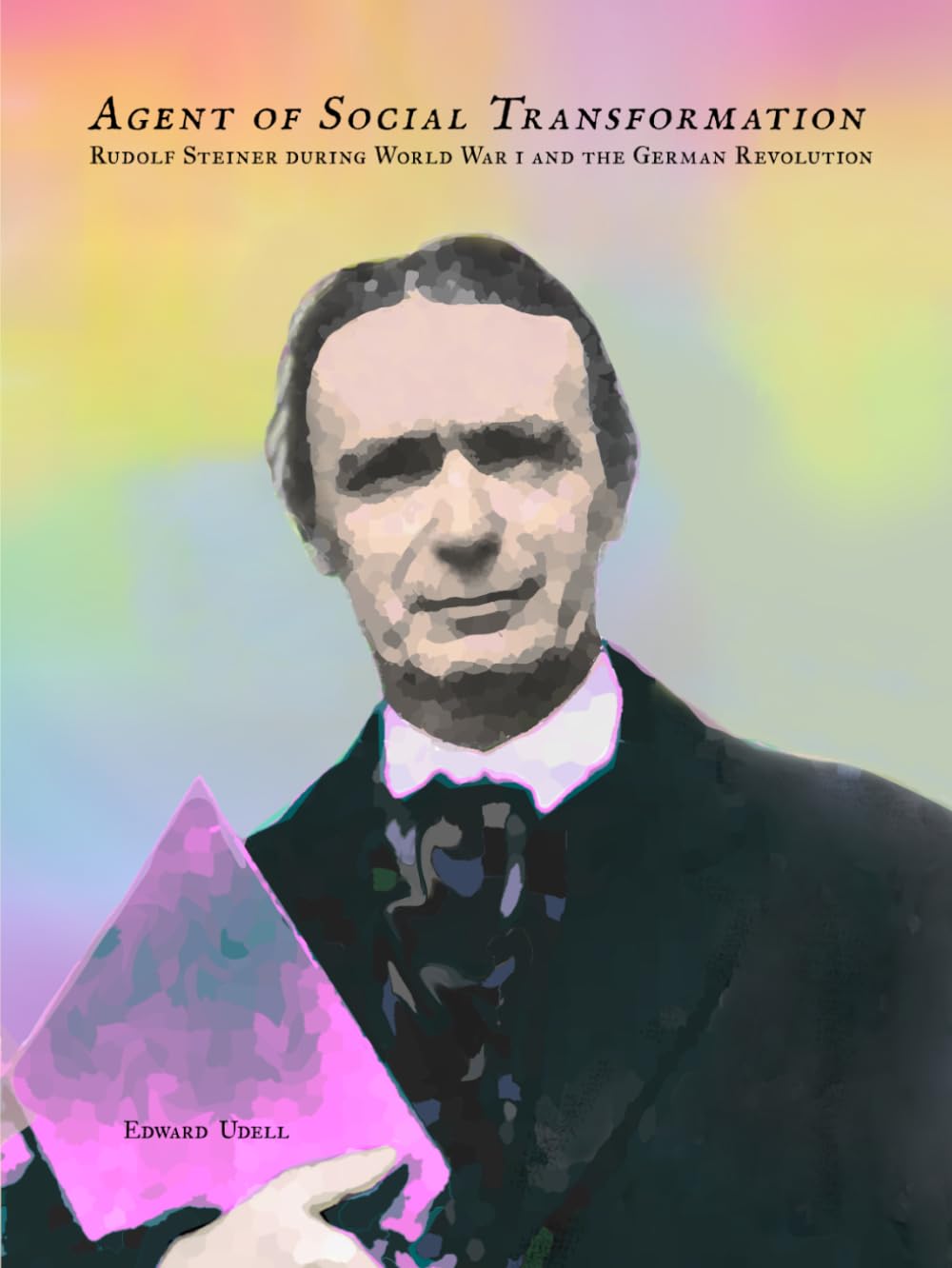
Agent of Social Transformation: Rudolf Steiner during World War I and the German Revolution
$22.00
by Edward H. Udell



“Edward Udell's new book, Agent of Social Transformation : Rudolf Steiner during World War I and the German Revolution , is a brilliant and colorful description of how Rudolf Steiner almost changed the course of world history in several different ways during and after WWI. The book is an important companion volume to Steiner’s own Toward Social Renewal and explains key concepts in a lucid and direct manner while linking them to current social and economic reform efforts. The text is accompanied by a myriad of paintings and photographs from the period, adding a delightful feeling for the tenor of the times in the early 20th century." - Christopher Schaefer, Ph.D. At a few critical junctures during the First World War and the German Revolution that followed it, Rudolf Steiner's surprisingly incisive influence on events and at the pinnacles of Central European power nearly managed to redirect the course of Central European history into peaceful democratic channels and away from currents toward fascism and the Second World War. This full-color, image-filled book (which grew out of an article the author contributed to the 2018 Hawthorn Press anthology Free, Equal and Mutual and has roots also in a few paragraphs he contributed to the Wikipedia article “Social Threefolding”) tells that little-known story and in the process throws fresh light on Steiner's social ideas. Among the new elements in this volume is its discussion of how Steiner's social innovations with respect to capital, labor, land, and money—together with innovations developed by others working in similar directions—are transforming the invisible hand described by Adam Smith. As has become evident over the course of more than a century now, utopian ideologies are generally cages gilded with fool's gold. Steiner from the beginning saw that truth clearly. That is one reason he viewed freedom of intellect and spirit, and thus the right to criticize social institutions, as essential. To Steiner, no system or ideology could be of much use. No “ism” would get people far. Only continual observation and thinking could help. Fundamentally, he sought to make social practices more transparent. That depended on a threefold decentralization process he said was in accord with the foundations of human society. He held that understanding “social threefoldment” and building institutions in harmony with it was necessary for social healing and that political democracy was an essential part of it. If societal threefoldment is not a closed ideology or a utopia, nor the kind of thing that can be imposed on a society, then what is it? As is shown at one point in these pages, it is a historical phenomenon that has been developing gradually for millennia. And today, if people find merit in threefoldment, there are small daily steps anyone can take to expedite its advance.