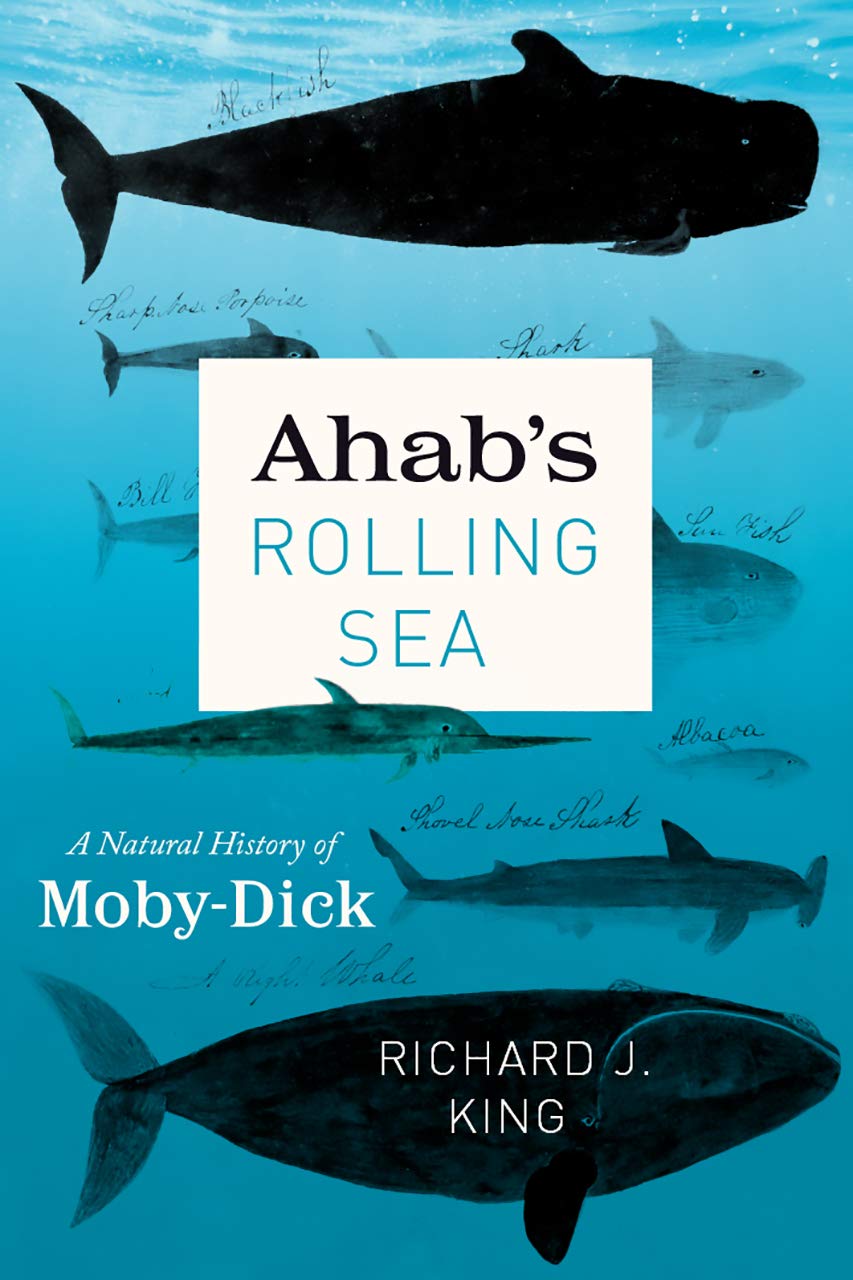



Although Herman Melville’s Moby-Dick is beloved as one of the most profound and enduring works of American fiction, we rarely consider it a work of nature writing—or even a novel of the sea. Yet Pulitzer Prize–winning author Annie Dillard avers Moby-Dick is the “best book ever written about nature,” and nearly the entirety of the story is set on the waves, with scarcely a whiff of land. In fact, Ishmael’s sea yarn is in conversation with the nature writing of Emerson and Thoreau, and Melville himself did much more than live for a year in a cabin beside a pond. He set sail: to the far remote Pacific Ocean, spending more than three years at sea before writing his masterpiece in 1851. A revelation for Moby-Dick devotees and neophytes alike, Ahab’s Rolling Sea is a chronological journey through the natural history of Melville’s novel. From white whales to whale intelligence, giant squids, barnacles, albatross, and sharks, Richard J. King examines what Melville knew from his own experiences and the sources available to a reader in the mid-1800s, exploring how and why Melville might have twisted what was known to serve his fiction. King then climbs to the crow’s nest, setting Melville in the context of the American perception of the ocean in 1851—at the very start of the Industrial Revolution and just before the publication of On the Origin of Species . King compares Ahab’s and Ishmael’s worldviews to how we see the ocean today: an expanse still immortal and sublime, but also in crisis. And although the concept of stewardship of the sea would have been entirely foreign, if not absurd, to Melville, King argues that Melville’s narrator Ishmael reveals his own tendencies toward what we would now call environmentalism. Featuring a coffer of illustrations and an array of interviews with contemporary scientists, fishers, and whale watch operators, Ahab’s Rolling Sea offers new insight not only into a cherished masterwork and its author but also into our evolving relationship with the briny deep—from whale hunters to climate refugees. "I’m an easy mark for books like Ahab’s Rolling Sea: A Natural History of ‘Moby-Dick ,’ which I’ve read a perhaps unhealthy number of times, in light of Annie Dillard’s opinion that Melville’s baggy masterpiece is the ‘best book ever written about nature.’ Focusing on nineteenth century oceanography, natural history, and, of course, the whalers’ understanding of his prey’s remarkable intelligence, King’s book is a fascinating and rare thing: a vital addition to Melville studies." -- Stephen Sparks ― LitHub, "12 Books You Should Read This October" “King uses modern sources and historical texts to take a fresh look at Melville’s book—published in the same decade as Charles Darwin’s On the Origin of Species —with the well-defined brief of assessing its natural history content. The result is a lighthearted and incredibly enjoyable read that manages somehow, at the right moments, to be both broad and narrow in scope. It should be required reading for anyone attempting Moby-Dick . . . . No captive of the library, King is an experienced seaman and an open-minded and intrepid guide. A visiting associate professor of maritime literature and history at the Sea Education Association in Woods Hole, Massachusetts, he is willing to pull on his old Sou’wester and sail into the watery part of the world. . . . King writes ably and in scholarly detail about albatrosses, ambergris, baleen, barnacles, seals, sharks, sperm whale behavior and language, swordfish, typhoons, and all sorts of marine and cetological marginalia. . . . [A] talented and clear-eyed . . . writer.” -- Christopher J. Kemp ― Science “A treasure trove. King situates Melville as a person of his time, writing amid a quickening pace of discoveries about the natural world but, pre- On the Origin of Species , inclined to couch them as further disclosures of God’s design.” -- Stephen Phillips ― Spectator “ Ahab’s Rolling Sea highlights our destructiveness as it teases fact from fiction in Moby-Dick , the obsessive hunt for a great white whale. . . . Rigorous. . . . Original.” -- Chris Simms ― New Scientist “King gives us natural history done Melville-style, looking over a ship’s rail, and this ingenious focus neatly weds field science and literary history, yielding a study that is fresh, provocative, and welcome.” -- William Howarth ― American Scholar "Ultimately, answering these questions involves poetry more than science. Melville has combined the rational, objective, Darwinian perspective with the emotional, poetic, Emersonian perspective, pushing the reader to see nature as both dangerous and damaged. Here is King’s main point: that Melville’s novel can now be read as an introduction to environmental issues of the twenty-first century." -- John P. Loonam ― Washington Independent Review of Books "Herman Melville’s sprawling masterpiece Moby-Dick is a fictional feat studded with empirical evidence, reveal