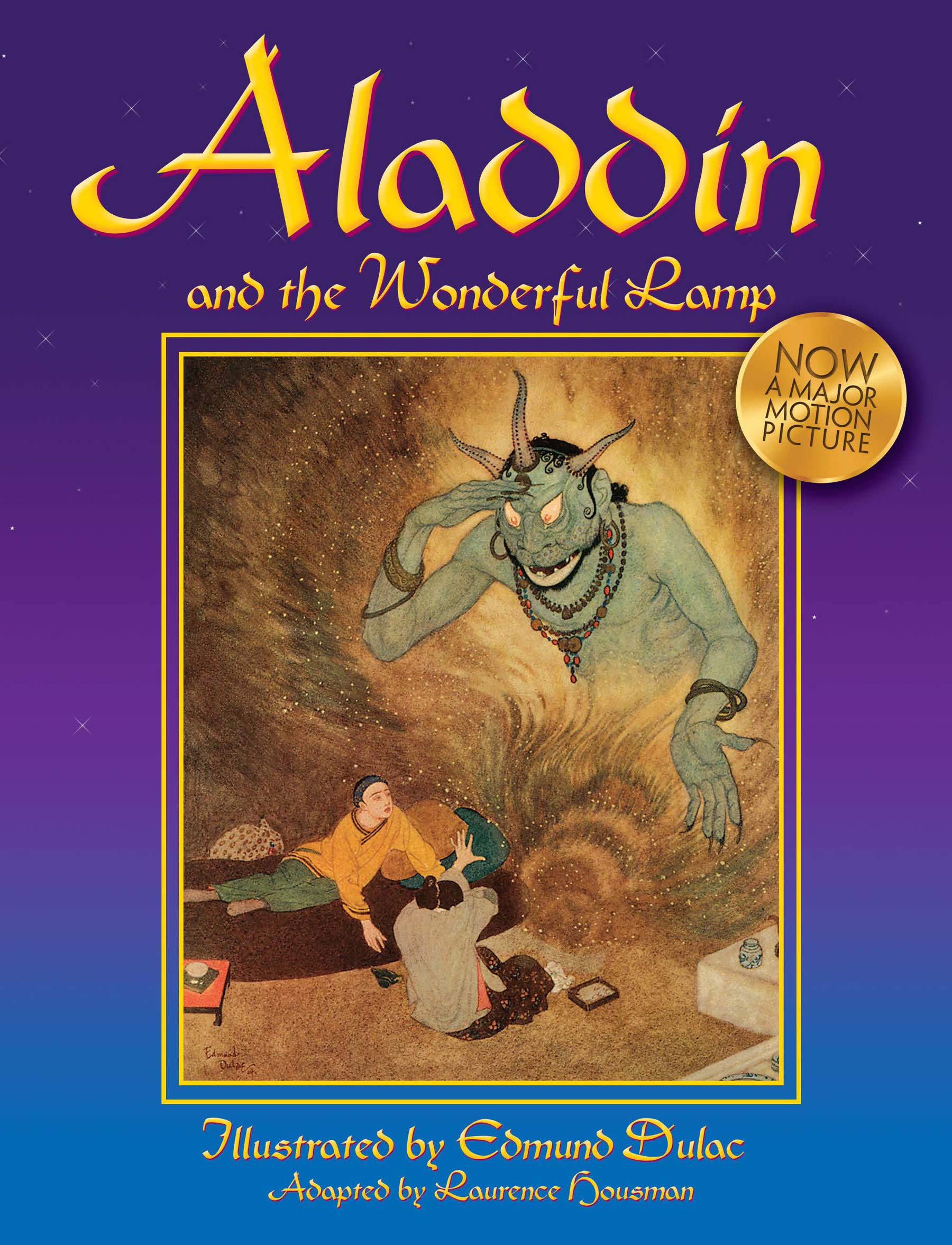



A feckless boy is lured by a wicked magician into a trap but the scheme backfires — the boy, Aladdin, is left with a magical lamp and a genie who showers him with riches. Aladdin's wealth makes him an attractive suitor for the sultan's daughter, but when the evil sorcerer returns to kidnap the bride, the young hero must rescue his princess or die trying. This classic retelling of the ever-popular Middle Eastern folktale has entranced readers for over a century. Originally published in 1914 as part of Sindbad the Sailor and Other Stories from The Arabian Nights, this beautiful version by Laurence Housman features eight full-color images by Edmund Dulac, one of the era's most famous illustrators. French-born artist Edmund Dulac (1882–1953) achieved prominence during the Golden Age of Illustration. His work encompasses a wide variety of themes and styles, although he preferred to work in watercolors and remains best known for his imaginative illustrations for fairy tales and other children's books. Dulac's interest in portraying scenes from Eastern literature is reflected in his illustrations for The Rubàiyàt of Omar Khayyàm, The Arabian Nights, and Sindbad the Sailor. Laurence Housman (1865–1959) worked as a book designer and illustrator for publisher John Lane and is best known for his work on Christina Rossetti's Goblin Market. Later in his career, he pursued his interest in writing, becoming a successful author and playwright. Aladdin and the Wonderful Lamp By Laurence Housman, Edmund Dulac Dover Publications, Inc. Copyright © 2019 Laurence Housman All rights reserved. ISBN: 978-0-486-83241-8 CHAPTER 1 Know, O King, that, once upon a time, in a far city of Cathay, there dwelt a poor tailor who had an only son named Aladdin. This boy was a born ne'er-do-well, and persistently resisted all his father's efforts to teach him a trade by means of which he would be able in future to earn a livelihood. Aladdin would sooner play at knucklebones in the gutter with others as careless as himself than he would set his mind to honest business; and, as to obeying his parents in the smallest matter, it was not in his nature. Such was this boy Aladdin, and yet — so remarkable is the favour of fate — he was strangely predestined for great things. Stricken with grief because of the waywardness and idle conduct of his son the father fell ill and died, and the mother found great difficulty in supporting herself, to say nothing of the worthless Aladdin as well. While she wore the flesh off her bones in the endeavour to obtain a meagre subsistence Aladdin would amuse himself with his fellow urchins of the street, only returning home to his meals. In this way he continued until he was fourteen years of age, when his extraordinary destiny took him by the hand, and led him, step by step, through adventures so wonderful that words can scarce describe them. One day he was playing in the gutter with his ragged companions, as was his wont, when a Moorish Dervish came by, and, catching sight of Aladdin's face, suddenly stopped and approached him. This Dervish was a sorcerer who had discovered many hidden secrets by his black art; in fact, he was on the track of one now; and, by the look on his face as he scrutinised Aladdin's features, it seemed that the boy was closely connected with his quest. The Dervish beckoned to one of the urchins and asked him who Aladdin was, who his father was, and indeed all about him. Having thus learned the whole history of the boy and his family the Dervish gave his informer some coins and sent him away to spend them. Then he approached Aladdin and said to him, "Boy, I seem to recognise in thee a family likeness. Art thou not the tailor's son?" Aladdin answered him that he was, and added that his father was dead. On hearing this the Dervish cried out with grief and embraced Aladdin, weeping bitterly. The boy was surprised at this and enquired the cause of such sorrow. "Alas!" replied the Dervish with tears running down his cheeks, "my fate is an unhappy one. Boy, I have come from a distant country to find my brother, to look upon his face again, and to cheer and comfort him; and now thou tellest me he is dead." He took Aladdin's face in his hands and gazed searchingly upon it as he continued: "Boy, I recognise my brother's features in thine; and, now that he is dead, I will find comfort in thee." Aladdin looked up at him in wonder, for he had never been told that he had an uncle; indeed, he was inclined to doubt the truth of the matter; but, when the Dervish took ten pieces of gold from his purse and placed them in his hand, all doubt was out of the question, and he rejoiced at having found so rich an uncle. The Dervish then asked him concerning his mother and begged him to show him the way to her house. And, when Aladdin had shewed him, he gave the boy more gold and said, "Give this to thy mother with my blessing, and say that her brother-in-law, who has been absent forty years,