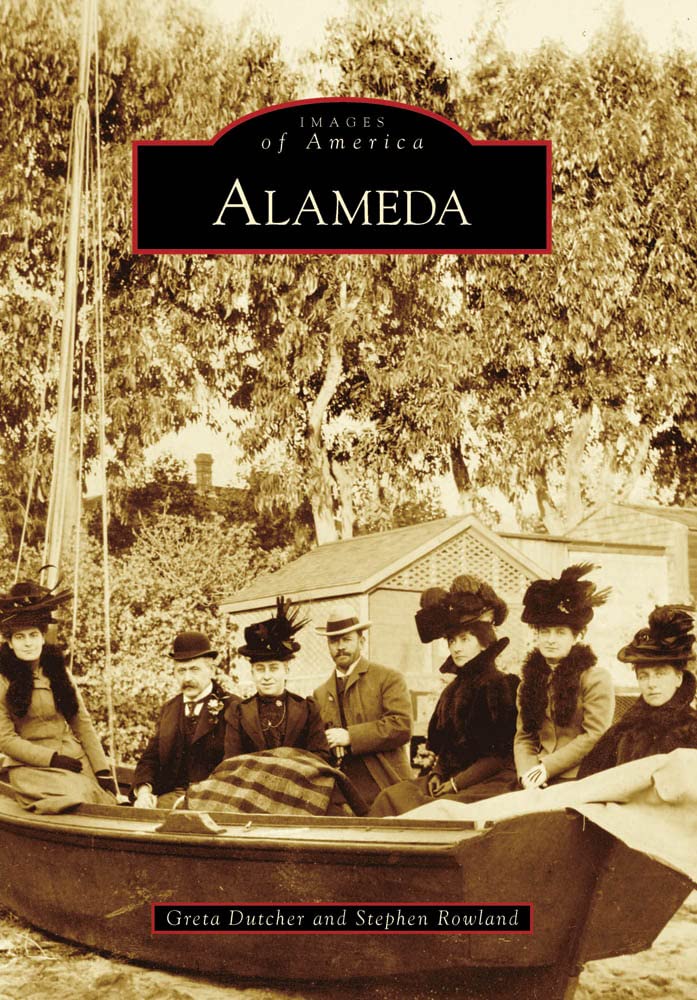



Through its many incarnations, Alameda has never lost its charm and ability to draw people from all walks of life. Originally a peninsula inhabited by Native Americans, it was purchased by Don Luis Peralta in 1818 and developed into a bedroom community of San Francisco. Alameda became an island in 1902, and a short time later, it was a new home to many refugees from the 1906 San Francisco earthquake and fire. The Neptune Beach amusement park attracted tourists who enjoyed the bathing, beaches, and rides, making Alameda "the Coney Island of the West." Modern transportation carried people and cargo in and out on ferries, trains, ships, and planes, which landed at the busy Airdrome. The creation of the Naval Air Station in 1938 and World War II made Alameda a military town. The 1990s brought Alameda back to its first purpose, as a small town amongst big cities, its streets lined with graceful Victorians and with a diverse and lively population. Title: New Book Unveils Alameda's Past Author: Dennis Evanosky Publisher: Alameda Sun Date: 1/8/2009 Greta Dutcher and Stephen Rowland's latest offering continues a journey they began four years ago with their tome Alameda in Arcadia Publishing's "Postcard History Series." This time they've written a book with the same title in Arcadia's "Images of America Series." "We have more variety in our images besides postcards," the authors explain in the introduction. This includes their "personal Holy Grail": the only known photograph of a certain Alameda landmark." Without revealing this "Holy Grail," suffice it to say having this photograph in a book on your shelf is definitely worth the price of admission. The book includes ephemera -- that written matter we so cavalierly throw into a waste bin, but that some, fortunately, choose to stow away. Among this transitory stuff Dutcher and Rowland have included a page from a 1909 Evening Times-Star calendar, an advertising card for the "Welcome Clothes Dryer" (a device that never caught on, by the way) and a Roaring '20s admission card "good at any gate" to Neptune Beach. Readers can smile at Lillie MacMahon's monthly report from Notre Dame Academy. In August 1886 she scored 100 percent in politeness, but could only manage a 98 percent in conduct and a mere 88 percent in scholarship. Lillie was absent five days and tardy four days, the report reveals. We can only wonder if her parents, John and Anne MacMahon who lived on Sherman Street, approved of that 88 percent mark. Anyone interested in seeing how Alamedans dressed at the turn of the 19th to the 20th centuries can have a look at the folks sitting on Felix Santillier's porch on Morton Street. The "Baths and Neptune Beach" chapter reminds us how modestly people once dressed to go for a swim; some dared not show a knee. William and Anne Phillips take a moment for the camera in front of the long-disappeared E. M. Derby Lumber Yard at Alameda Wharf. Members of the 40/8 pose in their unusual garb. (The authors explain the origin of the organization and the meaning of the term 40/8). Dutcher and Rowland have generously peppered postcards throughout the book. These postcards recall Alameda's business and commerce, its public buildings, as well as its parks and recreation areas. They also guide the reader along the Estuary and the Bay Shore and around Bay Farm and Government islands. There are letters to read, movie schedules to peruse and advertising to smile at (laundry done for 7 cents a pound; starched for 8 cents) in this enjoyable trip around Alameda and into the minds and hearts of Alamedans in a time long past. Title: 'Images of Alameda' delight Author: Lucinda Ryan Publisher: San Jose Mercury News Date: 1/8/2009 A photograph shows a crowd of businessmen men in hats and overcoats holding briefcases gathered at 1606 Park St. They're either waiting for or have just disembarked from a train at the Central Pacific Railroad depot. Behind them is a building sign with the legend "Alameda Stables" and below it another declaring the "Best Smoke On Earth." There are no women in the picture; perhaps they are at home, doing their domestic tasks rather than going to the stable to rent "gentle horses for ladies' driving." This was Alameda in the late 1890s. The photograph is one of some 200 pictures and postcards in the book "Images of America -- Alameda," written and compiled by Alamedans Greta Dutcher and Stephen Rowland (Arcadia Publishing, $21.99). Descriptions below the photos in the book provide a real sense of life in Alameda from more than a century ago to some scenes from the 1960s and 1970s. Dutcher worked with Rowland, who was unavailable for an interview, for about six months on the book, which is not their first. In 2005 they compiled images of Alameda postcards throughout the century for a book. Dutcher, an Oakland native, said she and husband Pete Rypins were driving through different Bay Area towns about 13 years ago and after driving into Alameda, she s