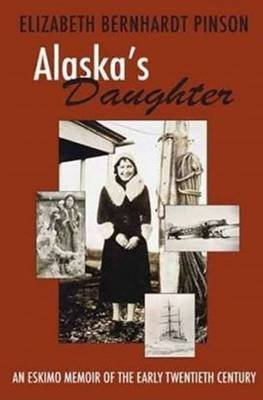
Alaska's Daughter: An Eskimo Memoir of the Early Twentieth Century
$30.95
by Elizabeth Pinson



Elizabeth B. Pinson shares with us her memories of Alaska's emergence into a new and modern era, bearing witness to history in the early twentieth century as she recalls it. She draws us into her world as a young girl of mixed ethnicity, with a mother whose Eskimo family had resided on the Seward Peninsula for generations and a father of German heritage. Growing up in and near the tiny village of Teller on the Bering Strait, Elizabeth at the age of six, despite a harrowing, long midwinter sled ride to rescue her, lost both her legs to frostbite when her grandparents, with whom she was spending the winter in their traditional Eskimo home, died in the 1918 influenza epidemic. Fitted with artificial legs financed by an eastern benefactor, Elizabeth kept journals of her struggles, triumphs, and adventures, recording her impressions of the changing world around her and experiences with the motley characters she met. These included Roald Amundsen, whose dirigible landed in Teller after crossing the Arctic Circle; the ill-fated 1921 British colonists of Wrangel Island in the Arctic; trading ship captains and crews; prospectors; doomed aviators; and native reindeer herders. Elizabeth moved on to boarding school, marriage, and the state of Washington, where she compiled her records into this memoir and where she lived until her death in 2006. Alaska's Daughter An Eskimo Memoir of the Early Twentieth Century By Elizabeth Bernhardt Pinson Utah State University Press Copyright © 2004 Elizabeth Bernhardt Pinson All right reserved. ISBN: 978-0-87421-591-5 Chapter One On my mother's side of the family I am Eskimo. My father was a German sailor shipwrecked in the Arctic Ocean off Alaska's northernmost coast. Ouiyaghasiak (pronounced ow-ee-yag-has-ee-ak), my mama, was born about 1889, daughter of Ootenna (pronounced oo-ten-nah) and Kinaviak (pronounced kin-ah-vee-ak), at the village of Shishmaref, Alaska, just below the Arctic Circle, facing on the Chukchi Sea about sixty miles from the eastern-most point of Siberia across the Bering Strait. By the time of Mama's birth, whalers, sealers, explorers, and traders from the outside world had already brought alcohol and diseases into the North, which began to decimate our people. With repeating rifles, iron-pointed lances, and harpoon guns-the modern methods of those days-the foreign seafarers had thinned out the once great population of ocean mammals that had provided my ancestors with clothing, food, fuel, and shelter. While sailing ships and steamers were returning from Arctic voyages with their holds loaded to capacity with casks of whale oil, baleen, walrus hides and ivory tusks, sheaves of seal skins, and otter and fox skins, the Natives on the shore were starving. With their age-old weapons and tactics, they could no longer obtain sustenance from the dwindling animals and fish of the land, sea, and ice pack. Until the late 1800s it was unlawful for an Alaska Eskimo, Indian, or Aleut to own a breech-loading firearm because the reasoning went in Washington, D.C., that the Natives would wipe out their food supply by improvident hunting practices. There were no such restrictions against white outsiders, who could simply sail away from a region when they had depleted the waters or the land of animals and their operations were no longer profitable. At the same time, the Indians of the interior of Alaska and Canada were being forced by hunger and destitution to leave their traditional hunting grounds because of white trappers, miners, voyagers, and other adventurers who were depleting the inland herds of caribou, moose, and other animals of the tundra and the mountains. Migrating toward the sea in search of food, the Indians, forced to leave their interior habitats, met and warred with the coastal Eskimos. My grandparents, Ootenna and Kinaviak, had vivid memories of battles their people fought with these strangers in defense of hunting lands and fishing waters. Like a plague that swept the North, wherever the white man came in contact with the Native people, great numbers eventually died. Tuberculosis and communicable diseases, such as measles and chicken pox, wiped out whole tribes and villages. One of the most tragic aspects for the Natives was a quickly acquired taste for liquor, to which they had no more resistance than they had to the diseases of civilization. Intoxicated, the ordinarily peaceful, happy, family-loving Eskimo might murder his wife and children or best friend or lie in a drunken stupor while migrating game was all around. In the summer of 1880, the United States revenue steamer Corwin , on a voyage to the Arctic Ocean in search of a fleet of overdue whalers, found mass suffering and death from starvation among the Eskimos as a direct result of dealings with whiskey traders. Visiting St. Lawrence Island in the northern Bering Sea, the Corwin 's crew examined several villages where everyone lay dead as a result of murder and sta