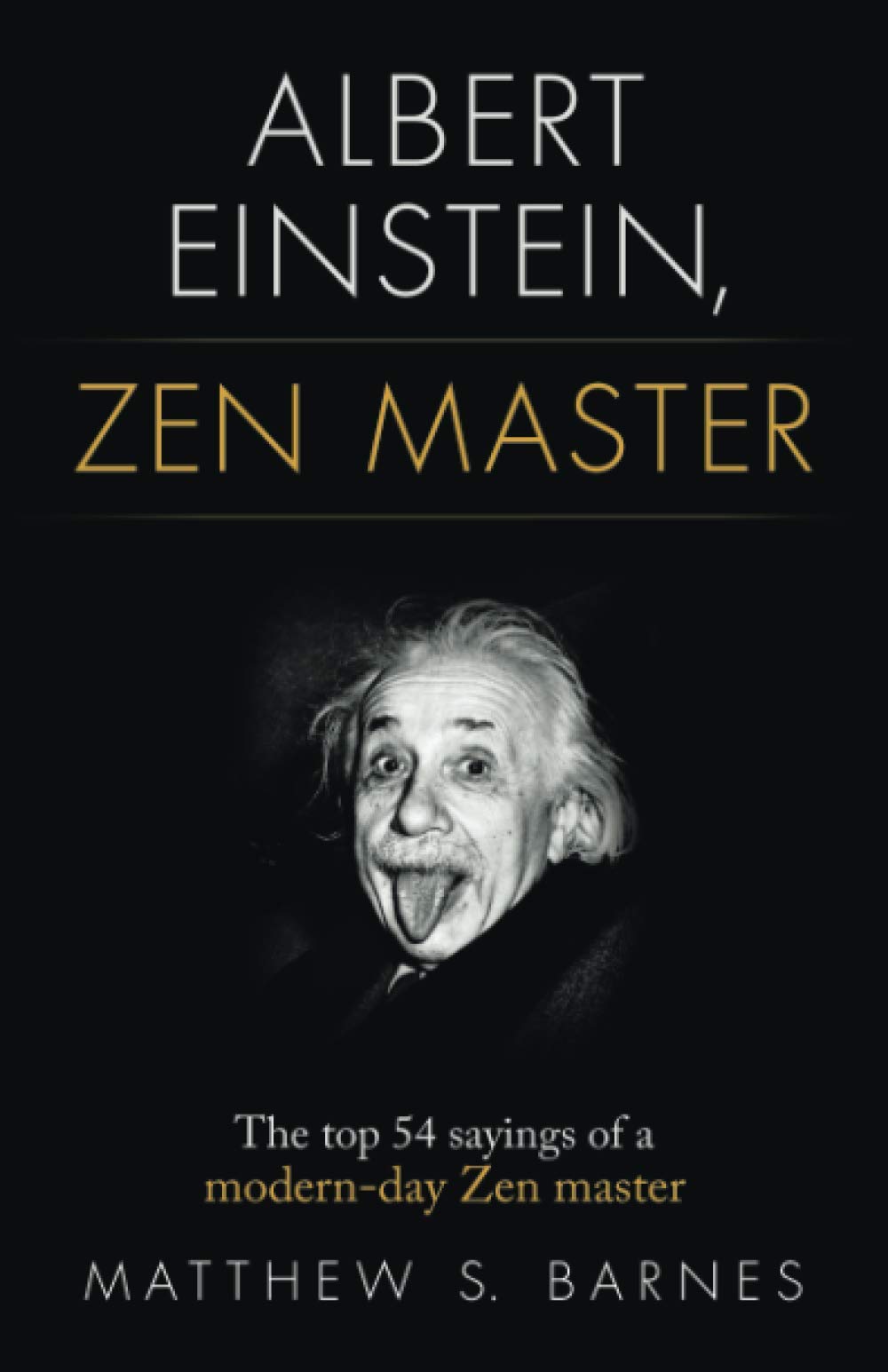
Albert Einstein, Zen Master: The top 54 sayings of a modern day Zen master (Zennish Series)
$14.99
by Matthew Barnes



Albert Einstein was a Zen master? I think so, and I aim to prove it. Imagine understanding how Einstein viewed the world, the Universe, and God. What if you could have the same understanding? How could it change your own outlook on life? Dr. Matthew Barnes, chemist, biochemist, doctor, and bestselling author of The Emerald Tablet 101, The Hermetica 101, The Tao Te Ching 101, The Bhagavad Gita 101, and J esus Christ, Zen Master presents his case for Einstein as being not only one of the most influential scientists of our time but also one of the most spiritual (in his own, unique way). In this work, you’ll discover: • In what ways Einstein’s views of reality coincide with those of some of the greatest Zen masters to have ever lived, past and present. • Quotes ranging from funny to contemplative to serious that outline my belief that through his unique understanding of the Universe, Einstein seems to have developed an appreciation for the forces of the natural world that are congruent with the philosophical ideals held by Zen, Taoist, and other Eastern religious masters through the ages. • Why Einstein considered himself to be “a deeply religious nonbeliever”. (Do you know what he considered himself to be instead?) • Why Einstein felt his viewpoints on God to be a “somewhat new kind of religion”. (Hint: It turns out that his views may not have been all that new, but really really old instead.) • How you too can begin to enjoy Einstein’s view of the world, the Universe, and God. “Reality is merely an illusion, albeit a very persistent one.” -Albert Einstein Change your outlook on life. Scroll up and grab your copy now! "With simple explanations and examples, Barnes introduces the reader to a spiritual understanding of life that is quite beautiful--one that seems very much in alignment with Einstein's own thoughts about the ultimate nature of this mysterious and miraculous universe we live in." - Steven Lane Taylor , (author of "Row, Row, Row Your Boat: A Guide for Living Life in the Divine Flow) " I've read all of this author's spiritual books, and once again he provides excellent insight concerning the path we are all ultimately on." - Jody Wilson (reader, Amazon.com) "This little read does a great job showing Einstein's "awe " of this magnificent universe we know so little about. Good read." - MT Granny (reader, Amazon.com) When I was in college, I experienced an existential crisis. Suffering depression, I sought to find the way out, and looked to religion, philosophy, and spiritual studies as the antidote. I came across Zen early in my studies. It was really my introduction to the spiritual path. However, for me, it was the hardest teaching to grasp, and took me the longest to understand. Once I did, it became my favorite overall. The main difference between Zen and other spiritual teachings is that Zen is all about experiencing the reality of existence for yourself, not just learning about it from others, or worshipping those who have found it. This concept is so ingrained in Zen that all attachment to teachers and paths are strictly admonished. There is a famous parable in Buddhism where Buddha points at the moon, which was symbolic of truth. The student was so captivated by Buddha's finger that he missed the moon that was being pointed to. According to Zen, this is the downfall of most paths. We worship the messenger and argue over their teachings instead of seeking the same truth that they found. Once I obtained a grasp on Zen, I wanted to share it with others. In order to do so, I had to find a way to explain the concepts and practices in a way that others might more easily understand. Ultimately, I found that explaining the sayings of some of the greatest thinkers in society, like Einstein, Tesla, and Twain was the easiest route. I hope you will agree. "Logic will take you from A to B. Imagination will take you everywhere." -Albert Einstein Though Einstein considered himself non-religious (because he dismissed the idea of a personalized God), he nevertheless developed, through his work, an appreciation and even an admiration for the intelligence that animates the living world - an intelligence whose essence he felt to be far beyond the sphere of human comprehension. Though Einstein's non-personalized beliefs were definitely new compared to Western concepts of religion, they fit right in with well-established Eastern concepts from Zen, Taoism, Buddhism, and even Hinduism. Through this work, I hope to point out a fairly different approach to spiritual appreciation than what most of us are used to; an approach I believe to be every bit as valid as the Western, personalized-God variety. At the very least, I hope this work will serve as a simple introduction to the eye-opening contributions of Eastern philosophical thought. Matthew Barnes is an avid learner who spent his early years in North Carolina. During college, he experienced a stint with depression whi