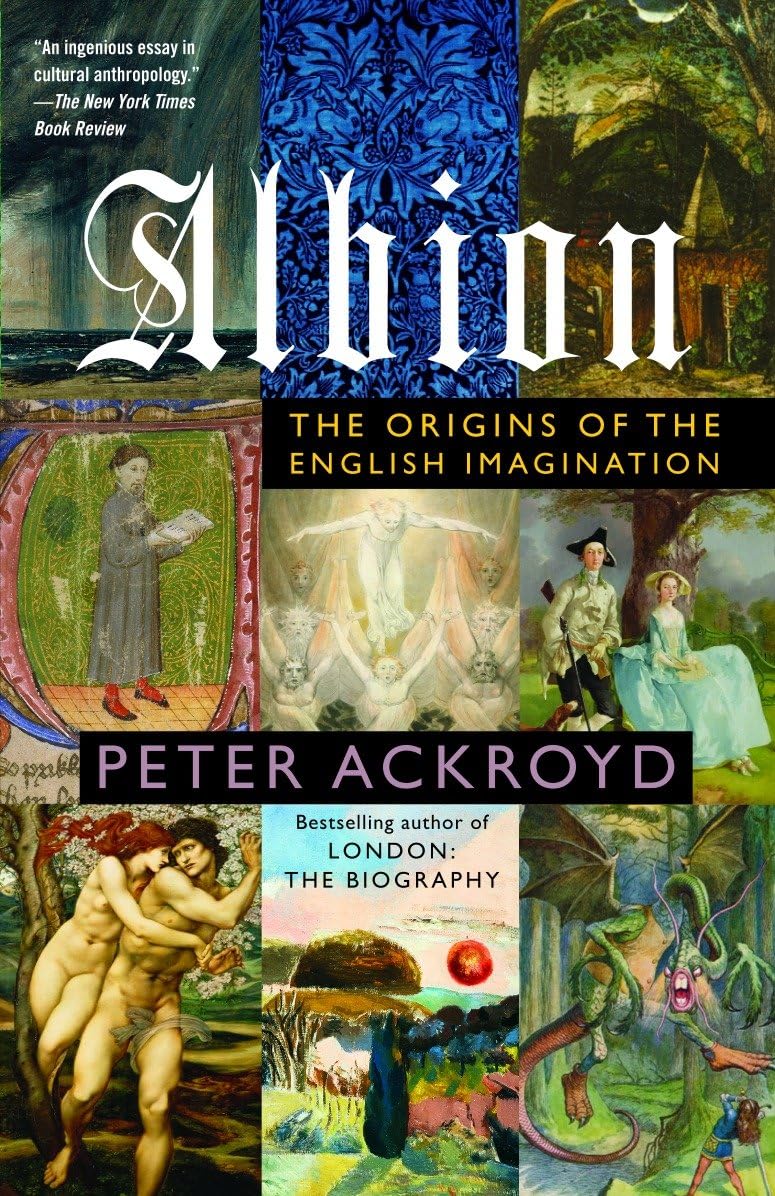



With his characteristic enthusiasm and erudition, Peter Ackroyd follows his acclaimed London: A Biography with an inspired look into the heart and the history of the English imagination. To tell the story of its evolution, Ackroyd ranges across literature and painting, philosophy and science, architecture and music, from Anglo-Saxon times to the twentieth-century. Considering what is most English about artists as diverse as Chaucer, William Hogarth, Benjamin Britten and Viriginia Woolf, Ackroyd identifies a host of sometimes contradictory elements: pragmatism and whimsy, blood and gore, a passion for the past, a delight in eccentricity, and much more. A brilliant, engaging and often surprising narrative, Albion reveals the manifold nature of English genius. “An ingenious essay in cultural anthropology.”-- The New York Times Book Review “Beguiling. . . . A hugely readable book. . . . Pick it up whenever you need, open it wherever you like, read as much as you want with profit and pleasure.”-- The Wall Street Journal "This work could have been produced only by the liveliest of intellects, drawing on an astonishing depth of experience. Ackroyd in his own writing demonstrates the quality of the English imagination." --The Spectator "As ever, where Ackroyd excels is in the patient accumulation of suggestive detail or sudden descent unto a distinctive corner of the English world." -- The Independent Highly original and magnificent in scope, Albion discovers the roots of English cultural history in the Anglo-Saxon period, and traces it through the centuries. What does it mean to be English? This dazzling work demonstrates that a quintessentially English quality can be discovered in all forms of English culture, not only in literature but also in painting, music, architecture, philosophy and science. Just as London: The Biography guided the reader through the great city with a mixture of narrative and theme, so Albion , employing the same techniques, engages the reader with stories and surprises -- from Beowulf to King Arthur and the Knights of the Round Table, via Chaucer and Shakespeare, to the Brontë sisters, Alice Through the Looking Glass and Lord of the Rings . Witty, provocative and anecdotal, this is Peter Ackroyd at his most brilliant and exuberant. With his characteristic enthusiasm and erudition, Peter Ackroyd follows his acclaimed London: A Biography with an inspired look into the heart and the history of the English imagination. To tell the story of its evolution, Ackroyd ranges across literature and painting, philosophy and science, architecture and music, from Anglo-Saxon times to the twentieth-century. Considering what is most English about artists as diverse as Chaucer, William Hogarth, Benjamin Britten and Viriginia Woolf, Ackroyd identifies a host of sometimes contradictory elements: pragmatism and whimsy, blood and gore, a passion for the past, a delight in eccentricity, and much more. A brilliant, engaging and often surprising narrative, Albion" reveals the manifold nature of English genius. Peter Ackroyd is the author of biographies of Dickens, Blake, and Thomas More, and of the bestselling London: The Biography . He has won the Whitbread Book Award for Biography, the Royal Society of Literature’s William Heinemann Award, the James Tait Black Memorial Prize, The Guardian Fiction prize, the Somerset Maugham Award, and the South Bank Award for Literature. He lives in London. Chapter 1 The Tree When William Wordsworth invoked "the ghostly language of the ancient earth" he spoke more, perhaps, than he knew. The mark or symbol of the hawthorn tree is to be found in the runic alphabet of the ancient British tribes, as if the landscape propelled them into speech. The worship of the forest, and of forest forms, characterised the piety of the Druids in whose rituals the spirits of the oak, the beech and the hawthorn are honoured. According to the texts of the classical historians the centre of the Druidical caste was to be found in Britain, from whose shores the practitioners of magic sailed to the European mainland. The forest worship of the northern and Germanic tribes, who were gradually to conquer Britain from the fifth to the seventh centuries, may derive from the Druids' ministry. That is why Hippolyte Taine, the French critic and historian who in the 1860s completed a capacious history of English literature, hears the first music of England in the fine patter of rain on the oak trees. The poetry of England is striated with the shade that the ancient trees cast, in a canopy of protection and seclusion. Thus John Lydgate, in the fifteenth-century "Complaint of the Black Knight," remarks of Every braunche in other knet, And ful of grene leves set, That sonne myght there non discende where the charm of darkness and mystery descends upon the English landscape. In the nineteenth century Tennyson recalls how Enormous elm-tree boles did stoop and lean Upon th