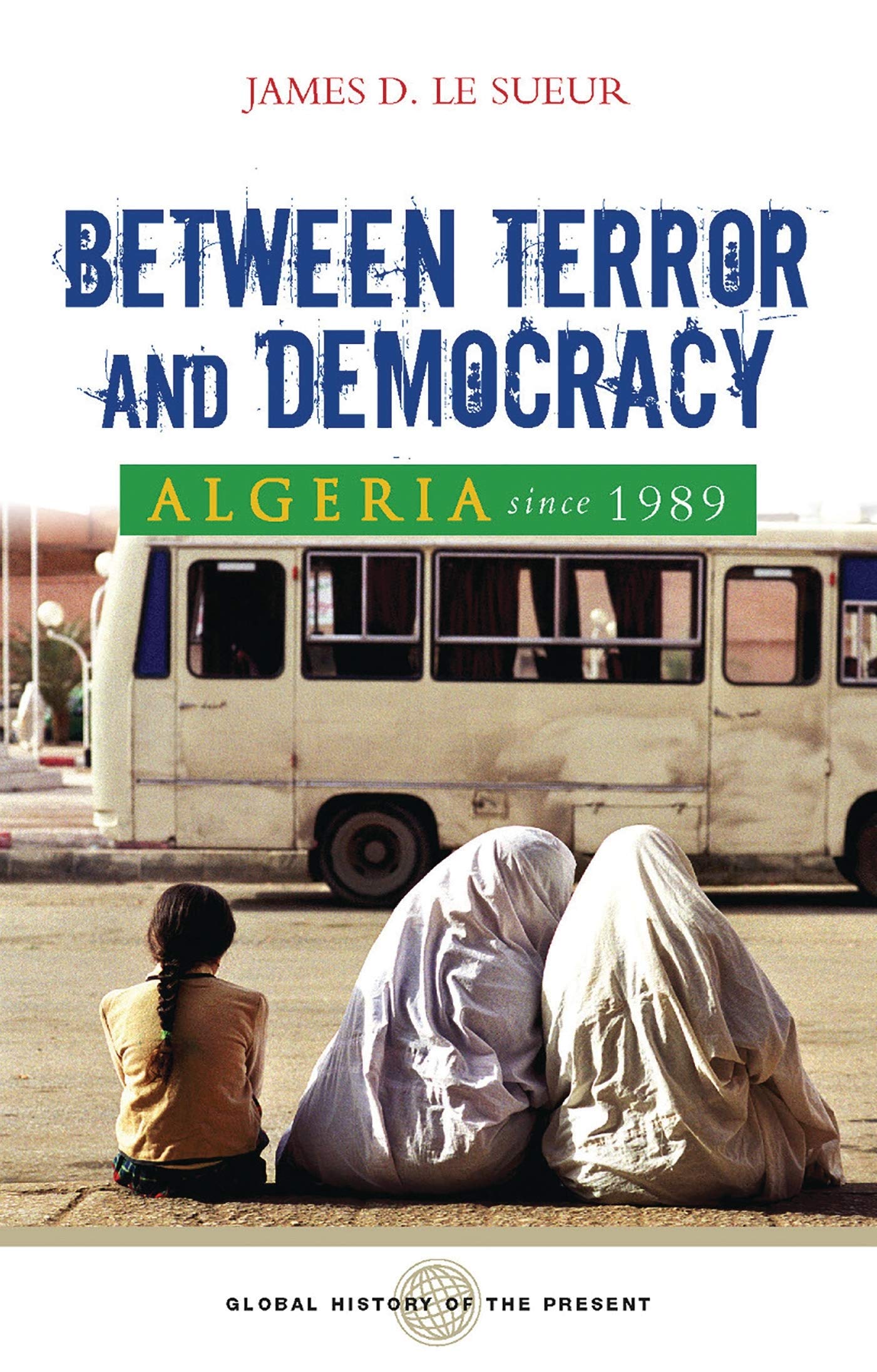
Algeria since 1989: Between Terror and Democracy (Global History of the Present)
$34.95
by James D. Le Sueur



Algeria's democratic experiment is seminal in post-Cold War history. The first Muslim nation to attempt the transition from an authoritarian system to democratic pluralism, this North African country became a test case for reform in Africa, the Arab world and beyond. Yet when the country looked certain to become the world's first elected Islamic republic, there was a military coup and the democratic process was brought sharply to a halt. Islamists declared jihad on the state and hundreds of thousands of civilians were killed in the ensuing decade of state repression. Le Sueur shows that Algeria is at the very heart of contemporary debates about Islam and secular democracy, arguing that the stability of Algeria is crucial for the security of the wider Middle East. Algeria Since 1989 is a lively and essential examination of how the fate of one country is entwined with much greater global issues. “Based on many years of close study of the country, the author unveils the many contradictions, complexities, and conflicts that continue to plague North Africa's most important political actor whose fate has implications for the Mediterranean region and beyond.” ― John P. Entelis, Fordham University “LeSueur makes an extremely valuable contribution to our understanding of contemporary Algerian history - placing this history into a broader geopolitical and sociological perspective, including the failure of democratic liberalism and the rise of political Islam and Islamic radicalism.” ― John Ruedy, Georgetown University “James Le Sueur provides a striking portrait of Algeria in the 1990s that is truly remarkable for presenting a fair and balanced analysis of an extremely controversial history. While Le Sueur's account provides a full account of Algerian developments, it places these experiences within broader global contexts, making this book distinctively valuable for policy makers as well as the broader public.” ― John Voll, Georgetown University James D. Le Sueur is Associate Professor of History at the University of Nebraska, Lincoln, and has been a Senior Associate Member of the Middle East Centre at St Antony's College, Oxford. He is an internationally recognized expert on Algeria and political Islam, French history and decolonization. He is currently producing a documentary film on the Algerian civil war. His books include Uncivil War: Intellectuals and Identity Politics during the Decolonization of Algeria (2005) and The Decolonization Reader (2003). Nicholas Guyatt is assistant professor of history at Simon Fraser University in Canada. Algeria since 1989: Between Terror and Democracy By James D. Le Sueur Fernwood Publishing and Zed Books Ltd Copyright © 2010 James D. Le Sueur All rights reserved. ISBN: 978-1-84277-725-1 Contents Acknowledgments, vi, Chronology, viii, The principals, xxi, Abbreviations and acronyms, xxv, Map, xxviii, Introduction: democratic reform, terrorism, and reconciliation, 1, 1 Building a postcolonial state, 11, 2 The road to reform, 31, 3 The kingmakers: generals and presidents in a time of terror, 53, 4 The Bouteflika era: civil society, peace, and sidelining generals, 74, 5 Energy and the economy of terror, 98, 6 A genealogy of terror: local and global jihadis, 122, 7 The future of radical Islam: from the GSPC to AQMI, 143, 8 Killing the messengers: Algeria's Rushdie syndrome, 169, Conclusion: a historian's reflections on amnesty in Algeria, 195, Notes, 207, Index, 230, CHAPTER 1 Building a postcolonial state On July 5, 1962, Algeria celebrated its independence from France, bringing to an end a violent eight-year war of national liberation. Algerian authorities chose July 5 for its symbolism. It was on that day in 1830 that France commenced its assault on the Ottoman Empire, the rulers who had remained in control of the territory since the 1500s. It would be on that day that Algerians would rejoice at the fact that they had finally rid themselves of the French. The war of independence had begun on November 1, 1954, and the ceasefire agreed to in Evian, France, between Algerian revolutionaries and President Charles de Gaulle's government had been in effect since March 19, 1962. Together the ceasefire and ensuing independence celebrations marked the death of "French Algeria" and the birth of a nation. The evidence of the slow, painful death and birth in the zero-sum game of decolonization came during the spring and summer of 1962, when roughly one million French settlers fled from Algeria to France in what has remained one of the largest mass exoduses of colonial settlers in world history. Ironically, South Africa's apartheid government, whose image had been severely damaged by the Sharpeville Massacre in March 1960, schemed to convince de Gaulle to divert the movement of some of these ex-colonial refugees to the Republic of South Africa. As the South African ambassador to France R. J. Jordaan put it in a confidential briefing: "Alg