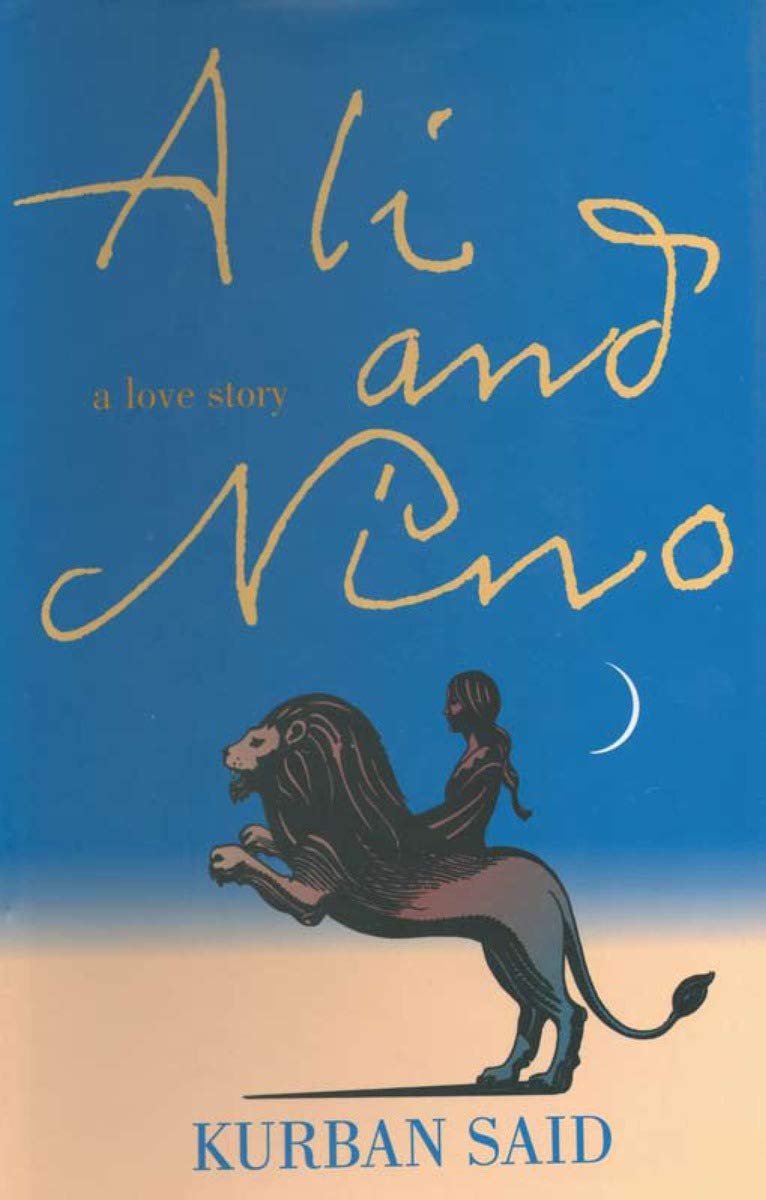



Ali and Nino is the epic novel of enduring romance in a time of war. It has been hailed as one of the most romantic epic novels of all time. Ali and Nino, two lovers from vastly different backgrounds, grow up together in carefree innocence in Baku on the Caspian Sea. Here, where Eastern and Occidental collide, they are inevitably drawn into the events of the First World War and the Russian Revolution. Torn apart by the turmoil, Ali joins the defense of Azerbajan from the onslaught of the Red Army, and Nino flees to the safety of Paris with their child, not knowing whether they will ever see each other again. A sweeping tale, as romantic and gripping as Gone with the Wind or Dr. Zhivago , it portrays, against a gloriously exotic backdrop, the enduring love between childhood friends divided by their separate cultures. As is true of all great literature, Kurban Said's Ali and Nino has timeless appeal. Set in the years surrounding the Russian Revolution and the rise of the Soviet Union, Said's tale of an Azerbaijani Muslim boy in love with a Georgian Christian girl is both tender and disturbingly prescient. The novel, first published in 1937, begins as Ali Khan Shirvanshir is finishing his last year of high school: We were a very mixed lot, we forty schoolboys who were having a Geography lesson one hot afternoon in the Imperial Russian Humanistic High School of Baku, Transcaucasia: thirty Mohammedans, four Armenians, two Poles, three Sectarians, and one Russian. The multi-ethnic Baku, it seems, stands at a crossroads between West and East, and, as the smug Russian professor informs his pupils, it is their responsibility to decide "whether our town should belong to progressive Europe or to reactionary Asia." For Ali Khan Shirvanshir there is no doubt--he belongs to the East; his beloved Nino, however, is "a Christian, who eats with knife and fork, has laughing eyes and wears filmy silk stockings." Far away, to the West, there are rumblings of war. When the Russian Revolution begins, Ali Khan chooses not to fight; the Czar's fate is of little interest to a Muslim living in far away Transcaucasia. But the young man senses that another, greater danger is gathering on his country's borders--an "invisible hand" trying to force his world into new ways, the ways of the West. He assures his worried father that, like his ancestors, he is willing to die in battle, but at a time of his own choosing. In the meantime, he courts Nino and eventually marries her in the teeth of scandal and opposition. This union of East and West is at times a difficult one as Ali Khan finds himself lured further and further into European ways. When Soviet troops invade, however, he must choose once and for all whether to stand for Asia or Europe. One of the many pleasures Ali and Nino offers is Kurban Said's lovingly rendered evocations of Muslim culture. Another is his compassionate portrait of the protagonists' difficult but profound relationship. Modern readers coming to this novel in the wake of the fall of Communism, outbreaks of sectarian violence, and the rise of religious fundamentalism will find disturbing parallels in its cautionary chronicle of cultures colliding and a way of life brutally destroyed. In the end, however, it is not historical accuracy, but rather the charm and passion of the title characters that lifts Said's only novel into literature's highest ranks. --Alix Wilber Little is actually known about this author except that he wrote this one and only book in Vienna in 1937 though he was not Austrian. He left Austria for Italy soon after and died there, of unknown causes. The book tells of the love between the title characters, which is challenged by the political upheaval of both World War I and the Russian Revolution. Copyright 1999 Reed Business Information, Inc. "One feels as if one had dug up buried treasure…one feels completely caught up in the novel's exotic setting…an epic of cultural change that seems more immediate than this morning's headlines." -- The New York Times "Poignant and beautiful…alive with a vividly unique vision of colliding culture and enduring love." -- Newsweek Kurban Sand is the alias of the author of Ali and Nino a wonderful love story first published iin German 1937