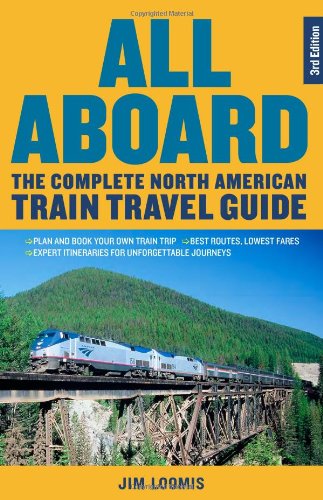



It's about the journey, not the destination. All Aboard --first published in 1995, and here completely revised and updated--is much more than just a mile-by-mile scenery guide for train travelers. Written both for veteran train travelers and those considering their first rail journey, it will make any trip smoother and more enjoyable with its insightful travel trips and information about how railroads operate. With trains attracting new riders in record numbers because of the economy, the price of gasoline, and the delays and crowding that are now the norm when traveling by air, the time is perfect for a new edition of All Aboard . Here you can learn how and why the first railroads came about, the building of America's trans-continental railroad, and how individual trains are operated. The author also offers advice that can only come from a veteran traveler: booking trips, finding the lowest fares, avoiding pitfalls, packing for an overnight trip, what to do on board, whom to tip and how much. All Aboard is the ultimate guide to American train travel and its unique history and culture. “Crammed with excellent ideas for booking, preparing for and enjoying your next rail journey.” — Railfan & Railroad “A plethora of information . . . a primer on railroading itself.” —International Railway Traveler "The freshest, most comprehensive, and frankly the best." — TrainWeb “A down-to-tacks how-to book that describes in detail just about everything you need to know to take a train trip in the United States and Canada.” — Honolulu Advertiser “This easy-to-read, lively book would make an excellent gift.” — Passenger Train Journal “With all my rail experience, I still found things in Loomis’ book that I didn’t know about train life.” — Hawaii Sun Press “This guide covers everything from booking a [train] trip to the various routes available to on-board etiquette.” —Boston Sunday Globe , on a previous edition “This comprehensive guide will assist the traveler in planning an excursion and executing it with minimum effort and maximum pleasure.” —Library Journal , on a previous edition Jim Loomis writes frequent columns about train travel for Sunday newspaper travel sections and has ridden every one of Amtrak’s routes, including taking all their long-distance trains several times. He is a member of the National Association of Railroad Passengers and was elected to NARP's Council of Representatives, the governing body of the organization. All Aboard The Complete North American Train Travel Guide By Jim Loomis Chicago Review Press Incorporated Copyright © 2015 Jim Loomis All rights reserved. ISBN: 978-1-56976-309-4 Contents Acknowledgments, Foreword: Rediscovering the Train, 1 Why Take a Train?, 2 How It All Began, 3 Amtrak to the Rescue, 4 Planning Your Own Train Trip, 5 Packing and Last-Minute Details, 6 Life Onboard, 7 Who's in Charge Here?, 8 When Things Go Wrong, 9 Passenger Train Equipment, 10 How It All Works, 11 What About All Those Freight Trains?, 12 Safety Is Priority Number One, 13 Taking the Train in Canada, 14 Mexico's Copper Canyon Train, 15 Your Top Ten Railroad Stations, 16 Will There Be Trains in Our Future?, 17 Pick a Train, Any Train, 18 Suggested Itineraries, Appendix A: Railroad Terms and Slang, Appendix B: How to Find a Rail-Savvy Travel Agent, Appendix C: Private Rail Excursions, Appendix D: Passenger Rail Advocates, Appendix E: Excursion Trains and Railroad Museums, Index, CHAPTER 1 WHY TAKE A TRAIN? Sophie Tucker once said, "I've been rich and I've been poor. Believe me, rich is better." Well, in my many travels I've been comfortable and I've been uncomfortable. Believe me, comfortable is better. A lot better. And that's why I take the train. There are a lot of societal and environmental reasons for being pro-rail, and we'll talk about those in another chapter. But for long-distance travel, the train is the only civilized option left for us. You think not? Just consider the other choices. See America Through a Windshield? Forget it. Droning great distances across the country by car or — I shudder at the very thought — by bus is, for the most part, a waste of time. If you're the driver, it's tiring. If you're a passenger, it's boring. Either way, it's confining and uncomfortable. In Charles Kuralt's delightful book, On the Road with Charles Kuralt, he said, "Thanks to the Interstate Highway System, it is now possible to travel across the country coast-to-coast without seeing anything." Kuralt's exaggeration can be forgiven, but you won't come close to seeing much of the real America until you leave the interstate. When we build superhighways in this country, we level everything, carving swaths hundreds of yards wide across the land from horizon to horizon. When we're through, there's nothing much left to see. The only conceivable reason for traveling long distances by car is to save money; that