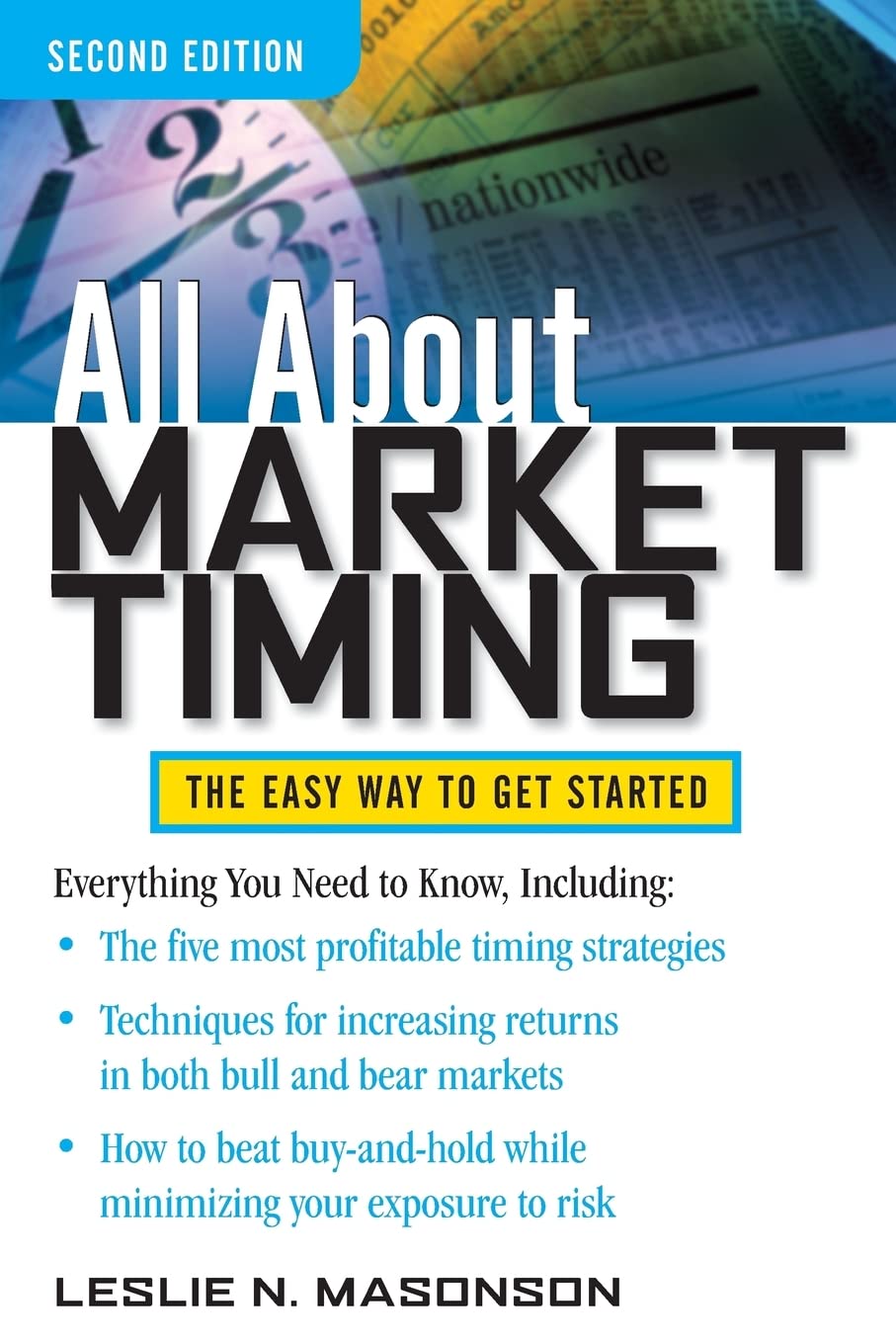



Use market timing to generate positive returns―with lower volatility! Events of the past decade have proven beyond doubt that buy-and-hold strategies don’t work in bear markets. Market timing, however, is extraordinarily effective in declining markets―and it provides positive returns in bull markets, as well. All About Market Timing , Second Edition, offers easy-to-use market-timing strategies you can weave into your investment approach. And it’s not as complex as you may think. In no time, you’ll master the skills you need to maximize profits while minimizing risk―no matter what direction the market takes. Devoid of the incomprehensible jargon and complex theories of other books, All About Market Timing covers: The five most profitable strategies for timing the market - The best market-timing resources available today, from newsletters to Web sites to advisors - Four indicators for determining the market’s health - Techniques for timing even the most bearish of markets Leslie N. Masonson, MBA, CCM , is president of Cash Management Resources and has more than 40 years of experience in investing, trading, and authoring financial books. Leslie N. Masonson, MBA, CCM , is president of Cash ManagementResources and has more than 40 years of experience in investing, trading, and authoringfinancial books. All About MARKET TIMING THE EASY WAY TO GET STARTED By LESLIE N. MASONSON The McGraw-Hill Companies, Inc. Copyright ©2011 Leslie N. Masonson All rights reserved. ISBN: 978-0-07-175377-7 Contents ForewordAcknowledgmentsIntroductionPART 1: MARKET TIMING BASICSChapter 1 The Stock Market = Bull Markets + Bear MarketsChapter 2 The Buy-and-Hold MythChapter 3 Market Timing: What You Need to KnowChapter 4 Determing the Market's TrendChapter 5 No-Load Mutual Funds: Index, Sector, and Leveraged FundsChapter 6 Exchange-Traded FundsPART 2: MARKET TIMING STRATEGIES AND RESOURCESChapter 7 Calendar-Based Investing: The Best Six Months StrategyChapter 8 Combining Presidential Cycle Years with SeasonalityChapter 9 Using Simple Moving Averages to Time the MarketChapter 10 The Value Line 4 Percent Strategy versus the Value Line 3 Percent StrategyChapter 11 Nasdaq Composite 6 Percent StrategyChapter 12 Market Timing Resources: Newsletters, Web Sites, and AdvisorsEpilogueAppendix: The Capitalism DistributionBibliography and Web SitesIndex Excerpt CHAPTER 1 The Stock Market = Bull Markets + Bear Markets The first rule is not to lose. The second rule is not to forget the firstrule. —Warren Buffett In the battlefield that is the stock market, there are the quick and thereare the dead! ... The fastest way to take a bath in the stock market is to tryto prove that you are right and the market is wrong. —William J. O'Neil ( How to MakeMoney in Stocks , 2002, p. 54) ING DIRECT SHAREHOLDER SURVEY Before covering the stock market's performance in bull and bear markets, let'sfirst begin by reviewing the results of a survey of 1,021 young (ages 21 to 39years) and old (ages 40 to 65 years) investors conducted by ING DIRECT to obtaintheir views about investing in the stock market. The study was conducted onlinefrom January 7 to 19, 2010, ten months after the market bottomed in March 2009.The survey questioned these investors on the following subjects: confidence andoptimism, influencers, motives, barriers, and expected returns. The key survey findings were as follows: * 43 percent of those 21 to 39 years of age plan to invest more in 2010 comparedwith 33 percent of those 40 to 65 years of age. * 26 percent of younger investors and 28 percent of older investors expect anannual return of between 10 and 20 percent. * Older investors are leading the trend to become self-directed investors.Almost half (49 percent) of those 40 to 65 years of age have reduced oreliminated their reliance on financial professionals compared with 37 percent ofinvestors aged 21 to 39 years. * Younger investors currently rely more on financial Web sites and blogs (49percent) and financial print publications (39 percent) than on financialplanners or advisors (35 percent) or brokers (18 percent) for investing advice. * Investors aged 40 years and older also rely more on financial Web sites andblogs (47 percent) and financial print publications (41 percent) than onplanners or advisors (39 percent), brokers (36 percent), and family (19percent). * On average, investors think that they need $699 to get started investing. * Almost half (48 percent) of younger investors think that they need more than$500 to start investing compared with 56 percent of older investors. * Almost half (44 percent) of those with access to an automated platform thatenables investing in small dollar amounts say that you can get started with just$100 or less. * Almost one-third (30 percent) of the younger group say that their parents hadthe biggest influence in getting them started investing. * 17 percent of investors 40 to 65 years of age say that their parents had thelarges