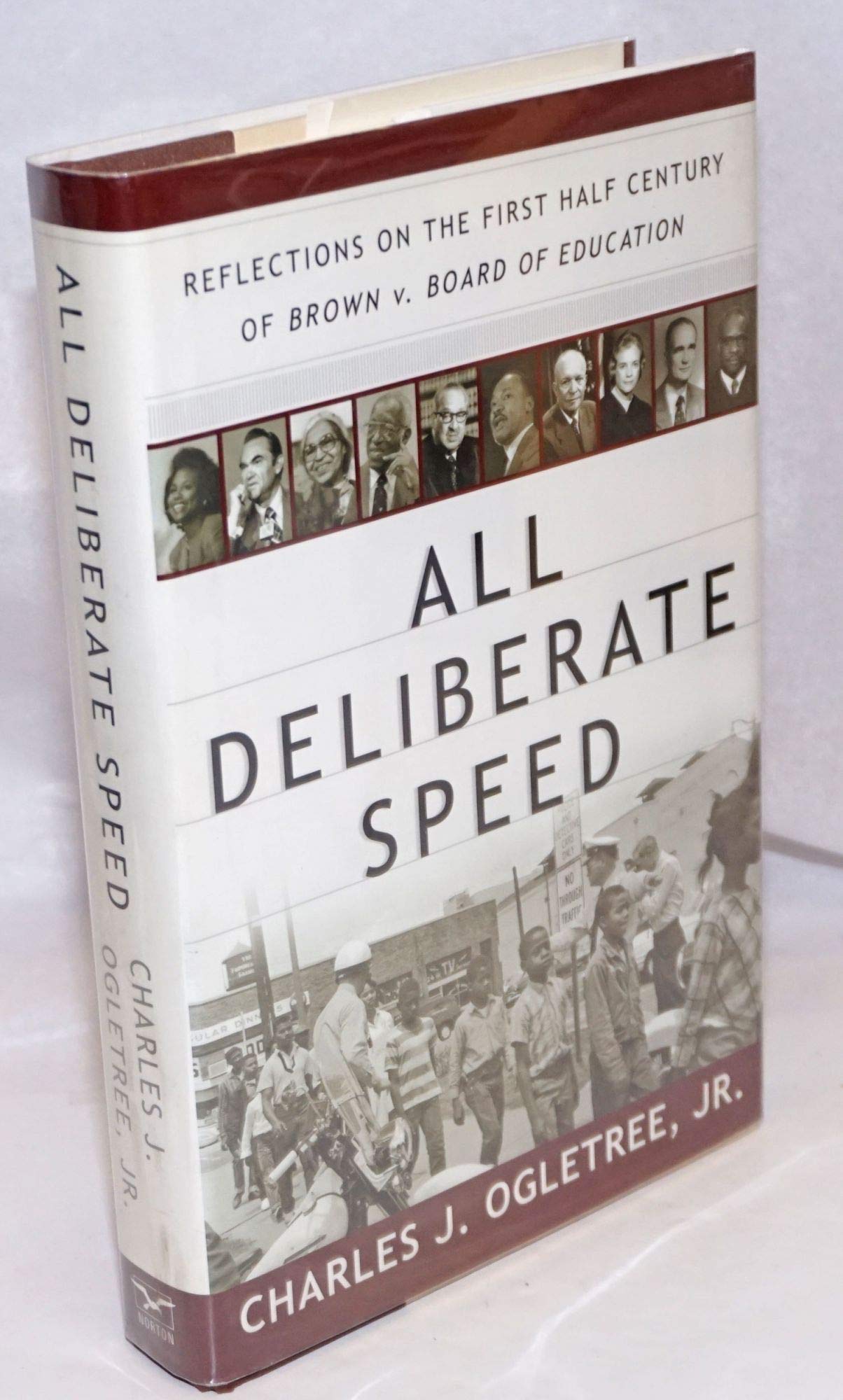
All Deliberate Speed: Reflections on the First Half-Century of Brown V. Board of Education
$18.40
by Charles J. Ogletree



A Harvard Law School professor examines the impact that Brown v. Board of Education has had on his family, citing the contributions of such individuals as Thurgood Marshall, Martin Luther King, Jr., and Earl Warren while revealing how the reforms promised by the case were systematically undermined. Harvard Law professor Ogletree presents an objective analysis of the progress and limitations of the two Brown decisions: the first ruling that separate but equal, i.e., segregation, was inherently unequal; the second urging desegregation with all deliberate speed. Ogletree follows the legal case history in pursuit of Brown , including its limited successes, its failures, and what appears to be resistance to, if not reversal of, Brown 's objective. Born around the time of the landmark decision, Ogletree sees himself as a real beneficiary. He places affirmative action in the context of pursuing the objectives of Brown and analyzes the strategies used by Charles Houston and Thurgood Marshall to challenge southern states to provide equal opportunities for blacks as a platform for outlawing segregation per se. Ogletree follows Marshall's career in the U.S. Supreme Court, his death, and his replacement by the archconservative Clarence Thomas. Thomas' hostility toward affirmative action reflects our nation's failure of commitment to achieve integration at a time when resegregation appears to be the order of the day. Vernon Ford Copyright © American Library Association. All rights reserved A bold and original analysis of the complex and often surprising effects of Brown v. Board on American society. -- Henry Louis Gates, Jr. A provocative and intimate reflection...not only Charles Ogletree's story, it is the story of an entire generation. -- Anita Hill A remarkable and very readable account of one young man's coming of age during the civil rights movement....downright exciting. -- John Hope Franklin, Professor of History Emeritus, Duke University, Author of From Slavery to Freedom A superb account of the history and relevance of Brown v. Board of Education at its half-century. -- Peter J. Gomes, Plummer Professor of Christian Morals and Pusey Minister in The Memorial Church, Harvard University Charles Ogletree's engrossing memoir of 50 years of personal growth and professional achievement is a profoundly significant meditation. -- David Levering Lewis, author of Pulitzer Prize-winner W. E. B. Du Bois [Ogletree's] powerful book is a grand testament to his intellectual sophistication, moral passion and political integrity. -- Cornel West [Ogletree] personalizes this historic case in a compelling, dramatic way. This is a must-read as well as a great read. -- Alan Dershowitz, author of The Case For Israel A professor at Harvard Law School and a leading civil rights authority, Charles J. Ogletree, Jr. has represented Anita Hill and the plaintiffs in the Tulsa Race Riots case. He lives in Cambridge, Massachusetts. For those who didn't have the experience, it is difficult to imagine what living in this country was like before Brown v. Board of Education. For so many who were around before that landmark Supreme Court decision, and subject to the worst of what has been called "American apartheid," it is impossible to forget. In the America that existed as two worlds in 1954, separated with the sanction of law, Brown was something of a judicial Rorschach test: People saw in it what they wanted to see. Where many blacks saw promise, many whites saw threat. Now, as the country commemorates the 50th anniversary of the May 17, 1954 ruling, the authors of two new books contend that -- to some extent at least -- both groups were wrong. Both All Deliberate Speed, by Harvard law professor Charles J. Ogletree Jr., and Silent Covenants, by New York University law professor Derrick Bell, supply not only a cross-generational appreciation of the historic significance of the Supreme Court decision in the five consolidated cases of Brown but also provide painstaking analyses of its failings. Brown is widely credited with paving the way to desegregation in so many areas -- implying an end to segregation everywhere and fueling the civil rights movement that ultimately led to federal anti-discrimination laws with substance and enforcement. Yet, ironically, the ruling has not had an enduring effect on the one issue advocates had pushed the Supreme Court to consider: achieving public school integration. Ogletree and Bell (who had been Ogletree's mentor when Bell also taught at Harvard Law School) reach the same disappointing conclusion about the effects of Brown, but they come at it from different points of departure. Through an effective blend of memoir, history and legal analysis, Ogletree, one of the self-described "Brown babies," illustrates the ascension of an entire generation of black talent that he credits to opportunities created by the ruling. Bell, a former civil rights attorney, mixes provocative cr