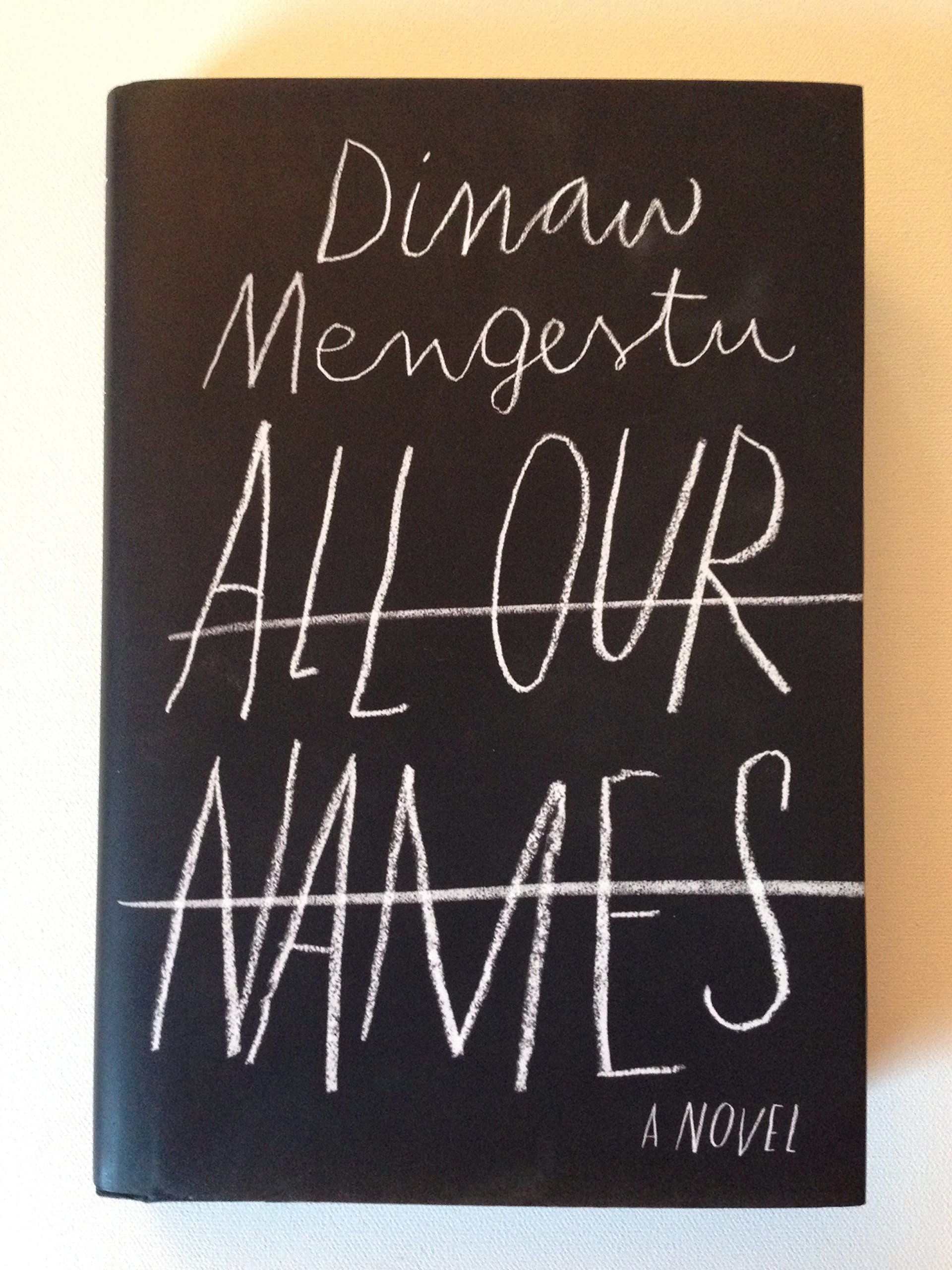



From acclaimed author Dinaw Mengestu, a recipient of the National Book Foundation’s 5 Under 35 award, The New Yorker ’s 20 Under 40 award, and a 2012 MacArthur Foundation genius grant, comes an unforgettable love story about a searing affair between an American woman and an African man in 1970s America and an unflinching novel about the fragmentation of lives that straddle countries and histories. All Our Names is the story of two young men who come of age during an African revolution, drawn from the safe confines of the university campus into the intensifying clamor of the streets outside. But as the line between idealism and violence becomes increasingly blurred, the friends are driven apart—one into the deepest peril, as the movement gathers inexorable force, and the other into the safety of exile in the American Midwest. There, pretending to be an exchange student, he falls in love with a social worker and settles into small-town life. Yet this idyll is inescapably darkened by the secrets of his past: the acts he committed and the work he left unfinished. Most of all, he is haunted by the beloved friend he left behind, the charismatic leader who first guided him to revolution and then sacrificed everything to ensure his freedom. Elegiac, blazing with insights about the physical and emotional geographies that circumscribe our lives, All Our Names is a marvel of vision and tonal command. Writing within the grand tradition of Naipul, Greene, and Achebe, Mengestu gives us a political novel that is also a transfixing portrait of love and grace, of self-determination and the names we are given and the names we earn. An Amazon Best Book of the Month, March 2014: Idealism, disillusionment, justice and love--these are the topics beautifully explored in this novel by the MacArthur “Genius” grantee and author of How to Read the Air . A young African man called Isaac has come to the Midwestern United States, where he embarks on a relationship with Helen, a social worker, who, for all her heart and intelligence, has trouble understanding him. Part illusion, part product of the revolutionary past in his own country, Isaac purposely makes himself unknowable. Who is Isaac (nicknamed “Dickens” by some, for his love of the writer) now? And who was he as a student in Ethiopia? Do names and times even matter? Sometimes lyrical, sometimes plaintive--“He’s the closest thing I have to a past in this country,” Isaac explains to Helen about a friend from home--Mengestu’s novel is about a young man coming to terms with his past and trying to determine his future. But it’s also a searing, universal story of emigration and identity. --Sara Nelson Mengestu’s previous novels (The Beautiful Things That Heaven Bears, 2007; How to Read the Air, 2010) established him as a talented writer interested in the imaginations, memories, and interpersonal collisions of African immigrants in the U.S. His latest, which presents the parallel narratives of a melancholy social worker in the American Midwest and a bookish witness to revolutionary violence in Uganda, returns to themes of alienation and exile but also explores the challenges and possibilities of love amid bleak circumstances. Both of his protagonists are drawn to a man named Isaac. Both stories take place in the early 1970s, a time of conflict in African states emerging from colonial rule as well as a time of persistent racial tensions in the U.S. The author highlights the dense slums of Kampala with the same intensity as he does the flatness of his midwestern farm town. But Mengestu is less interested in photographing a particular historical moment than he is fascinated by the dangers each setting imposes upon his vulnerable protagonists and their fragile relationships. And in the end, despite the bleak settings, tenderness somehow triumphs. --Brendan Driscoll “You can’t turn the pages fast enough, and when you’re done, your first impulse is to go back to the beginning and start over . . . While questions of race, ethnicity, and point of origin do crop up repeatedly in Mengestu’s fiction, they are merely his raw materials, the fuel with which he so artfully—but never didactically—kindles disruptive, disturbing stories exploring the puzzles of identity, place, and human connection. Mengestu began this exploration with his dazzling first novel, The Beautiful Things That Heaven Bears , and extended it in How to Read the Air . Good as they were, those books now look like warm-up acts . . . All Our Names is a book about an immigrant, but more profoundly it is a story about finding out who you are, about how much of you is formed by your family and your homeland, and what happens when those things go up in smoke . . . Like the best storytellers, Mengestu knows that endings don’t have to be happy to be satisfying, that mysteries don’t need to be explained, that discriminating between what can and can’t be known is more than enough. And he is generous enough to imbue his c