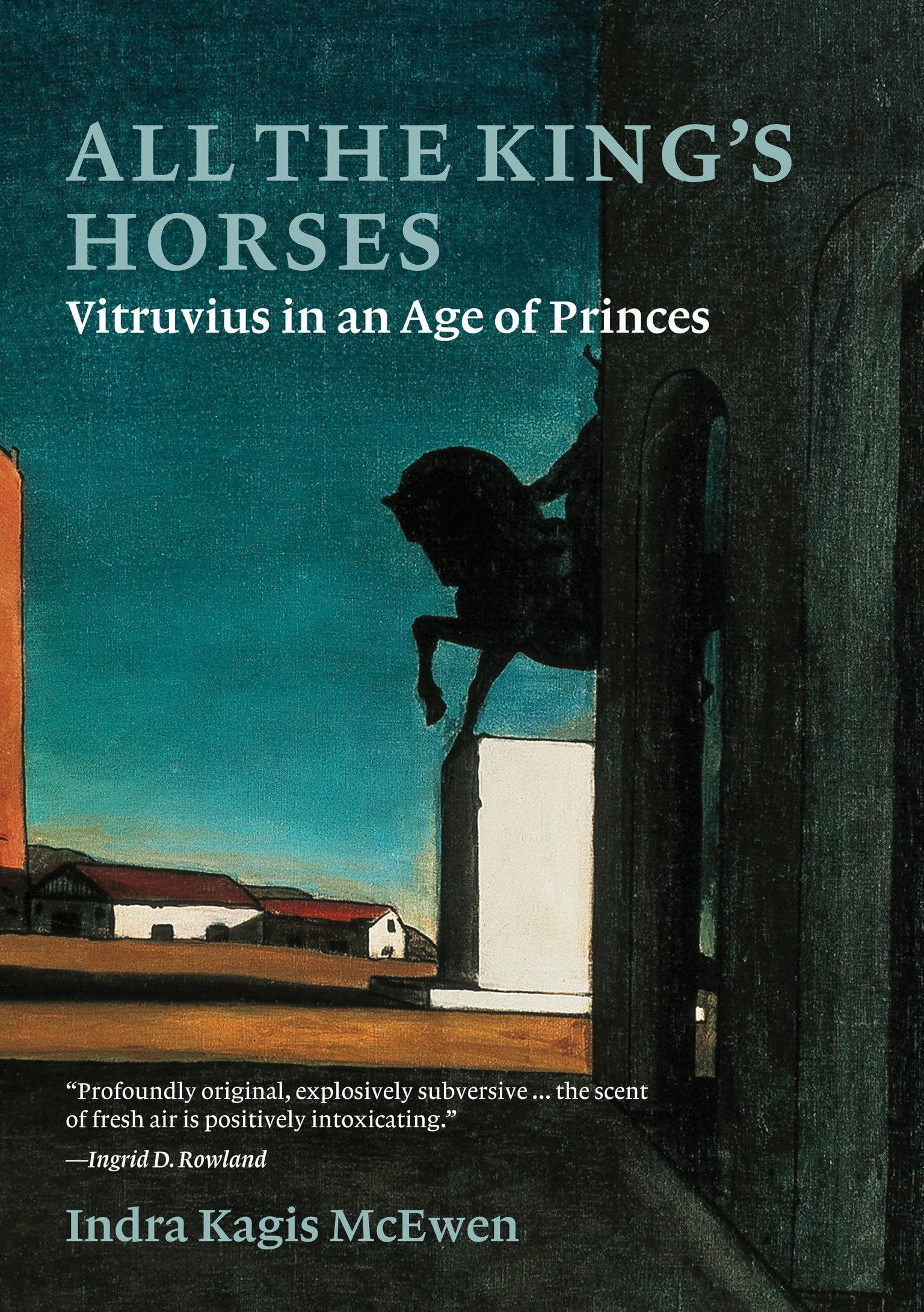



How the Italian Renaissance reinvented the power of princes by rediscovering Vitruvius and his architecture—and justified their right to rule. In Vitruvius: Writing the Body of Architecture , Indra Kagis McEwen argued that Vitruvius’s first-century BC treatise De architectura was informed by imperial ideology, giving architecture a role in the imperial Roman project of world rule. In her sequel, All the King’s Horses , McEwen focuses on the early Renaissance reception of Vitruvius’s thought beginning with Petrarch—a political reception preoccupied with legitimating existing power structures. During this “age of princes” various signori took over Italian towns and cities, displacing independent communes and their avowed ideal of the common good. In turn, architects, taking up Vitruvius’s mantle, designed for these princes with the intent of making their power manifest—and celebrating “the rule of one.” Through meticulous descriptions of the work of architects and artists from Leon Battista Alberti to Leonardo, McEwen explains how architecture became an instrument of control in the early Italian Renaissance. She shows how architectural magnificence supported claims to power, a phenomenon best displayed in one of the era’s most prominent monumental themes: the equestrian statue of a prince, in which the horse became an emanation of the will of the rider, its strength the expression of his strength. "McEwen’s thoughtful book not only helps us better understand a particular moment in the Renaissance fascination with Vitruvius but also invites us to reflect on the way that this ancient architectural treatise functions as a lens on a changing world." — Journal of the Society of Architectural Historians “ All the King’s Horses is a profoundly original, explosively subversive study of the alliance between classical architecture and despotism forged in fifteenth-century Italy when the brilliant but ambiguous scholar-architect Leon Battista Alberti, armed with the Ten Books on Architecture of the ancient Roman writer Vitruvius, helped a series of popes and warlords to dismantle the communal institutions that had turned the cities of medieval Italy into models of prosperity, and create what we know as the Italian Renaissance. The scent of fresh air is positively intoxicating.” —Ingrid Rowland, Professor at the School of Architecture, University of Notre Dame “By reading the reappraisal of Vitruvius by such authors as Alberti, Filarete and Francesco di Giorgio against the background of the profound and problematic political transformation of the main centers of the Italian renaissance, All the King’s Horses masterfully demonstrates how the imperial ideology that Indra Kagis McEwen uncovered in her earlier work on Vitruvius lies at the very core of what she terms ‘the politics of antique revival’ in the Quattrocento. At once wide-ranging, erudite and piercing, this book is an indispensable critical examination of the mythology of renaissance architecture, its purpose, and its afterlife.” —Maarten Delbeke, Professor and Chair of the History and Theory of Architecture, ETH Zürich Indra Kagis McEwen is an architect, historian, and affiliate professor in the Art History Department at Concordia University in Montreal. Her publications include two books, Socrates’ Ancestor: An Essay on Architectural Beginnings (1993) and Vitruvius: Writing the Body of Architecture (2003), both published by the MIT Press.