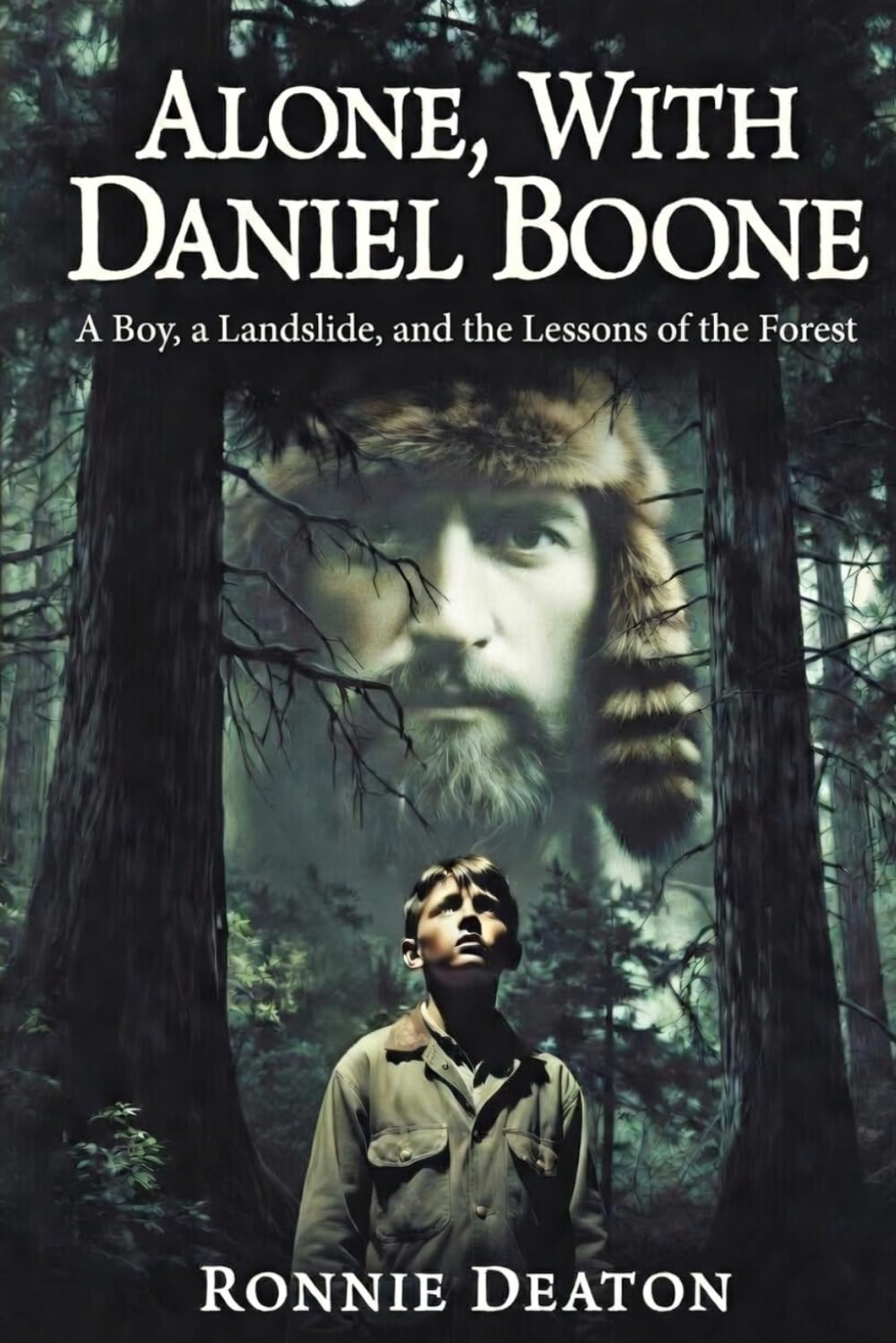
Alone, With Daniel Boone: A Boy, a Landslide, and the Lessons of the Forest
$14.95
by Ronnie Deaton



In the summer of 1956, the hills of southeastern Kentucky still belonged to men like Daniel Boone, at least in the stories told on front porches after supper. The Cumberland Forest rolled green and deep, its ridges sharp against the sky, its hollows thick with hickory and oak. Down in the narrow valleys, farms clung to the land like stubborn roots. One of those farms belonged to the Wilson family, tucked along Maple Grove Road where the creek met the pasture, and the woods pressed close on three sides. Caleb Wilson was eleven that August, all elbows and questions, with his father’s quiet ways and his mother’s soft eyes. He had five younger siblings who filled the house with noise, Ruthie’s endless questions, the twins’ squabbles, and little Ben’s thumb-sucking wonder. But the real world, the one that mattered most to Caleb, lay beyond the back pasture where the trees began. There, his father, Tom, had been teaching him the old ways: how to walk quietly so the woods wouldn’t know you were there, how to read a ridge like a book, how to take only what you needed and leave the rest for tomorrow. Most mornings, Caleb woke to the smell of biscuits and gravy, the clatter of his mother at the woodstove, and the low murmur of his father lacing his boots. Life moved steadily and slowly, chores, school in September, church on Sundays, and the long summer days that felt like they might never end. But Caleb carried a restlessness his little brothers didn’t yet understand. He wanted to prove something. Not to the world, maybe, but to the man who had shown him deer tracks in the mud and taught him that a sharp knife and a steady hand could keep a body alive. On the fifteenth of August, that restlessness found its moment. The knock on his bedroom door came soft but sure, the way his father always did it when he didn’t want to wake the little ones. At four o’clock in the morning, the clock was chiming four times in the dark. Outside, fog pressed thick against the windows, turning the yard into something soft and secret. Caleb sat up, heart already quickening. He knew what the day might hold. His father had promised, if the weather held, if the boy was ready. They ate in near silence at the kitchen table, bacon and biscuits and strong coffee that tasted like grown-up medicine. His mother pressed a small sack of ham biscuits into his hands and kissed the top of his head. “Don’t you two go getting lost up there,” she said, though they all knew the words were mostly for show. Tom Wilson knew these ridges like the lines on his own palms. Outside, the old Ford waited in the drive, mist beading on the windshield. Caleb climbed in, the Remington shotgun resting between his knees, barrel down the way he’d been taught. As the truck bounced down the rutted road toward Molly Morgan Ridge, the boy felt something shift inside him, like a door cracking open to a room he hadn’t known was there. He was only eleven. The woods were older than time. But that morning, with his father beside him and the forest waking around them, Caleb Wilson stepped into the story that would change him forever.