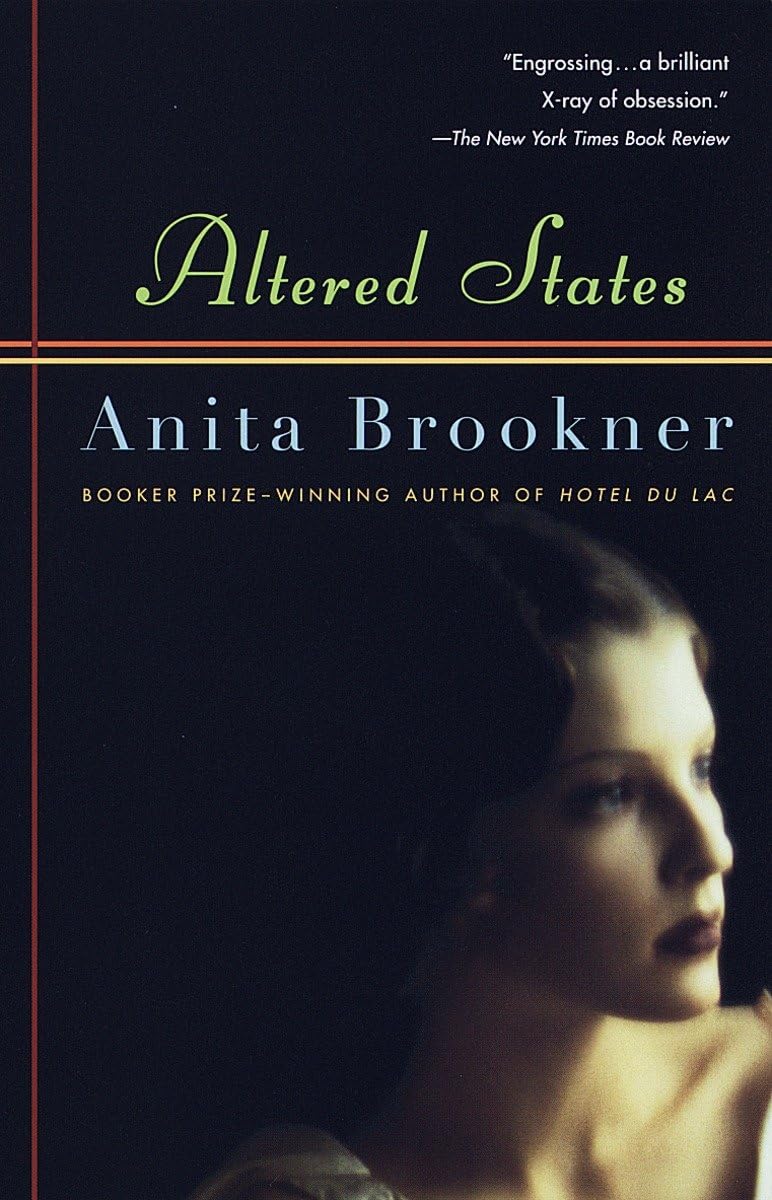



Standing on a railway platform in a Swiss resort town, sensibly clad in his Burberry raincoat and walking shoes, a man thinks he may be looking at the woman for whom he ruined his life many years earlier. Alan Sherwood, a quiet English solicitor, remembers back to a time when he stepped briefly out of character to indulge in a liaison with Sarah Miller, an intriguing but heartless distant relative--only to find himself in a series of absurd situations that culminated in his marriage to Sarah's clinging, childlike friend Angela. With her compassionate portrait of a man who has paid a terrible price for his folly, Anita Brookner gives us a novel that it at once harrowing and humane. In the traditions of Henry James and Thomas Mann, Altered States is a beautifully rendered tale of loneliness, guilt, and erotic obsession. "Engrossing-- a brilliant X-ray of obsession." - New York Times Book Review "Brilliant.... In a category of its own." - The Globe and Mail " Altered States -- is among [Brookner's] best. Its spare, gripping narrative and sombre, yet illuminating look at the power of passion is extraordinary." - The London Free Press "Brookner's vision of human behaviour is scrupulously honest, without ever being cruel-- a gem of revelation." - Chicago Tribune Standing on a railway platform in a Swiss resort town, sensibly clad in his Burberry raincoat and walking shoes, a man thinks he may be looking at the woman for whom he ruined his life many years earlier. Alan Sherwood, a quiet English solicitor, remembers back to a time when he stepped briefly out of character to indulge in a liaison with Sarah Miller, an intriguing but heartless distant relative--only to find himself in a series of absurd situations that culminated in his marriage to Sarah's clinging, childlike friend Angela. With her compassionate portrait of a man who has paid a terrible price for his folly, Anita Brookner gives us a novel that it at once harrowing and humane. In the traditions of Henry James and Thomas Mann, Altered States is a beautifully rendered tale of loneliness, guilt, and erotic obsession. Standing on a railway platform in a Swiss resort town, sensibly clad in his Burberry raincoat and walking shoes, a man thinks he may be looking at the woman for whom he ruined his life many years earlier. Alan Sherwood, a quiet English solicitor, remembers back to a time when he stepped briefly out of character to indulge in a liaison with Sarah Miller, an intriguing but heartless distant relative--only to find himself in a series of absurd situations that culminated in his marriage to Sarah's clinging, childlike friend Angela. With her compassionate portrait of a man who has paid a terrible price for his folly, Anita Brookner gives us a novel that it at once harrowing and humane. In the traditions of Henry James and Thomas Mann, Altered States is a beautifully rendered tale of loneliness, guilt, and erotic obsession. Anita Brookner was born in London and, apart from several years in Paris, has lived there ever since. She trained as an art historian and taught at the Courtauld Institute of Art until 1988. The woman on the station platform had her back to me. If she had turned round I would have been able to satisfy myself that she was not someone I had once known. Even at this distance of time and place I should have known that other woman anywhere. As it was I could only contemplate this particular back view and once again return my memories to the oubliette to which I had consigned them. I was in any case reluctant to proceed to an identification. The woman on the station platform was smartly but not fashionably dressed in a sober chestnut-coloured suit and the sort of brown felt hat still favoured by certain middle-aged middle-class women in Germany. I doubted whether this woman was German, although she certainly looked European. This much was attested by her shoes, which again were smart without being fashionable: narrow brown brogues, with a medium heel. I noticed that they were brilliantly polished. That I was able to contemplate this woman at such length no doubt says something about myself, but I am averse to falsely intelligent summaries, such as seem to be prevalent nowadays, and prefer long moments of reverie and speculation, which seem to me more conducive to satisfactory conclusions. We were the only two people on this particular platform, and I was only there because I had come down to the station to buy the English papers, which usually arrived at about four o'clock. The light was already going: it was a misty dusky afternoon, still quite mild, but with that particular stillness that speaks so eloquently of the decline of the year, and with it all hopes one had had in the spring, season of false promises. Behind me, in the town, I had left the subdued comfort of the English Tea Rooms: beyond, at the end of the main street, at the foot of the steep path leading up to the hilly suburbs where all the more prospero