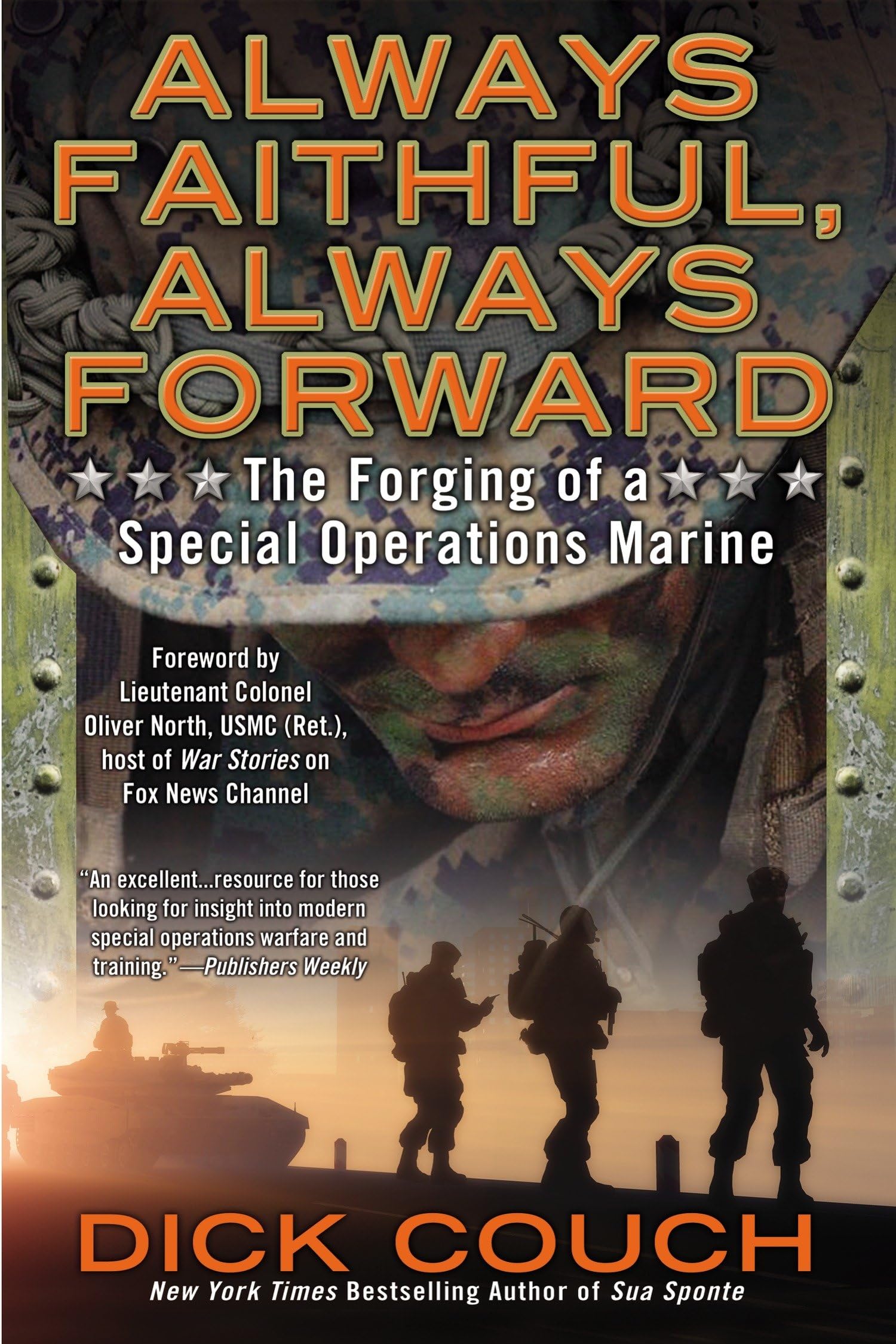
Always Faithful, Always Forward: The Forging of a Special Operations Marine
$15.39
by Dick Couch



Established in 1986, the U.S. Special Operations Command was set up to bring the special operational disciplines of all branches of the military under a single, unified command to act on missions involving unconventional warfare, special reconnaissance, foreign internal defense, and direct action... The Marine Special Operations Command ("MARSOC") is the newest component of the military's shift toward a fully integrated Special Operations Command structure. At first, the Marines were strongly against any Marines serving under anyone other than another Marine. Then 9/11 happened. In the years following, Marine forces found themselves growing more agreeable to inter-branch operational command, finally forming the Marine Special Operations Command in 2006. Always Faithful, Always Forward follows the journey of a class of Marine candidates from their recruitment, through assessment and selection, to their qualification as Marines Special Operators. Retired Navy Captain Dick Couch has been given unprecedented access to this new command and to the individual Marines of this exceptional special-operations unit, allowing him to chronicle the history and development of the Marine Special Operations Command and how they find, recruit, and train their special operators. “An excellent...resource for those looking for insight into modern special operations warfare and training.”— Publishers Weekly “A gripping insider’s account of Marine Special Operations Command.”—Nathaniel Fick, author of One Bullet Away “I can’t imagine anyone doing a better job of telling the Marine Special Operations story.”—Larry Bond, author of Exit Plan “By the end of the book, you’ll be grateful that these proud fighting Marines are on our side—and you’ll be thankful to Dick Couch, who takes you inside their world.”—Eric Greitens, Navy SEAL, New York Times bestselling author of The Heart and the Fist A 1967 graduate of the U.S. Naval Academy, Dick Couch served with the Navy Underwater Demolition and SEAL Teams. He led one of the only successful POW rescue operations of the Vietnam War while a platoon leader with SEAL Team One in 1970. On release from active duty in 1972, he joined the Central Intelligence Agency, where he served as a Maritime Operations Officer. He is the New York Times bestselling author of numerous books and articles on military special operations, including Sua Sponte: The Forging of a Modern American Ranger . He also serves as a consultant and keynote speaker on issues of tactical ethics, moral battlefield conduct, and the future employment of American Special Operations Forces. Dick and his wife, Julia, live in Idaho. INTRODUCTION Let me say at the outset of this work that I consider myself among the most fortunate of authors. Not only am I fortunate, but I am doubly blessed. As a young man from a small town in southern Indiana, I was afforded the opportunity to attend the United States Naval Academy. That was in the summer of 1963. As my parents drove me to the city and put me on the train that would take me from Indianapolis to Annapolis, I was filled with dreams of travel, ships, service, and adventure. My time aboard a Navy destroyer following my graduation from Annapolis and my subsequent service in Navy Underwater Demolition and SEAL teamsfollowing my time at sea made those dreams a reality and then some. Following my active service, I joined the Central Intelligence Agency, and it was just as exciting and rewarding. Collectively, those experiences were my first blessing. However, special operations and field intelligence work are the province of young men. Along about my mid-forties, when I knew my operational glass was well past half-empty, I began my career as a writer. I began by writing novels. The first was SEAL Team One, where the reader and I followed a young man through Basic Underwater Demolition/SEAL training and into combat in Vietnam. It very much paralleled the journey I had made some twenty years earlier, only this young fictional warrior was smarter, faster, and more daring. Yet he had the same anxieties, doubts, and fears as I did; he felt the same crushing responsibility that comes from leading men in combat. He also felt the same rush that comes with surviving mortal combat. I wrote SEAL Team One back when there was only one Navy SEAL writing books—me. SEAL Team One did well, and is still in print through the Naval Institute Press. I followed this book with Pressure Point, Silent Descent,and Rising Wind—all novels about SEALs and terrorists in more contemporary settings. Each day I arose early, got myself a cup of coffee, and went to my word processor. Each morning I was able to hang out with my imaginary friends for a few hours and do some dashing and daring things. I created bad guys with evil in their hearts who plotted against our nation. To defeat these enemies, I developed SEALs and other special operators who stepped into the breach to counter those threats. Then the folk