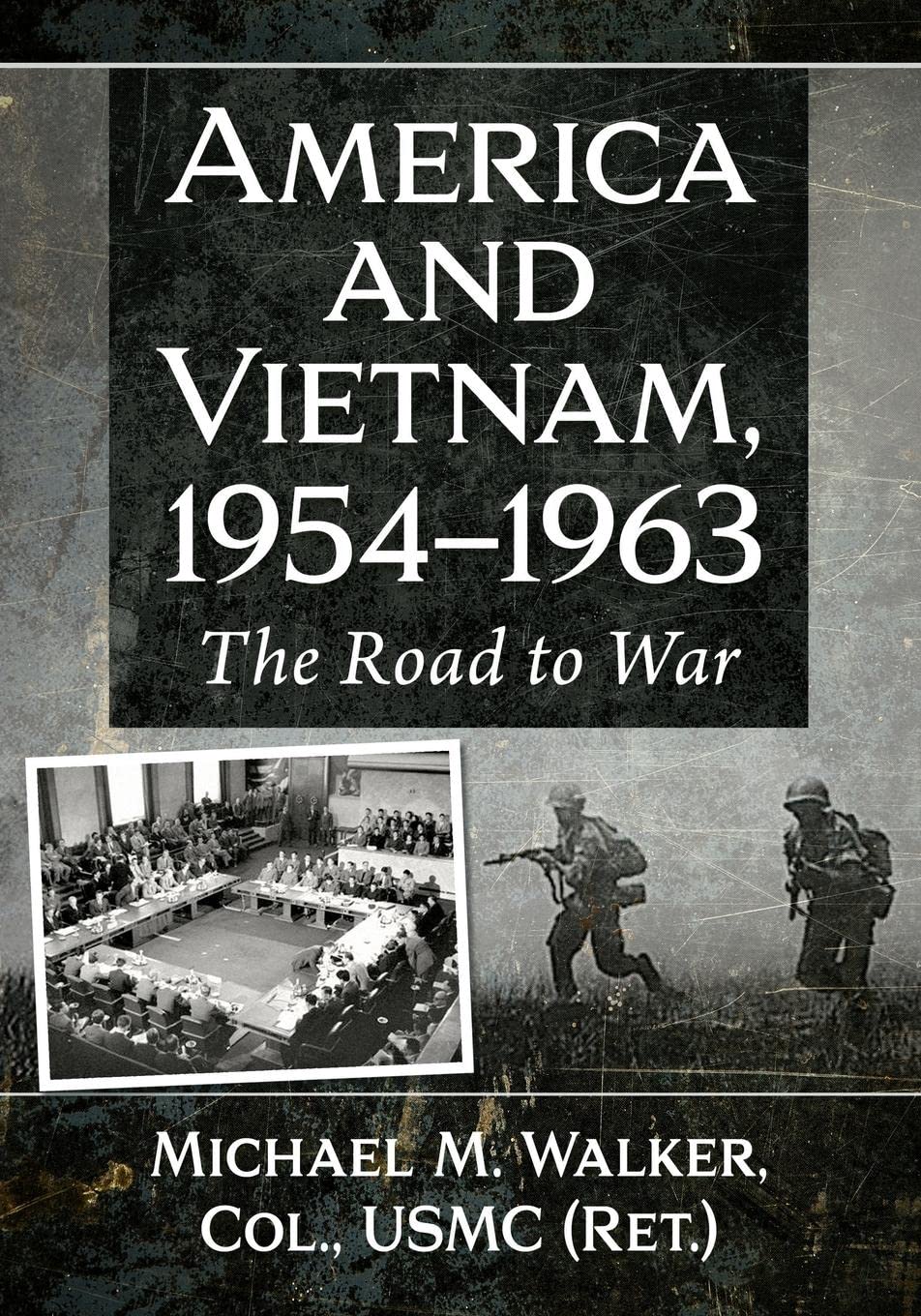



The conventional narrative of the Vietnam War often glosses over the decade leading up to it. Covering the years 1954-1963, this book presents a thought-provoking reexamination of the war's long prelude--from the aftermath of French defeat at Dien Bien Phu--through Hanoi's decision to begin reunification by force--to the assassination of South Vietnamese President Ngo Dinh Diem. Established narratives of key events are given critical reappraisal and new light is shed on neglected factors. The strategic importance of Laos is revealed as central to understanding how the war in the South developed. John Cirafici of the Vietnam Veterans of America America and Vietnam, 1954-1963: The Road to War (McFarland, 391 pp. $49.95, paper; $22.49, Kindle) is an exceptionally well-researched and written history. It is an outstanding single-volume look at the Vietnam War's origins, examining how and why America's fate became entwined with the internal struggle between Vietnamese factions. The goals of this book are to identify the origins of the war, the nature of the adversaries, their capabilities, and the evolving commitment of the United States. In other words, what happened that led to America's direct and overwhelming involvement in a war the country chose to fight, not one we fought out of necessity. In answering that question, Michael Walker explains the very complicated power struggle following the end of the First Indochinese War in 1954 in the South, after which Ngo Dinh Diem created a functional state (the Republic of South Vietnam) in an otherwise dysfunctional mess. Walker, a retired U.S. Marine Corps colonel, provides a complete picture of President Diem, who was a very complicated man, showing how he consolidated power. Walker claims that it was the one-sided and damaging treatment of Diem in the American press that contributed to the 1963 coup that resulted in his death. Walker then explains how the North's highly experienced and disciplined Worker's Party quickly consolidated power after the French defeat in anticipation of future unification and the impact of the war in Laos on the conflict in Vietnam. The chaotic events of 1963-including a series a Buddhist-led protests against Diem, the U.S.-supported coup and Diem's assassination, as well as Hanoi's decision to exploit the post-coup instability in the South—changed the face of the war. To explain how a civil war between the northern and southern Vietnamese became a major part of American history Walker examines the decade immediately preceding the American war in Vietnam. He focuses on Resolution 15 issued by Hanoi in 1959, which formally began a second phase of the war, the first being the struggle for independence from the French. Walker addresses the creation of armies in both the North and South and provides insights into the professional and highly effective use of intelligence collection and signals intelligence by the North. Perhaps the most impressive success of the North was the placement of agents into the highest reaches of the South's military and government. One undercover agent who revealed his role after the war actually worked for American news correspondents and influenced their opinions about the war. This is an informative book that answers many questions about how the United States wound up fighting in Vietnam in a much-expanded conflict. It is well worth the time to read. "Superb account ... should be read by anyone interested in understanding how and why the United States went to war in Vietnam." - Mark Moyar, author of Triumph Forsaken: The Vietnam War, 1954-1965 "[C]lears the fog that the orthodox school of Vietnam War history had so carefully created ... a must read for any serious scholar of that conflict." - Dr. Geoffrey D.T. Shaw, Ph.D., author of The Lost Mandate of Heaven and director of the Alexandrian Defense Group. THE JOURNAL OF MILITARY HISORY, vol. 87, No.3, July 2023 Walker's work is a solid addition to the body of scholarly work on U.S. involvement in Vietnam. It can be enjoyed by scholars, students, or history enthusiasts, and could be a valuable supplemental text for classes on the Vietnam War. Mary K. Laurents University of Maryland, Baltimore County Baltimore, Maryland Michael M. Walker, Colonel USMC (Ret) served in the Marine Corps for 26 years as an infantry and intelligence officer to include three tours in the Pacific-East Asia region, one in Europe, and two in Southwest Asia. He lives in Meridian, Idaho.