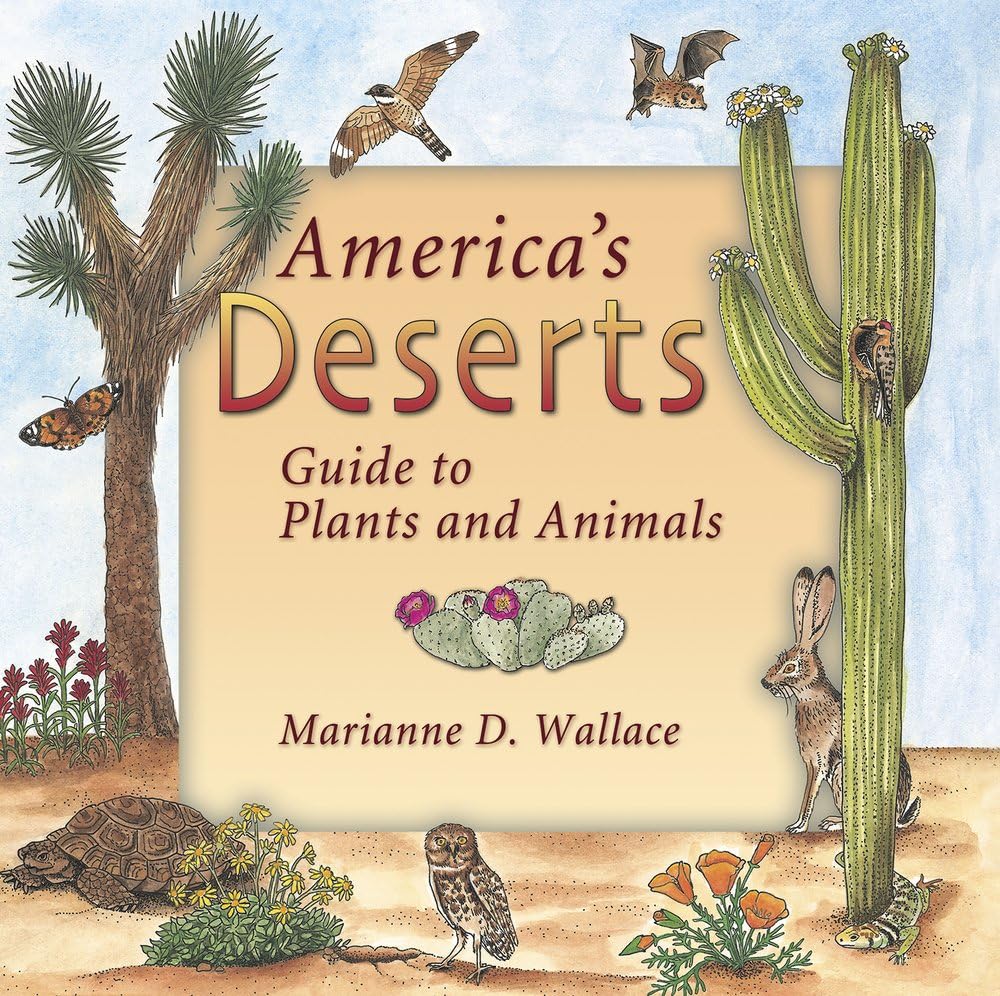
America's Deserts: Guide to Plants and Animals (America's Ecosystems)
$13.95
by Marianne Wallace



Discover the remarkable biodiversity of North America's desert ecosystems with this comprehensive, beautifully illustrated field guide. America's Deserts takes readers on an exploration of four distinct desert regions―the Sonoran Desert, Mojave Desert (including Death Valley), Chihuahuan Desert, and Great Basin Desert―revealing how each unique environment sustains different communities of plants and animals adapted to extreme conditions. Through stunning watercolor-and-ink illustrations and accessible text, natural science illustrator and writer Marianne Wallace brings desert life into vivid detail. Each desert habitat is introduced with location maps and double-page spreads showcasing the remarkable variety of wildlife found there, from iconic saguaro cacti and roadrunners to desert tortoises, rattlesnakes, and colorful wildflowers. The book also highlights two exceptional regions: Death Valley and the Colorado Desert, demonstrating the incredible diversity within North American desert ecosystems. The second section provides detailed profiles of common desert birds, arthropods, mammals, reptiles, annual wildflowers, cacti, shrubs, and trees, with species names highlighted for easy identification. Practical features include an animal tracks guide, pronunciation guide, glossary, annotated species list with both common and scientific names, and a thorough index. Additional resources and contact information help readers continue their desert exploration beyond the book. Perfect for nature enthusiasts, students, families, homeschoolers, and anyone fascinated by desert ecology, this guide makes complex desert ecosystems accessible and engaging for readers ages 8 and up. Grade 3-6?This title focuses on four distinct North American deserts?Sonoran, Mojave, Chihuahuan, and Great Basin?and the specific plants and animals that survive in each. Species names are highlighted in bold within the text, and specific places to find them appear in both text and illustrations. Area maps and double-page watercolor-and-ink illustrations realistically reflect the natural colors of desert life. An annotated list of common plants and animals, a section showing animal tracks, and a brief pronunciation guide and glossary are appended. A thorough index and a list of addresses of places to contact for additional information round out the book. A strength of this presentation is the opportunity it offers to compare life in different ecosystems; Wallace makes it clear that desert environments are not all the same, and that varying climates sustain different species. An attractive, well-organized guide for readers who can explore a desert first hand, as well as for report writers.?Diane Nunn, Richard E. Byrd Elementary School, Glen Rock, NJ Copyright 1996 Reed Business Information, Inc. Gr. 3^-5. In the first section of this introduction to the animals and plants of North American deserts, four-page chapters discuss the major desert habitats, Sonoran, Mojave, Chihuahuan, and Great Basin, as well as two unique regions within those areas, Death Valley and the Colorado Desert. Each chapter features a description of the particular desert biome, a map showing its location, and a double-page spread illustrating the variety of wildlife there. The second section focuses on plants and animals common to North American deserts. Ink drawings appear throughout the book, some with one-color and others with full-color washes. This sturdy paperback is well designed for browsing and equally useful for school units. Carolyn Phelan Marianne Wallace is a nature writer and illustrator who has also worked as an elementary school science teacher, a writer for the US Forest Service, a veterinarian's assistant, and a tour guide at a botanic garden. In her backyard at the base of mountains near Los Angeles, she has witnessed a bear asleep in the oak tree, deer eating fallen apples, a hawk using the birdbath, and squirrels fighting over who gets the most acorns. No wonder she writes about nature. She has a pet tarantula named Tilly.