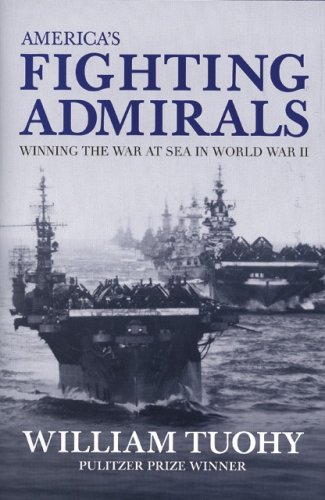
America's Fighting Admirals: Winning the War at Sea in World War II
$18.97
by William Tuohy



American naval actions of World War II comprise the most widespread, complex, and dramatic battles in the history of sea warfare. The fighting took place over vast distances in the Atlantic and Pacific oceans, as well as in the constricted spaces of the Mediterranean and Solomon seas. Each of the major actions had an admiral, the commander in charge, who led the battle. In combat, the abilities and determination of these commanders at sea were put to the most severe test. Americas Fighting Admirals describes the course of U.S. sea action in World War II. It examines the skills, strengths, weaknesses and personalities of the American admirals who fought the battles at sea. It examines the effect that stress, tension, and responsibility have on commanders making vital decisions in the red-hot crucible of battle. And it reveals the changing nature of the responsibilities of flag officers as the war progressed and became enormously complex. World War II navy veteran and Pulitzer Prize-winning journalist Tuohy has credentials and credibility to write a good popular introduction to the WWII U.S. Navy. And he has, in the form of a group portrait of the admirals who oversaw America's navy as it became the largest in history, larger than the contemporary combined fleets of the rest of the world. The admirals' range of experience was vast, for some had started out in coal-burning battleships, while others' careers commenced soon after leaving Annapolis. The famous likes of King, Spruance, Mitscher, and the more-aggressive-than-skilled Halsey are here, of course, but so are well-serving battleship admirals and amphibious specialists including the ferocious Turner and MacArthur's right-hand landing expert, Barbey. Some failed to distinguish themselves--Kimmel of Pearl Harbor notoriety, Pownall, and Theobald--and few of the Atlantic admirals are here, since they served in an ocean dominated by the fight to the death between the British and the U-boats. An honorable tribute to honorable men, most of whom served their country well. Roland Green Copyright © American Library Association. All rights reserved Booklist, May 2007 “World War II navy veteran and Pulitzer Prize-winning journalist Tuohy has credentials and credibility to write a good popular introduction to the WWII U.S. Navy. And he has, in the form of a group portrait of the admirals who oversaw America's navy as it became the largest in history, larger than the contemporary combined fleets of the rest of the world ... An honorable tribute to honorable men, most of whom served their country well.” Warships International Fleet Review ( UK ) , November 2007 “Comprehensive and well-written – almost cinematic in some places, it is recommended for anyone interested in naval combat leadership or the U.S. Navy in general ... a superb, enthralling account of the U.S. Navy’s WWII titans and their achievements.” US Naval Institute Proceedings, June 2007 “In America’s Fighting Admirals , a Navy veteran of World War II provides valuable reference points for the study of high-level naval leadership.” AMERICA S FIGHTING ADMIRALS WINNING THE WAR AT SEA IN WORLD WAR II American naval actions of World War II comprise the most widespread, complex, and dramatic battles in the history of sea warfare. The fighting took place over vast distances in the Atlantic and Pacific oceans, as well as in the constricted spaces of the Mediterranean and Solomon seas. For each of these major actions and battles, the commander in charge was an admiral. The abilities and determination of these commanders at sea were severely tested. No one could predict in peacetime who would have that rare Nelson touch, who would prove successful in battle and who would not measure up in the red-hot crucible of combat. America s Fighting Admirals: Winning the War at Sea in World War II describes the course of U.S. naval combat in World War II from the perspective of American admirals who fought the battles at sea. World War II navy veteran and Pulitzer Prize winning Los Angeles Times war correspondent William Tuohy examines the effect that stress, tension, and responsibility have on commanders making vital decisions in the heat of the moment. · Shows how American admiralship evolved during the war · Covers all campaigns and significant American naval actions during World War II · Features both well-known flag officers like Bull Halsey as well as lesser-known but significant figures such as Slew S. McCain, grandfather of U.S. Senator John McCain, who commanded the final carrier-launched air strikes against Japan William Tuohy served with the U.S. Navy in the Pacific in 1945 46. He won the Pulitzer Prize in 1968 for his Vietnam War reporting in the Los Angeles Times. As a journalist, he covered the conflicts in the Middle East, Central America, Northern Ireland, and the Gulf, as well as covering the fall of Saigon in 1975 and the Berlin Wall in 1989. He is the author of Dangerous Company: I