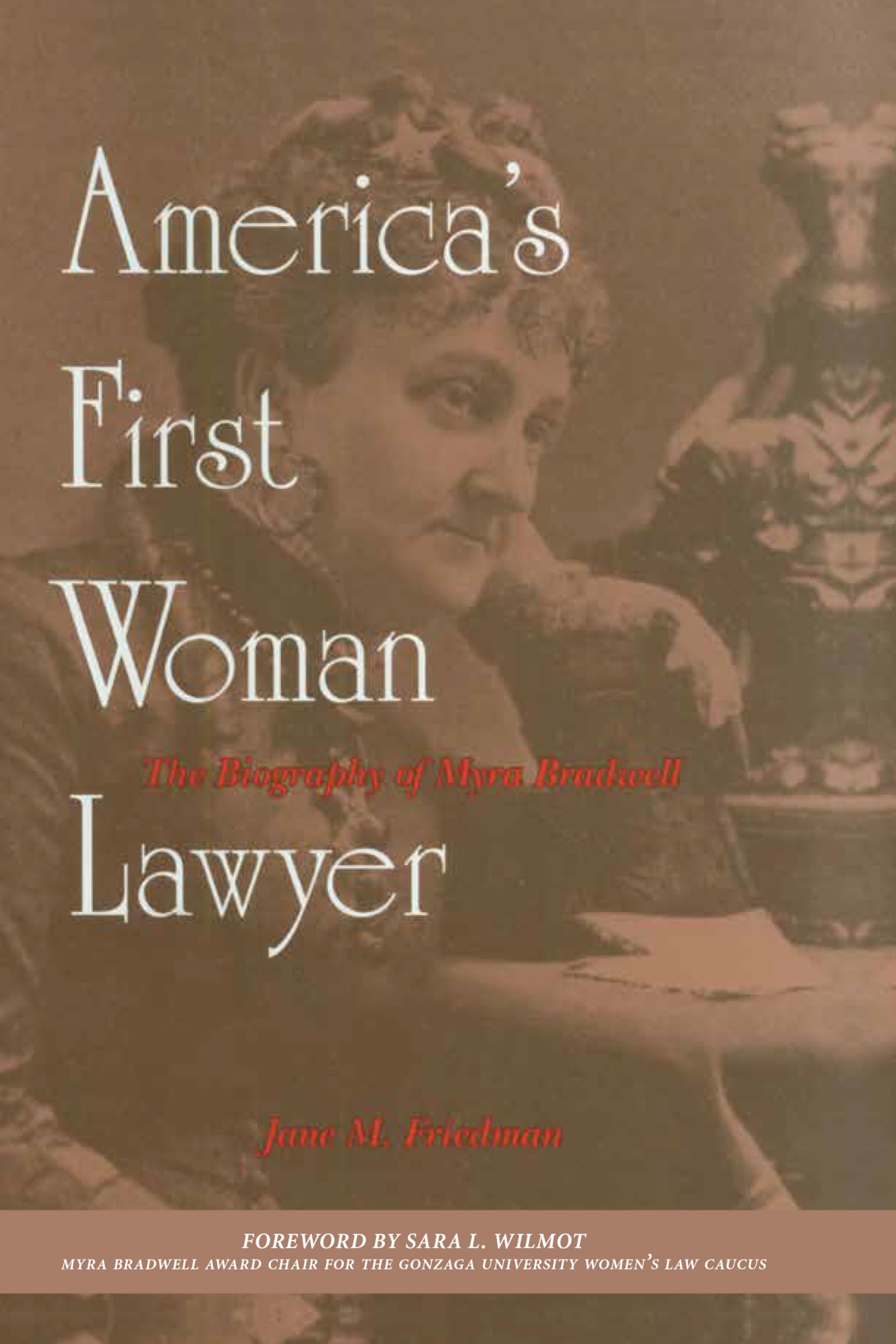



This biography of Myra Bradwell brings long overdue attention to a woman who deserves to be ranked among the leading women's rights advocates of nineteenth-century America.During her lifetime, Myra Bradwell (1831-1894) - America's "first" woman lawyer as well as publisher and editor-in-chief of a prestigious legal newspaper - did more to establish and aid the rights of women and other legally handicapped people than any other woman of her day. Her female contemporaries - Susan B. Anthony, Elizabeth Cady Stanton, Lucy Stone - are known to all. Now it is time for Myra Bradwell to assume her rightful place among women's rights leaders of the nineteenth century. With author Jane Friedman's discovery of previously unpublished letters and valuable documents, Bradwell's fascinating story can at last be told. Jane M. Friedman (d. 2016) was professor of law at Wayne State University. Sara Wilmot is the Myra Bradwell Award chair for the Women's Law Caucus and editor-in-chief of the Gonzaga Law Review at Gonzaga University. She is focused on public interest law and social advocacy. Prologue - "Myra Who?" Their responses were inevitable and almost uniform. "Myra who?" queried my friends and many of my colleagues whenever I mentioned that I was writing this biography. Unfortunately, the name of Myra Bradwell is recognized by virtually no one, except for historians of women and some teachers and students of constitutional law. However, during Myra Bradwell's lifetime (1831-94), her fame was widespread. Upon her death, one legal commentator characterized her as "one of the most remarkable women of her generation and one who had no small share in making that generation what it is. " As America's "first" woman lawyer and also as publisher and editor-inchief of an extremely prestigious and widely circulated legal newspaper, Myra Bradwell did more to create rights for women and other legally handicapped persons than did any other woman of her day, or perhaps any day. Yet the names of many of her female contemporaries are known to all, while Myra Bradwell has, sadly, been consigned to obscurity. I first learned of Myra Bradwell two decades ago. I was teaching a course in constitutional law at Wayne State University and decided to expand the unit on gender-based discrimination to include materials not then covered in the textbook. A colleague, Edward Wise, handed me the United States Supreme Court's opinion in Bradwell v. Illinois (1873), the case in which the Court upheld the right of the state of Illinois to exclude Bradwell from the practice of law solely because she was a woman. In a sonorous voice, I read to my class from Justice Bradley's concurring opinion: "The natural and proper timidity and delicacy which belongs to the female sex evidently unfits it for many of the occupations of civil life. The constitution of the family organization which is founded in the divine ordinances as well as in the nature of things indicates the domestic sphere as that which properly belongs to the domain and functions of womanhood. The harmony, not to say identity of interests and views which belongs, or should belong, to the family institution is repugnant to the idea of a woman adopting a distinct and independent career from that of her husband. . . . The paramount destiny and mission of woman are to fulfill the noble and benign offices of wife and mother. This is the Law of the Creator ." I repeated my theatrical presentation for several years, and a good laugh was usually had by all. Eventually I began pursuing other interests and dropped the constitutional law course from my teaching curriculum. But I couldn't drop the matter of Myra Bradwell from my mind. What had become of her? Did she ever become a lawyer, or did she simply shrivel up and go back to the kitchen? My initial investigation of the matter was frustrating. A check of the card catalogues at university libraries, law libraries, public libraries, and even the Library of Congress revealed nothing relating to Myra Bradwell. Biographical dictionaries yielded little that was noteworthy, except that she had been the editor of a newspaper called the Chicago Legal News , a fact that I glossed over much too lightly. I surmised that Justice Bradley had had the last word and that Myra Bradwell must have, in large measure, resigned herself to "fulfilling the paramount destiny and mission of woman." Believing that further pursuit of the elusive Myra Bradwell would be futile, I abandoned the project. Several years later, while browsing in a law library, I stumbled upon a complete set of the bound volumes of the Chicago Legal News. I picked up the dusty volume, expecting to find merely synopses of court opinions and news of happenings in the Chicago legal community during the latter part of the nineteenth century. To my great surprise and pleasure, I found much more! The Chicago Legal News was Myra Bradwell's alter ego. In her capacity as both publisher and