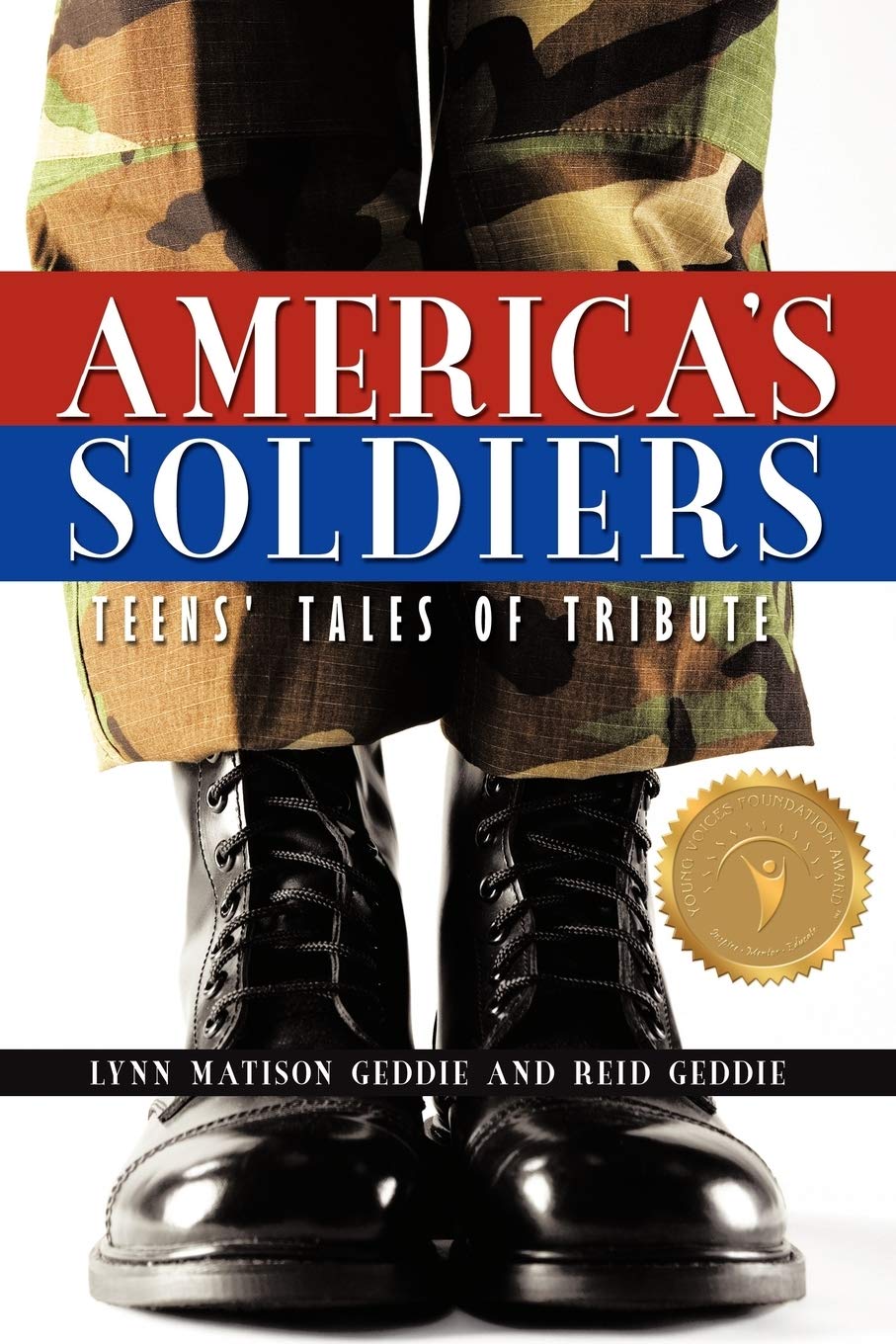



Here is an inspiring and poignant collection of teen essays, depicting individual stories of the courage and humanitarianism demonstrated by soldiers who served from World War II through the conflicts in the Middle East. These engaging stories illustrate how American soldiers, driven by perseverance and a spirit of patriotism, have provided our country with over 200 years of freedom and prosperity. Experience the tragedy of WWII pilot Lt. Norman J. Rogers, whose B-24 and crew went down over Germany and the massacre that unfolded. Observe how the victorious Tuskegee Airmen and one of their fighter pilots, Lt. William M. Wheeler proved their superior aerial abilities while faced with discrimination and segregation in the military. Find out about flying the Hump in the 'Forgotten Theater' of WWII. Learn what it was like for Marine Sergeant, Leroy Caughey to survive a rocket attack on his barracks in Vietnam. Read the stirring memorial to Captain Benjamin Sklaver, U.S. Army reserve officer killed by a suicide bomber in Afghanistan. These are some of the remarkable stories featured and the history about those who lived it. Interwoven in the essays, are the younger generation's (the young writers') introspective reasons why they chose to honor these heroes. American's Soldiers: Teens' Tales of Tribute Soldiers' stories from the mid-20th century through the turn of the 21st century By Lynn Matison Geddie Reid Geddie AuthorHouse Copyright © 2010 Lynn Matison Geddie All right reserved. ISBN: 978-1-4389-8901-3 Contents PREFACE...............................................xiACKNOWLEDGMENTS.......................................xviiChapter 1 WORLD WAR II................................1Chapter 2 KOREAN WAR..................................55Chapter 3 VIETNAM WAR.................................65Chapter 4 GULF WARS & MIDDLE EAST.....................89Chapter 5 MENTORS.....................................129Chapter 6 LETTERS FROM PATRIOTS.......................153REFERENCES............................................169ABOUT THE AUTHORS.....................................173 Chapter One WORLD WAR II Capt. Dave A. Matison, Jr. 2nd Lt. Norman J. Rogers, Jr. SF1 Richard Holladay 1st Lt. Ken Maatman Lt. Col. Morris Crossen 2nd Lt. William M. Wheeler Corporal Ernest Lee PFC Thad Alfred Tingle MP. James Cook WASP Doris Brinker Tanner S/Sgt. Alphonse A. Wolak Sgt. James Paul Sartain S/Sgt. Doyle Maylon Walker Sgt. Sy Lengkok CAPT. DAVE A. MATISON, JR. WWII, CHINA-BURMA-INDIA U.S. ARMY AIR FORCES, AIR TRN.COM. By Grandson, Reid Geddie of Georgia "Hump Pilot" "Flying the `Hump' was the foremost and by far the most dangerous, difficult, and historic achievement of the entire war." General Albert C. Wedemeyer, Commanding General United States Forces, China Theater I never knew my grandfather, but he was born on November 10, 1923 and grew up in a Jewish-American family in Laurel, Mississippi. Raised during the Great Depression his family was lucky, they had a family business. He learned to fly airplanes as a teenager at age 17 and attended racing pilot, Roscoe Turner's Flying School in Indianapolis. He earned his commercial pilot's license at age 19 before enlisting in the Army Air Forces in 1943. After he earned his license he flew for an airline in Vermont briefly. He quit flying for the airline to enlist because he believed in freedom and wanted to help free the Jewish people from the Germans, and their plan to exterminate them. His training in the USA was flying ferry missions for The 4th Ferry Group, Air Transport Command, Nashville, Tennessee. He never served a tour in the European Theater. Instead he was assigned as a pilot to the China Burma India Theater (CBI) in early 1945 to fly The Hump. The CBI is also called The Forgotten Theater because little has been told about it in the news or the movies. It was a small theater, about one quarter of a million troops were stationed there. But, it is an important theater because the first great airlift in history began there in World War II. He was stationed at the 1337th AAF Base Unit at Sookerating in Assam, India. It was a British tea plantation before and during the war. My grandfather flew supply missions over the Himalaya Mountains from India to China and back. The Japanese had bombed the main supply road in Burma so they had to bring gasoline, bombs, earth moving equipment, troops, and other support supplies to the Flying Tigers, the fourteenth Air Force and the Chinese Army who were fighting the Japanese Army. The Himalayas were called The Hump of the World, because they are the highest mountain range on earth. The pilots called them The Hump or The Rock Pile. Missions were flown night and day, and many planes and lives were lost due to the dangerous weather and altitude conditions. From pilots Dr. Carl Constein and J.V. Vinyard who experienced it, during January 6 and 7, 1945, Hump crews experienced the worst weather on the Hump;