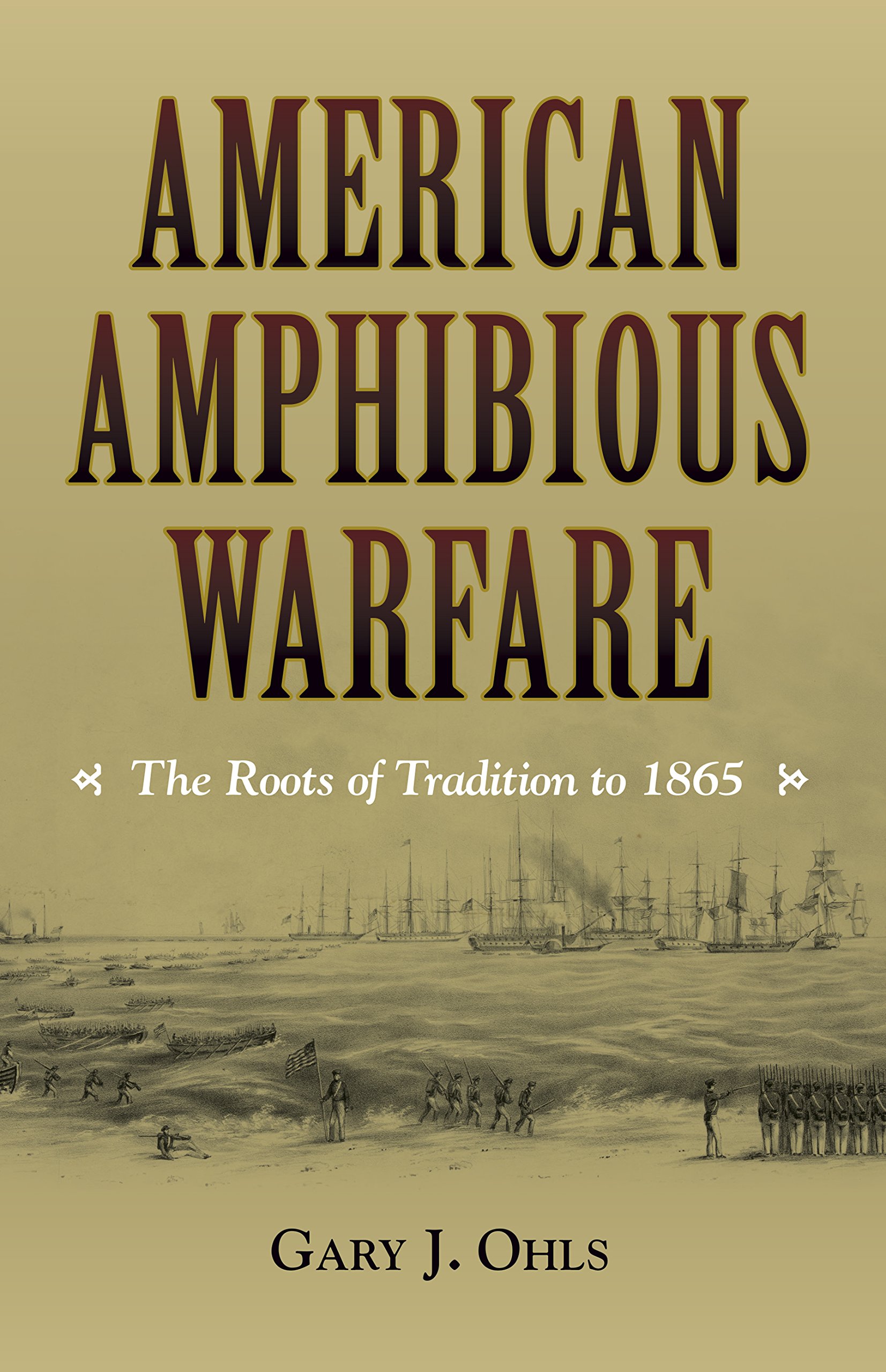
American Amphibious Warfare: The Roots of Tradition to 1865 (New Perspectives on Maritime History and Nautical Archaeology)
$34.56
by Gary J Ohls



American Amphibious Warfare offers analysis of the early amphibious landing operations from the Revolutionary War to the Civil War. Through a case study approach, the operational and strategic significance of each action is analyzed and its impact on the development of the United States is assessed. By focusing on seven major campaigns, Gary J. Ohls provides readers with a richer appreciation of the origins of American amphibious warfare. For many Americans, the concept of amphibious warfare derives from the World War II model in which landing forces assaulted foreign shores and faced determined resistance. These actions usually resulted in very high casualty rates, yet they proved uniformly successful. The circumstances of geography coupled with the weapons and equipment available at that time dictated this type of warfare. During the eighteenth and nineteenth centuries, no such equipment or weapons existed for assaulting defended beaches. Commanders attempted to land their forces in areas where the resistance would be light or nonexistent. The initiative and maneuverability inherent in naval forces permitted the delivery of combat power to the point of attack faster that the land-based defenders could react. Ohls explains how amphibious traditions began in this era and shows how they compare with modern amphibious forces, particularly the tactics of today's U.S. Marine Corps. The author makes a compelling case for a continuing tradition of American amphibious warfare learned and honed through a set of key battles and carried forward. Further, Ohls argues that the Marine Corps is the true inheritor of this warfare tradition formed in early America, concluding that weapons and equipment, coupled with new doctrine, actually allow modern forces to return to the sort of amphibious tactics and operations practiced more than two centuries ago. Both a work of history as well as an analysis of operational conflict, this study should please readers looking for a clearer understanding of U.S. amphibious operations. Since the concepts presented in this book continue to serve as excellent tools for both the professional officer and the analytical historian, American Amphibious Warfare as a whole provides a much-needed comprehensive history of naval and military warfare. "In American Amphibious Warfare : The Roots of Tradition to 1865, part of the series New Perspectives on Maritime History and Nautical Archeology, Gary J. Ohls describes and analyses major amphibious landing and defensive deployments by U.S. forces from the Revolution to the Civil War....In an attempt to fill what he calls a gap in the historiography of America's naval and military story, his American Amphibious Warfare: The Roots of Tradition to 1865 succeeded admirably." —The Northern Mariner "This fascinating book investigates seven major battles or critical examples of amphibious campaigns in early American history." —Book Bit for WTBF-AM/FM "...An informed and informative analysis of the early amphibious landing operations from the Revolutionary War to the Civil War." —Midwest Book Review "The American military has a long history of amphibious operations. This book chronicles seven amphibious assaults in America's early military history when the tactics and equipment of the day argued against direct assaults on the defended beaches. The author examines each in great detail." —Military Heritage Magazine "Amphibious warfare, or rather its threat, is a strategy used by navies since the Peloponnesian Wars, but in American Amphibious Warfare: The Roots of Tradition to 1865 there are seven studies on its use as a tactic by early American forces. There is an inevitable essay on the US Marines' march from Derne to Tripoli of 1805 and the British use if amphibious warfare in the War of 1812 is mentioned." —Warships: International Fleet "Besides considering amphibious warfare, this wide-ranging book looks at other aspects of military planning and execution such as the development of the operational art and the concepts of operational maneuver and expeditionary warfare. Along the way, the author gives us a broad survey of American military history. In his postscript, Ohls writes, 'The [concepts presented in this study] are timeless and provide the historian and analyst a basis for evaluating naval and military events from any period.' Thoughtful readers will agree." —The Journal of America's Military Past "Gary Ohl's book on Early American amphibious warfare is a welcome addition to the historiography on this highly specialized aspect of naval warfare. He introduces new concepts and perspectives that ... will assist other scholars in their endeavors. At the same time, he also employs this history in a way that might be very valuable to strategic planners and policymakers. As such, the book is not just history but informed historical policy analysis." —Civil War Book Review Recipient of the 2018 John Lyman Book Award in the category of U.S. Naval Histor