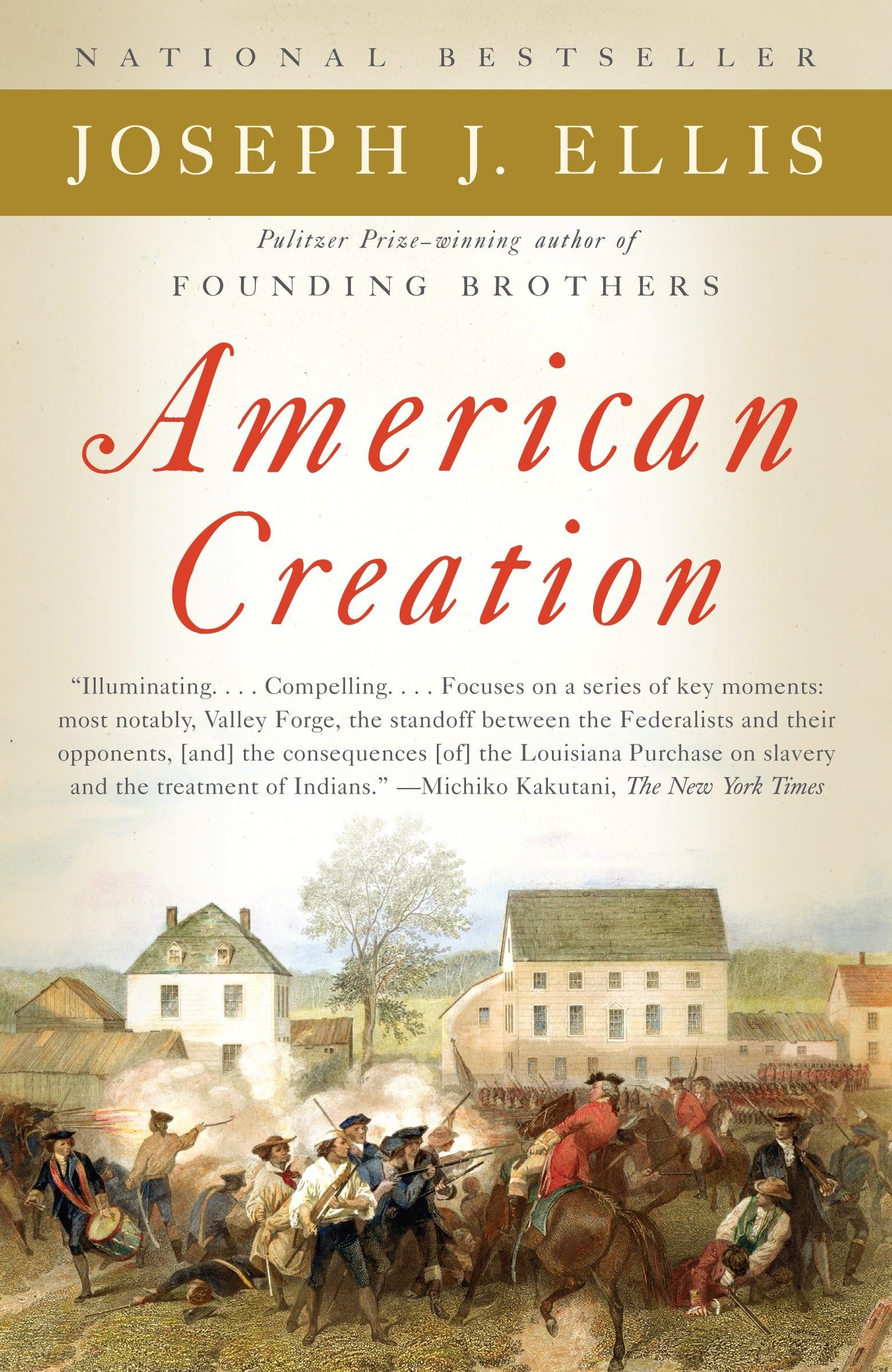
American Creation: Triumphs and Tragedies in the Founding of the Republic
$9.99
by Joseph J. Ellis



National Bestseller Acclaimed historian Joseph J. Ellis brings his unparalleled talents to this riveting account of the early years of the Republic. The last quarter of the eighteenth century remains the most politically creative era in American history, when a dedicated group of men undertook a bold experiment in political ideals. It was a time of both triumphs and tragedies—all of which contributed to the shaping of our burgeoning nation. Ellis casts an incisive eye on the gradual pace of the American Revolution and the contributions of such luminaries as Washington, Jefferson, and Madison, and brilliantly analyzes the failures of the founders to adequately solve the problems of slavery and the treatment of Native Americans. With accessible prose and stunning eloquence, Ellis delineates in American Creation an era of flawed greatness, at a time when understanding our origins is more important than ever. “Illuminating. . . . Compelling. . . . Focuses on a series of key moments: most notably, Valley Forge, the standoff between the Federalists and their opponents, [and] the consequences [of] the Louisiana Purchase on slavery and the treatment of Indians.” —Michiko Kakutani, The New York Times “[Ellis] is a storyteller, and a superb one . . . no historian is better at making a complicated jumble of events clear and comprehensible.” — The New York Review of Books “Illuminating . . . entertaining. . . . Ellis has done us a great service.” — The New York Times Book Review “Delightful. . . . Ellis is the reigning master of the episodic approach to history.” — The Boston Globe JOSEPH J. ELLIS is the author of many works of American history including Founding Brothers: The Revolutionary Generation , which was awarded the Pulitzer Prize; and American Sphinx: The Character of Thomas Jefferson, which won the National Book Award. He recently retired from his position as the Ford Foundation Professor of History at Mount Holyoke College and lives in Amherst, Massachusetts, with his wife and their youngest son. Chapter One: The Year If permitted the historical license to stretch the definition of a year, then the fifteen months between the shots fired at Lexington and Concord in April of 1775 and the adoption of the Declaration of Independence in July of 1776 can justifiably claim to be both the most consequential and the strangest year in American history. It was consequential because the rationale for American independence and the political agenda for an independent American republic first became explicit at this time. It was strange because while men were dying, whole towns being burned to the ground, women being raped, captured spies and traitors being executed, the official posture of what called itself “The United Colonies of North America” remained abiding loyalty to the British Crown.[1]Whether the American colonists were living a lie, an illusion, or a calculated procrastination is a good question. But when Thomas Jefferson finally got around to drafting the Declaration of Independence in June of 1776, one sentence enjoyed special resonance as an accurate characterization of the past year: “Prudence, indeed, will dictate that governments long established should not be changed for light and transient causes; and accordingly all experience hath shown, that mankind are more disposed to suffer, while evils are sufferable, than to right themselves by abolishing the forms to which they are accustomed.” This was Jefferson’s lyrical way of describing the quite remarkable feat of making an explosion happen in slow motion.After all, prudence does not ordinarily make its way onto any list of revolutionary virtues. The very idea of a cautious revolutionary would seem, on the face of it, a contradiction in terms. The standard story of most revolutions features a cast of desperate characters with impulsive temperaments, utopian visions, a surefire sense of where history is headed, and an unquenchable urge to get there fast. Indeed, tarrying along the way is usually regarded as counterrevolutionary.If that is what the standard story of a revolution requires, then one of two conclusions about the American Revolution follows naturally: either it was not really a revolution at all but merely (or perhaps not so merely) a war for colonial independence, the first of its kind in the modern world, to be sure, but not a fundamental shift in the social order that left the world changed forever. Or else it was a strange kind of revolution that did not fit the standard pattern because many of its most prominent leaders were convinced that the pace of change must be slowed down and the most radical of the revolutionary promises deferred. The result is another contradiction, or perhaps a paradox: namely, an evolutionary revolution.In short, the decision to secede from the British Empire was accompanied by a truly revolutionary agenda for the infant American republic. But the most prominent leaders, John Adams chief among them, ins