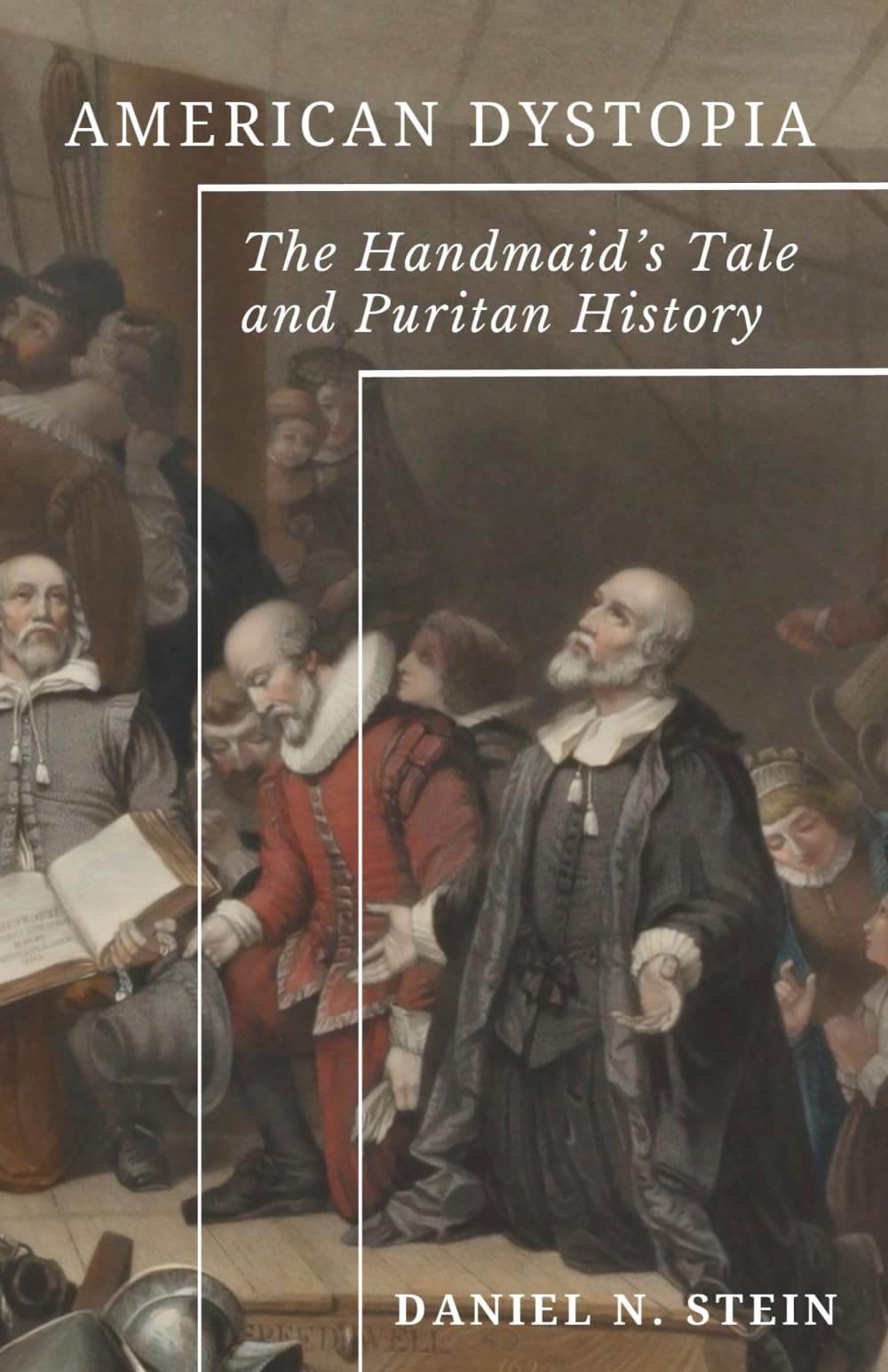



In an era when Americans tend to feel uncomfortable about certain periods of their country’s past, no historical group has suffered a greater hit to its reputation than the Puritan colonists who founded New England. Primarily remembered for their role in the Salem Witch Trials, Puritans have become poster-children for regressive tendencies in American history and culture. This is exemplified by the popularity of The Handmaid’s Tale , a dystopian novel (and now an award-winning TV show) by the Canadian author Margaret Atwood that depicts a potential American future based on its Puritan past. In this world, religious minorities are hunted down, races are segregated, dissident thinkers are monitored and punished by state police, and women are enslaved as “handmaids” to bear children for the ruling class. The Handmaid’s Tale has become a modern classic. It is now read alongside or has completely displaced earlier dystopias like 1984 and Brave New World in high school and college classrooms across the country. With every new abortion law, women in handmaid outfits emerge at protests, waving signs like “Make Margaret Atwood Fiction Again.” At a time when historical knowledge is low, politicized, and not always valued, we should reflect that there might be some history worth knowing—particularly about our own past. The Handmaid’s Tale is being taught as a realistic depiction of America’s past and its potential future to students who, in most cases, have not been given the foundation to evaluate its claims, and who have been conditioned to accept them uncritically. American Dystopia is the first comprehensive, critical analysis of The Handmaid’s Tale . Daniel Stein shows how every facet of Atwood’s world would be considered blasphemy for actual Puritans. He demonstrates how the Puritans, so important to America’s foundation, could never inspire such a society. Far from holding back progress, much of what thinkers like Atwood appreciate about America today is a secularized form of Puritan philosophy. Stein concludes that the Puritan legacy should be celebrated and appreciated as an advance for freedom, not a precedent for tyranny. The time has come for a reevaluation of the Puritans and their legacy for modern America. Taking the world of The Handmaid’s Tale as its point of reference, American Dystopia describes how the actual Puritans bore little resemblance to their characterization in this book and in contemporary popular culture. Far from representing a backwards and embarrassing historical anomaly that would be better forgotten, Puritans were ahead of their contemporaries in all of the areas referenced by Atwood, including women’s rights, racial tolerance, democratic government, and religious freedom. In laying the foundations for later American values, Puritans differentiated America from Old World societies in a positive way. By recovering the Puritans’ legacy, this book offers a defense of American origins. Daniel Stein is a former student at the University of Pennsylvania and The University of Alabama. He has a background in both science and historical research. His writing describes how lessons from history, religion, and human nature can be applied to the world today. He has authored several scholarly articles in undergraduate journals, including “Heinrich Schliemann: Maker of History,” “Athens and its Allies,” and “Plague, Climate Change, and the End of Ancient Civilizations." He also has scientific publications.