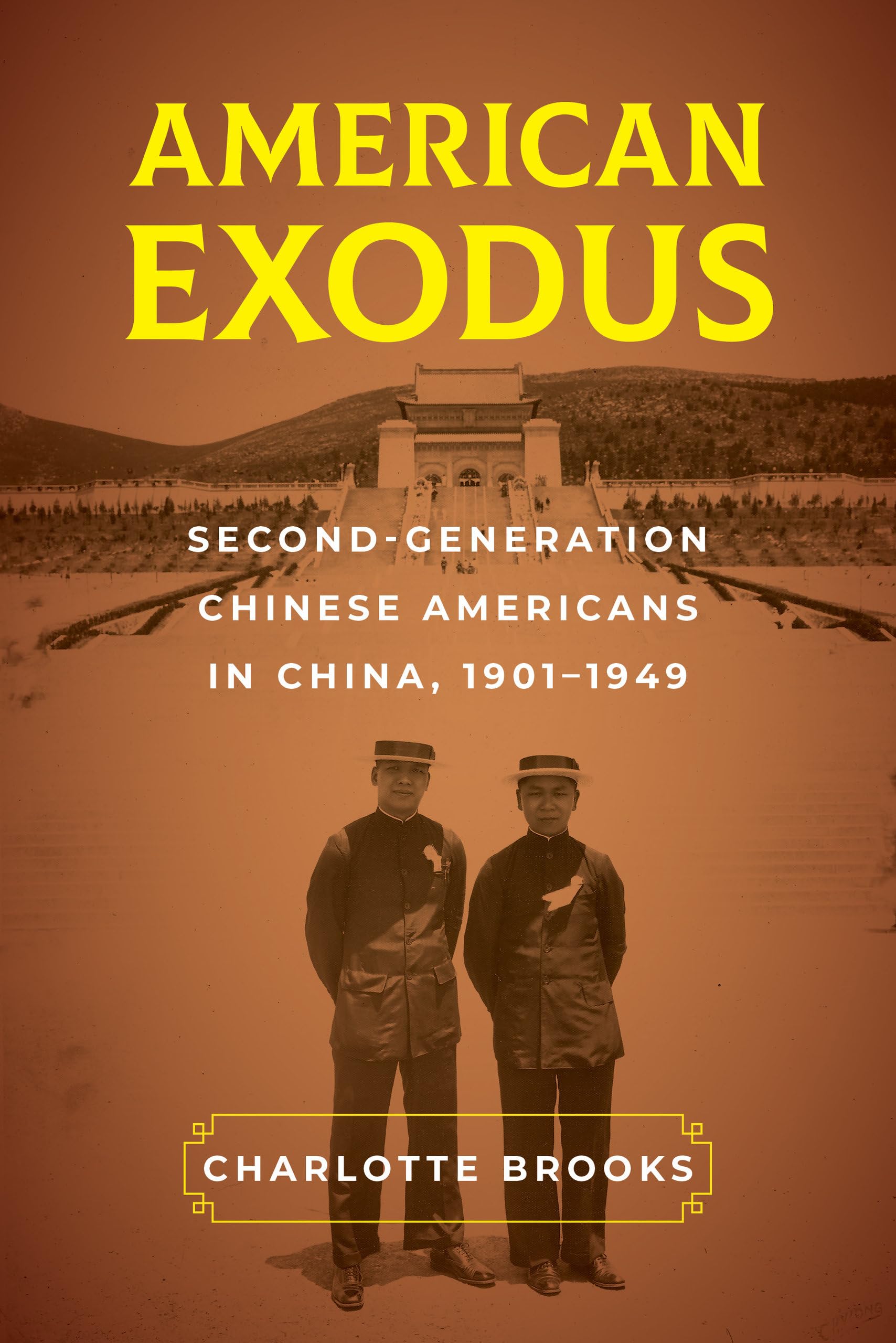
American Exodus: Second-Generation Chinese Americans in China, 1901–1949
$29.95
by Charlotte Brooks



In the first decades of the 20th century, almost half of the Chinese Americans born in the United States moved to China—a relocation they assumed would be permanent. At a time when people from around the world flocked to the United States, this little-noticed emigration belied America’s image as a magnet for immigrants and a land of upward mobility for all. Fleeing racism, Chinese Americans who sought greater opportunities saw China, a tottering empire and then a struggling republic, as their promised land. American Exodus is the first book to explore this extraordinary migration of Chinese Americans. Their exodus shaped Sino-American relations, the development of key economic sectors in China, the character of social life in its coastal cities, debates about the meaning of culture and “modernity” there, and the U.S. government’s approach to citizenship and expatriation in the interwar years. Spanning multiple fields, exploring numerous cities, and crisscrossing the Pacific Ocean, this book will appeal to anyone interested in Chinese history, international relations, immigration history, and Asian American studies. "In this startling new study Charlotte Brooks upends the standard narrative of eager immigrants clamoring to enter America by focusing on US-born Chinese American citizens. Facing racism and closed doors at home, a strikingly large number&;especially college educated&;chose instead to leave America and seek their fortune in Republican-era China."&;Parks M. Coble, author of China&;s War Reporters: The Legacy of Resistance against Japan "The stories of numerous forgotten Chinese Americans, skillfully woven together, shed new light on US-China relations and reveal neglected aspects of modern Chinese history. Highlighting the long-term consequences of continual migration beyond the first generation, Brooks makes a crucial contribution to migration studies."&;Elizabeth Sinn, author of Pacific Crossing: California Gold, Chinese Migration, and the Making of Hong Kong "In this startling new study Charlotte Brooks upends the standard narrative of eager immigrants clamoring to enter America by focusing on US-born Chinese American citizens. Facing racism and closed doors at home, a strikingly large number—especially college educated—chose instead to leave America and seek their fortune in Republican-era China."—Parks M. Coble, author of China’s War Reporters: The Legacy of Resistance against Japan "The stories of numerous forgotten Chinese Americans, skillfully woven together, shed new light on US-China relations and reveal neglected aspects of modern Chinese history. Highlighting the long-term consequences of continual migration beyond the first generation, Brooks makes a crucial contribution to migration studies."—Elizabeth Sinn, author of Pacific Crossing: California Gold, Chinese Migration, and the Making of Hong Kong Charlotte Brooks is Professor of History at Baruch College, CUNY. She is the author of Between Mao and McCarthy: Chinese American Politics in the Cold War Years and Alien Neighbors, Foreign Friends: Asian Americans, Housing, and the Transformation of Urban California . American Exodus Second-Generation Chinese Americans in China 1901–1949 By Charlotte Brooks UNIVERSITY OF CALIFORNIA PRESS Copyright © 2019 Charlotte Brooks All rights reserved. ISBN: 978-0-520-30268-6 Contents Illustrations, Acknowledgments, Note on Sources, Names, Data, and Translations, Introduction, 1. New Lives in the South: Chinese American Merchant and Student Immigrants, 2. The Modernizers: US-Educated Chinese Americans in China, 3. The Golden Age Ends: Chinese Americans and the Rise of Anti-imperialist Nationalism, 4. The Nanjing Decade: Chinese American Immigrants and the Nationalist Regime, 5. Agonizing Choices: The War against Japan, 1937–1945, Conclusion, Epilogue, Notes Abbreviations, Notes, Bibliography, Index, CHAPTER 1 New Lives in the South Chinese American Merchant and Student Immigrants Ng Ah Tye was born in Portland, Oregon, in 1871, just as the anti-Chinese movement began to catch fire across the Pacific Coast. Entrepreneurial from a young age, he opened the "Japanese Bazaar" in central Oregon's Prineville when he was only eighteen. Although the store dealt mostly in dishes and trinkets from China, Ng likely chose its name both because of a contemporary vogue for Japanese product stores and because of the anti-Chinese fervor still powerful in the West. The business proved successful enough to enable Ng to marry San Francisco native Lee Ting in 1895, but six years and three children later, a rising anti-Japanese movement with roots in the old anti-Chinese campaigns threatened the family's prosperity. In 1901 the "Tyes," as they called themselves, boarded a ship for Hong Kong, where "N. A. Tye" built a successful confectionary importing business using his American knowledge and his Chinese connections. Except for a few visits, he a