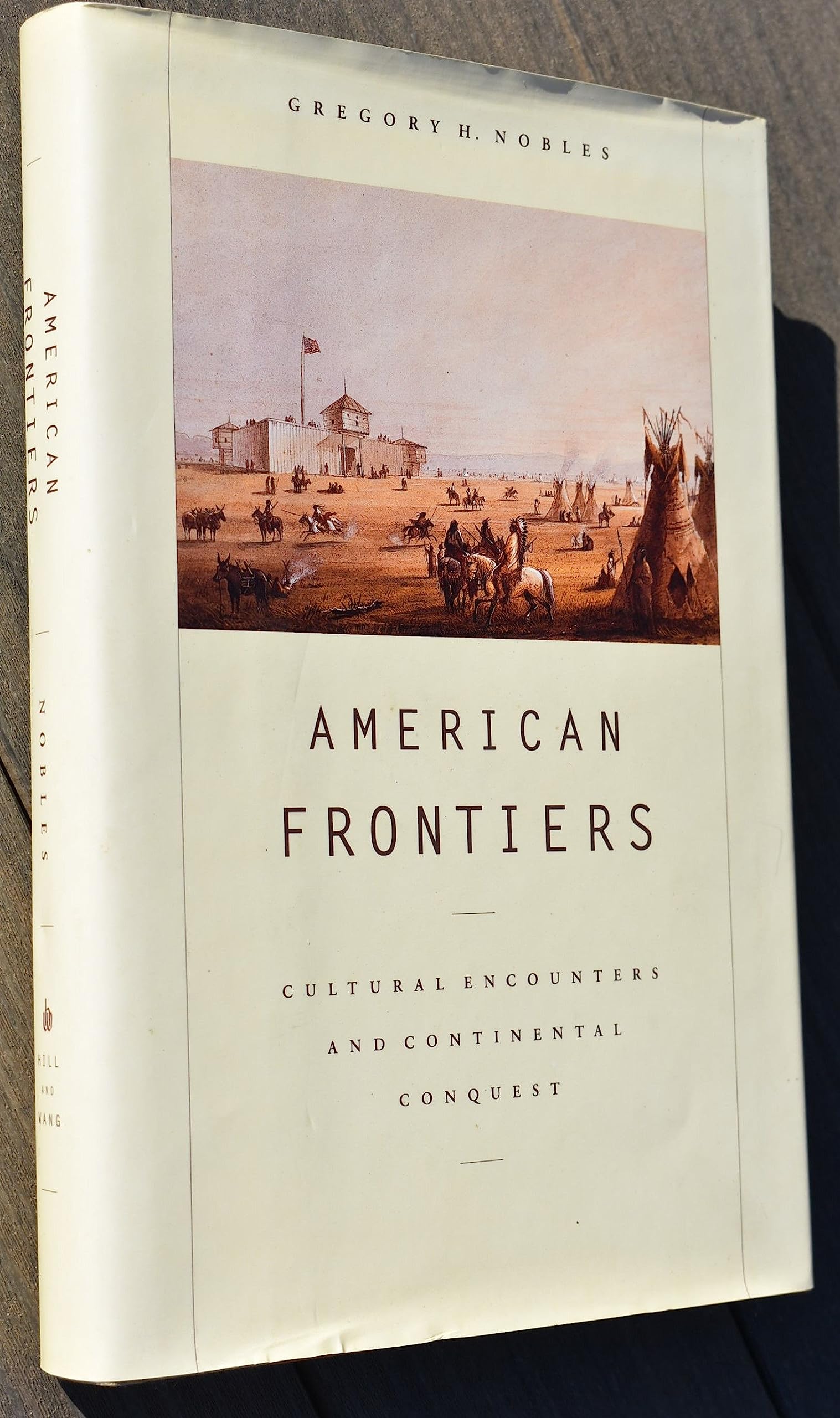
American Frontiers: Cultural Encounters and Continental Conquest
$19.95
by Gregory H. Nobles



Nobles (history, Georgia Institute of Technology) examines patterns of contact and conquest in the America's frontiers over the course of four centuries, examining the diverse and complex interactions between the native Americans and white settlers, the policies of national expansion and development pursued by American leaders beginning with Washington and Jefferson, and popular cultural ideas about the frontier. Annotation c. by Book News, Inc., Portland, Or. Gregory H. Nobles pulls together the work of many recent historians of the American West in this sensitive and synthesizing study of frontier history in North America. Using the frontier as both a spatial and phenomenological metaphor for the experience of Western expansion, Nobles considers the historical facts of frontier encounters and the frontier as cultural interchange between diverse people. Nobles's narrative begins and ends with the tragic story of the Pequots, from Captain John Mason's cowardly raid on a Pequot camp in 1637 that left more than 300 sleeping Pequots dead to Donald Trump's 1990s lawsuit attempting to deprive the tribe of their gambling license. In the pages of American Frontiers readers will also find details of the French and Indian War, Iroquois involvement in the American Revolution, the California gold rush, Texas independence, the tragedy of Wounded Knee, the resistance of Sitting Bull, and the Ghost Dance movement. Nobles's book is a good starting point for readers interested in the American West. His bibliographic essay alone, which provides a generous and thorough account of literature on the subject, makes this a useful reference even for accomplished students of the frontier. Collision is the best word to describe the way European explorers, American frontiersmen and entrepreneurs, and the U.S. military encountered the cultures of Native Americans from 1630 to 1890. In an engaging synthesis, historian and administrator Nobles (Georgia Tech.) relates American frontier expansion to the gradual but certain diminution of American Indian culture. He also reminds us that rather significant Indian civilizations were not necessarily as "savage" as portrayed in films and popular history. Much of the synthesis emanates from Nobles's use of previous research, beginning with Frederick Jackson Turner's 1893 essay on the frontier in American history. The author examines Colonial expansion, the often heated debate on the extension of slavery in the old Northwest, the Louisiana Territory, and the West and territorial disputes over Texas and Oregon. His contribution centers on intercultural collision and its impact on the extending American frontier. Scholarly yet aimed at a wider audience, this brief monograph is recommended for all academic and larger public libraries.?Boyd Childress, Auburn Univ. Lib., Ala. Copyright 1997 Reed Business Information, Inc. In 1893, Frederick Jackson Turner published his seminal "Frontier Thesis," celebrating the role of the frontier in the development of the American democratic character. Of course, the Turner thesis was never universally embraced in scholarly circles. In recent years, so-called revisionist historians have virtually discarded Turner's views in analyzing westward expansion. Nobles' survey of American continental expansion is in the revisionist mode, but it is balanced, beautifully written, and provocative. Where Turner saw the frontier as a line between "civilization and savagery," Nobles describes frontier areas as "zones of contact" between diverse Indian populations and surprisingly diverse European and American groups. Although conflict between those groups was inevitable, Nobles illustrates how frequently groups cooperated in a pattern of constantly shifting alliances. The injustice of Indian displacement is given ample coverage; yet Nobles avoids the trap of sentimentalizing their cultures, and he doesn't sugarcoat examples of Indian brutality and aggressiveness. This work is a very valuable contribution to the evolving conception of American continental growth. Jay Freeman . . . frontier history has broken free of the ethnocentric mindsets of founding figures like Frederick Jackson Turner and Ray Allen Billington . The measure of its liberation is that it now has its new canon nailed into place. . . . Readable and succinct, this book might well be the most workable place to begin, for readers who have sat out the more energetic and agitated exchanges in the field of Western and frontier history. . . . Readers who will ask their own questions and offer their own challenges will find many thought-provoking mysteries hidden just below the surface of the text. -- The New York Times Book Review, Patricia Nelson Limerick Used Book in Good Condition