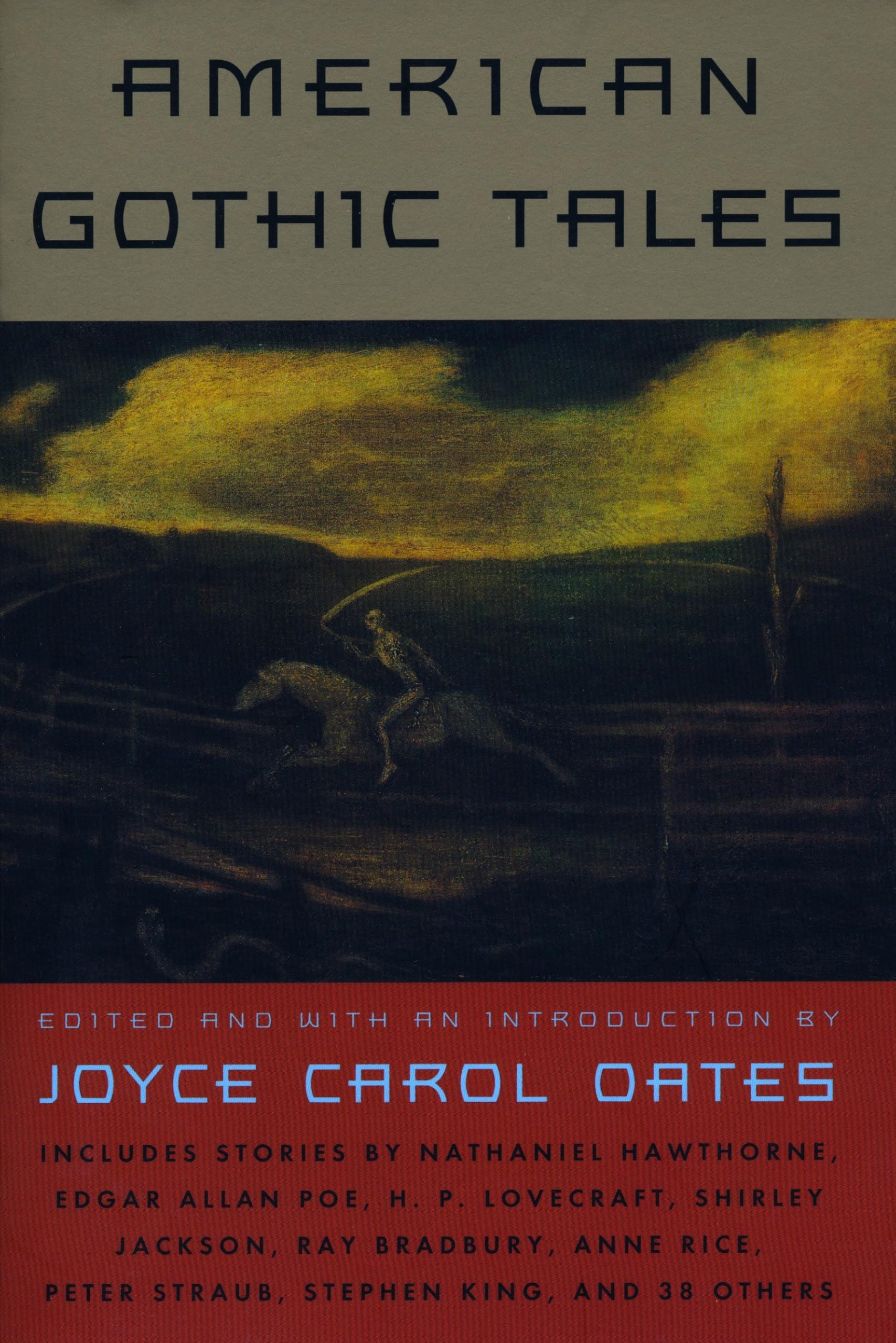



This remarkable anthology of gothic fiction, spanning two centuries of American writing, gives us an intriguing and entertaining look at how the gothic imagination makes for great literature in the works of forty-six exceptional writers. Joyce Carol Oates has a special perspective on the “gothic” in American short fiction, at least partially because her own horror yarns rank on the spine-tingling chart with the masters. She is able to see the unbroken link of the macabre that ties Edgar Allan Poe to Anne Rice and to recognize the dark psychological bonds between Henry James and Stephen King. In showing us the gothic vision—a world askew where mankind’s forbidden impulses are set free from the repressions of the psyche, and nature turns malevolent and lawless—Joyce Carol Oates includes Henry James’s “The Romance of Certain Old Clothes,” Herman Melville’s horrific tale of factory women, “The Tartarus of Maids,” and Edith Wharton’s “Afterward,” which are rarely collected and appear together here for the first time. Added to these stories of the past are new ones that explore the wounded worlds of Stephen King, Anne Rice, Peter Straub, Raymond Carver, and more than twenty other wonderful contemporary writers. This impressive collection reveals the astonishing scope of the gothic writer’s subject matter, style, and incomparable genius for manipulating our emotions and penetrating our dreams. With Joyce Carol Oates’s superb introduction, American Gothic Tales is destined to become the standard one-volume edition of the genre that American writers, if they didn’t create it outright, have brought to its chilling zenith. "Many of the writers in this volume are not 'gothic' writers but simply--writers. Their inclusion here is meant to suggest the richness and magnitude of the gothic-grotesque vision and the inadequacy of genre labels if by 'genre' is meant mere formula." So writes Joyce Carol Oates in a historical introduction to this anthology of 46 tales--tales that span a range from the Puritan paranoia of Charles Brockden Brown (1798) to the biological surrealism of Nicholson Baker (1994). Some critics have written that the gothic sensibility has no relevance in contemporary literature: by showing how gothic tales portray the all-too-current phenomenon of "assaults on individual identity and autonomy," Oates proves them wrong. I predict this will in time be considered a classic and influential anthology. A thoughtful and compelling collection of dark fiction that ranges from the beginnings of American literature to its most modern practitioners, American Gothic Tales is quite possibly one of the finest anthologies of its kind. The early writers (Irving, Hawthorne, Melville, Poe, Bierce, Charlotte Perkins Gilman, and Henry James) give a particularly New England point of view, while later writers (Ray Bradbury, Isaac Bashevis Singer, Harlan Ellison, and Anne Rice) fill out more of the American literary landscape. The time line of the book parallels the timeline of America, from the colonies to the Westward expansion and on. Besides great stories from acclaimed authors (Stephen King, H.P. Lovecraft, E.L. Doctorow, William Faulkner, Sylvia Plath, Shirley Jackson, and editor Oates herself), outstanding pieces from lesser-known writers are also included, e.g., John Crowley's lyrical and poignant "Snow" and Nancy Etchemendy's taut thriller "Cat in Glass." This diverse collection is truly a "greatest hits" of the horror/fantasy genre and essential for every fiction section. Order one for yourself, too. Ali Lemer, New York Copyright 1996 Reed Business Information, Inc. A generous anthology of 46 stories, written between the late- 18th century and the present, representing the genre characterized by editor Oates (in her Introduction) as ``the surreal, raised to the level of poetry.'' Inevitably, perhaps, the contents include several warhorses (such as Washington Irving's ``The Legend of Sleepy Hollow'' and William Faulkner's ``A Rose for Emily''), thoroughly dispensable excerpts from novels by Charles Brockden Brown and Anne Rice, and a few clunkers (Gertrude Atherton's pretentious ``The Striding Place,'' John L'Heureux's nauseating ``The Anatomy of Desire''). But elsewhere Oates has chosen wisely and well: Several genuinely interesting and relatively unfamiliar modern stories (by John Crowley, Paul Bowles, Melissa Pritchard, and Steven Millhauser, among others); one of Shirley Jackson's finest (``The Lovely House''); and a nasty little shocker by Raymond Carver (``Little Things''). On balance, an entertaining and welcome collection, one of the more pleasing products of Oates's ceaseless energies. -- Copyright ©1996, Kirkus Associates, LP. All rights reserved. “In compiling 40 short stories that represent the 200-year history of ‘gothic’ fiction in America, from Washington Irving's classic The Legend of Sleepy Hollow to Stephen King's The Reach , Oates employs an eclectic and elastic definition of the genre… Oat