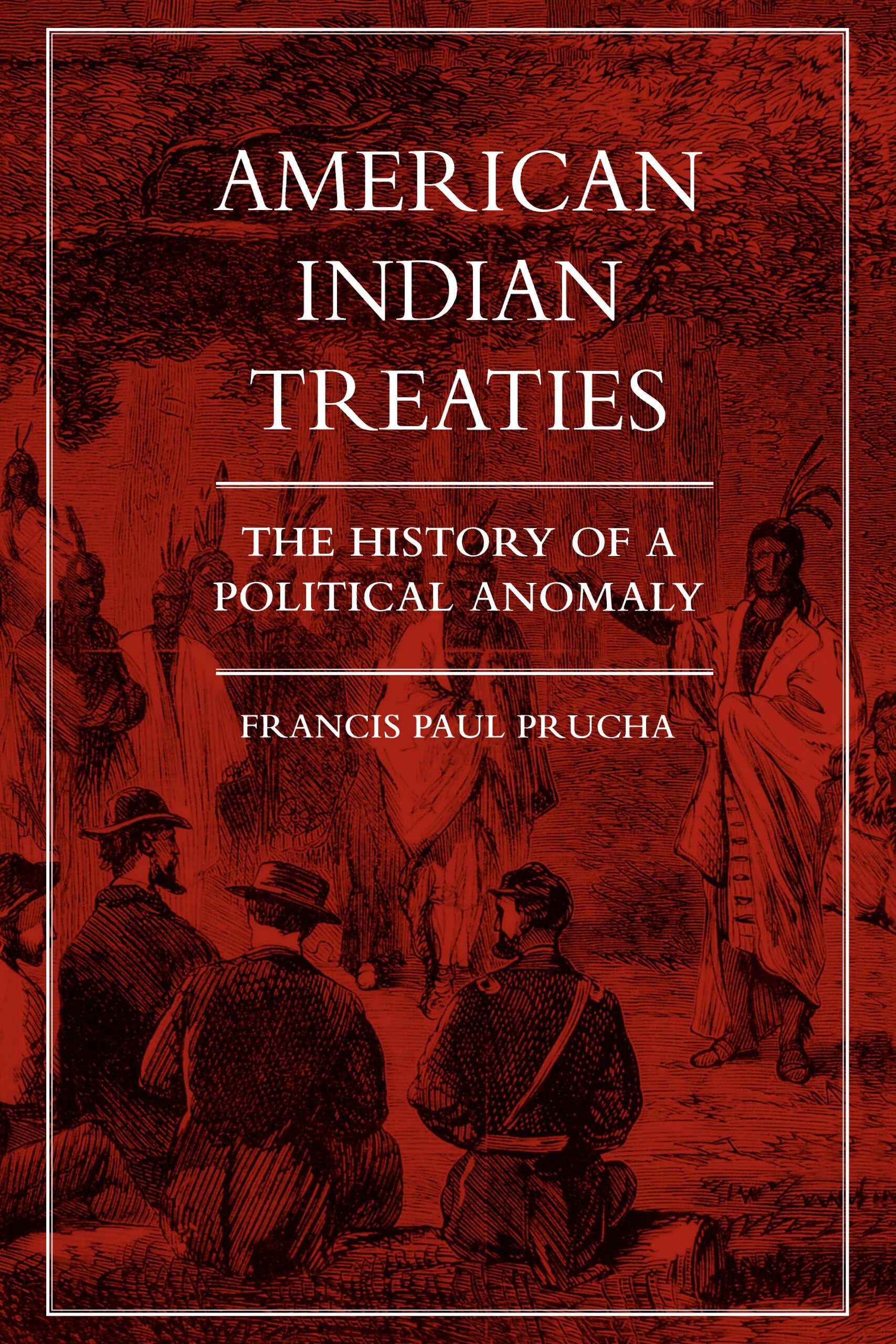



American Indian affairs are much in the public mind today―hotly contested debates over such issues as Indian fishing rights, land claims, and reservation gambling hold our attention. While the unique legal status of American Indians rests on the historical treaty relationship between Indian tribes and the federal government, until now there has been no comprehensive history of these treaties and their role in American life. Francis Paul Prucha, a leading authority on the history of American Indian affairs, argues that the treaties were a political anomaly from the very beginning. The term "treaty" implies a contract between sovereign independent nations, yet Indians were always in a position of inequality and dependence as negotiators, a fact that complicates their current attempts to regain their rights and tribal sovereignty. Prucha's impeccably researched book, based on a close analysis of every treaty, makes possible a thorough understanding of a legal dilemma whose legacy is so palpably felt today. "For anyone investigating federal Indian policy, this will be an indispensable work. . . . as with any sound historical work, even those who disagree can richly draw on the research. In doing so, they will be aided by a wonderful, old-fashioned innovation that makes the book a joy to engage: footnotes at the bottom of the page. . . . the 130 pages of appendices and notes on sources alone are worth the price." ― American Historical Review "This is a big book, an important book, sweeping in conception and content. . . . Like Prucha's other works, American Indian Treaties is meticulously researched, well written, and essential reading. It is by intent policy- rather than Indian-centered history." ― Journal of American History "This book should be required reading by people who are interested in federal Indian law . . . Prucha's book is as good a guide as this generation will get. Let us hope that it sparks some enthusiasm for scholarship among Indians." ― American Indian Quarterly "This book will be a standard reference work for the entire profession. . . . an admirable research tool." ― Western Historical Quarterly "Sources for the study of American Indian treaties will be of great interest to future scholars who pursue this subject. The book will be a valuable reference work for every archive and every college and university library." ― Pacific Northwest Quarterly "By the end of the book, the reader will have a much better understanding of how the policies, resources, and sheer brute force of the federal government manifested in treaties with Native Americans played a central part in the history of 'civilizing' the American 'wilderness.'" ― Law and History Review Francis Paul Prucha, S.J. (1921-2015) was Professor Emeritus of History at Marquette University. Among his many books is The Indians in American Society: From the Revolutionary War to the Present . American Indian Treaties: The History of a Political Anomaly By Francis Paul Prucha University of California Press Copyright 1997 Francis Paul Prucha All right reserved. ISBN: 0520208951 Chapter One The Revolutionary War Years During the Revolutionary War, as the Continental Congress groped its way toward a satisfactory procedure for dealing with the Indian tribes within the boundaries of the nation, the United States got its first taste of treaty making with the Indians. The Congress hoped to gain the friendship or at least the neutrality of the tribes in the war with Great Britain, to ease the continuing pressure of white settlement on Indian lands, and withal to maintain a posture of justice and humanity that would win the support and admiration of the whole civilized world. It was not an easy task for the weakly united colonies, which were intent first of all on vindicating by military force the independence from Great Britain that they had so eloquently proclaimed in the Declaration of Independence. The colonies, of course, did not lack precedents on which to base their actions. The Mother Country, against whom they were now rebelling, had dealt with the American Indians for almost two centuries. The two culturesmarked by distinct raceshad worked out patterns of accommodation for coexistence. Colonial governors, assemblies, and other agencies spent a good deal of time on problems concerning the struggle for control of America's lands. The Indians, on their side, followed diplomatic and economic interests of their own and were not merely passive recipients of European initiatives. Out of the joint concerns, as a means of diplomatic engagement, came numerous treaties and treaty councils.1 The Role of Indian Treaties Confusion about the initial dealings of the Congress with the Indians arises from reading back into the past our modern understandings of the word t