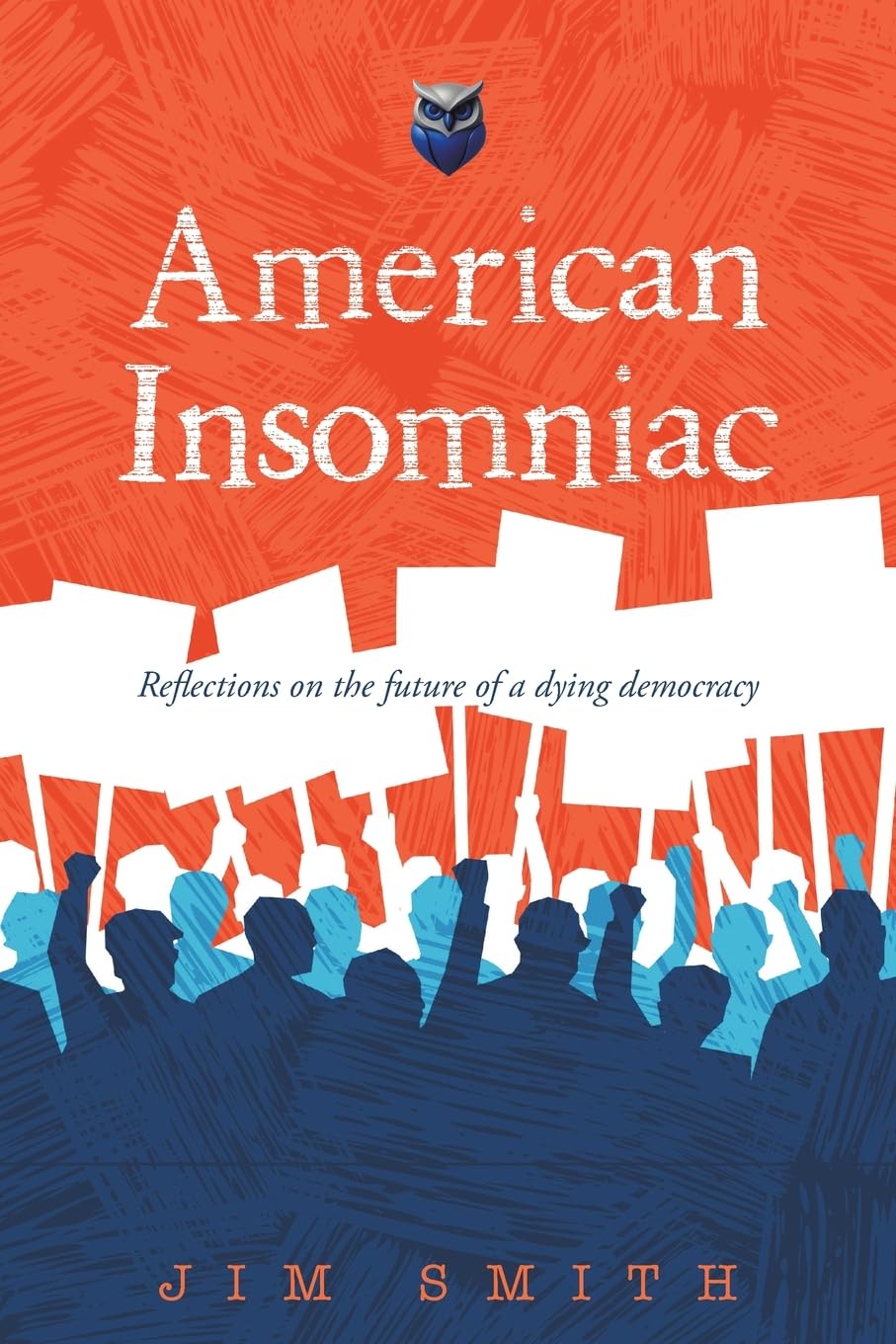



American Insomniac: Reflections on the future of a dying democracy is a compilation of academic articles, blog pieces, other writings, and op-eds written during the first years of the twenty-first century about current political, economic, cultural, and social events which are shaping our reality. The author, Jim Smith, has a unique perspective stemming from his childhood experiences of growing up on the carnival, living in a rural area, experiencing poverty and homelessness, and then radicalization through the anti-war and civil rights movements of the 1960’s and 1970’s. The writings are about the great challenges facing the future of democracy, the struggle for equality and equity, and will, hopefully, add to a civil discourse on the solutions to the social, economic, and cultural problems that are interwoven within the times we live in. These issues and concerns have kept thinking people awake at night trying to figure out how we got here, how to reach a consensus for solutions for the common good, and how to protect the gains made in the prior century from the forces at work to deconstruct and destroy them currently. Hence the title, American Insomniac. The problems and challenges are complex. The forces at work on all sides are equally complex, with intentions that are both noble and immoral. No perspective is purely evil or purely altruistic. But there is still truth, facts, and progress to oppose lies, fiction, and barbarism. This is one person’s attempt to add to this conversation. "American Insomniac is a restless, wide-ranging collection of essays, op-eds, and personal reflections that circles around one big worry. American democracy feels like it is slipping away. Author Jim Smith moves through three big territories. First, he pulls apart the health of democracy and freedom in the United States and ties it to capitalism, inequality, and political polarization. Then he turns to culture, from a gripping story about Argentina's "Dirty War" to feminism, consciousness, and the way modern life sells us "experiences" as products. Finally, he dives into explicitly philosophical explorations of thinkers like Vine Deloria, Lukacs, and Gregory Bateson and uses them to ask what a more humane, sane society might look like. All of it sits inside one frame. An insomniac citizen who lies awake at three in the morning, trying to make sense of a country that feels both familiar and broken. The opening autobiography of carnival life instantly hooked me. The details about flat stores, grab joints, rock o planes, and a childhood spent as "other" among carnies and then "other" again back in a small town, give his later anger and skepticism real roots. That early outsider lens never really leaves the page, and I found myself trusting him more because of it. When he goes after Congress, the Supreme Court, Trump, Montana's legislature, or the hollow language of nationalism, it feels less like a partisan rant and more like the long view of someone who has watched the same bad habits play out in different costumes. The tone swings between dry humor, exasperation, and real grief. I caught myself laughing at his jokes about both parties and then, a page later, feeling that heavy, sinking sense that he might be right about how fragile things have become.
Stylistically, the book is a bit of a mixed bag, and I mean that in a good way. Parts of it read like newspaper op eds, quick and punchy, rooted in specific Montana fights and court cases. Other sections feel like seminar papers, thick with references and theory, especially when he gets into consciousness, reification, or Bateson. Those more academic stretches slowed me down, and at times I wished he had trimmed or translated the theory a bit more for general readers. On the other hand, that density also signals how seriously he takes ideas. This is not a collection of hot takes. It is the product of years of teaching, reading, and arguing with the world, and I appreciated that he did not talk down to me. Even when some statistics or political references feel a little dated, the core worries about authoritarian drift, commodified life, and the erosion of public trust still hit hard, maybe even harder now. The book makes a convincing case that "natural stupidity" and bad faith politics are not going anywhere on their own. I was encouraged, though, because Smith never fully gives up on the idea that ordinary people can organize, think clearly, and push back. I would recommend American Insomniac to readers who already pay attention to politics and culture and want something more honest and personal than a standard textbook. It will work especially well for folks who enjoy critical essays, progressive political writing, and memoir woven together and who do not mind doing a bit of intellectual heavy lifting in return for an honest, insomniac tour of a "dying democracy" that is still fighting to stay alive. Rating: 5 STARS"
Stylistically, the book is a bit of a mixed bag, and I mean that in a good way. Parts of it read like newspaper op eds, quick and punchy, rooted in specific Montana fights and court cases. Other sections feel like seminar papers, thick with references and theory, especially when he gets into consciousness, reification, or Bateson. Those more academic stretches slowed me down, and at times I wished he had trimmed or translated the theory a bit more for general readers. On the other hand, that density also signals how seriously he takes ideas. This is not a collection of hot takes. It is the product of years of teaching, reading, and arguing with the world, and I appreciated that he did not talk down to me. Even when some statistics or political references feel a little dated, the core worries about authoritarian drift, commodified life, and the erosion of public trust still hit hard, maybe even harder now. The book makes a convincing case that "natural stupidity" and bad faith politics are not going anywhere on their own. I was encouraged, though, because Smith never fully gives up on the idea that ordinary people can organize, think clearly, and push back. I would recommend American Insomniac to readers who already pay attention to politics and culture and want something more honest and personal than a standard textbook. It will work especially well for folks who enjoy critical essays, progressive political writing, and memoir woven together and who do not mind doing a bit of intellectual heavy lifting in return for an honest, insomniac tour of a "dying democracy" that is still fighting to stay alive. Rating: 5 STARS"