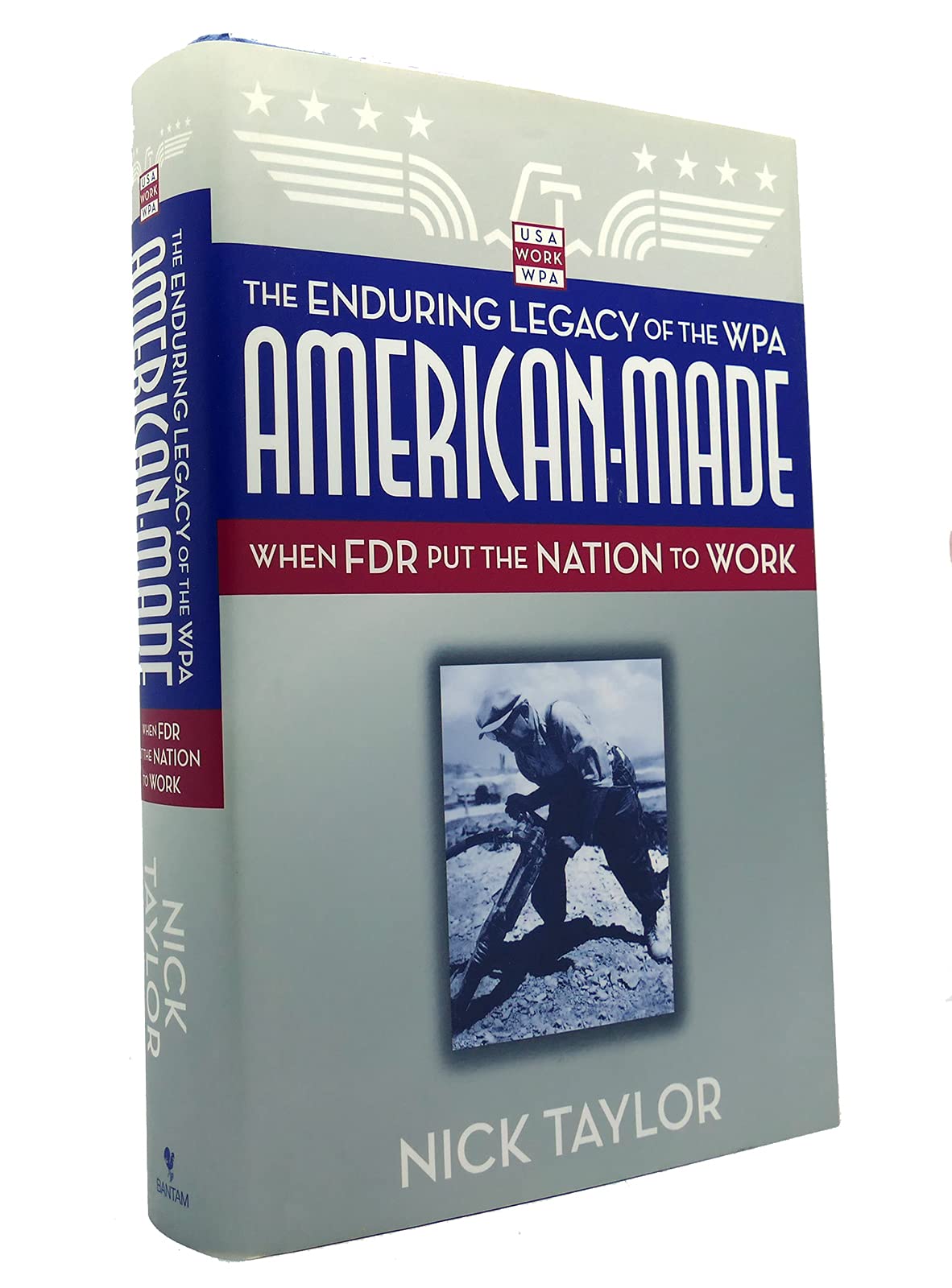
American-Made: The Enduring Legacy of the WPA: When FDR Put the Nation to Work
$16.52
by Nick Taylor



If you’ve traveled the nation’s highways, flown into New York’s LaGuardia Airport, strolled San Antonio’s River Walk, or seen the Pacific Ocean from the Beach Chalet in San Francisco, you have experienced some part of the legacy of the Works Progress Administration (WPA)—one of the enduring cornerstones of Franklin D. Roosevelt’s New Deal. When President Roosevelt took the oath of office in March 1933, he was facing a devastated nation. Four years into the Great Depression, a staggering 13 million American workers were jobless and many millions more of their family members were equally in need. Desperation ruled the land. What people wanted were jobs, not handouts: the pride of earning a paycheck; and in 1935, after a variety of temporary relief measures, a permanent nationwide jobs program was created. This was the Works Progress Administration, and it would forever change the physical landscape and the social policies of the United States. The WPA lasted for eight years, spent $11 billion, employed 8½ million men and women, and gave the country not only a renewed spirit but a fresh face. Under its colorful head, Harry Hopkins, the agency’s remarkable accomplishment was to combine the urgency of putting people back to work with its vision of physically rebuilding America. Its workers laid roads, erected dams, bridges, tunnels, and airports. They stocked rivers, made toys, sewed clothes, served millions of hot school lunches. When disasters struck, they were there by the thousands to rescue the stranded. And all across the country the WPA’s arts programs performed concerts, staged plays, painted murals, delighted children with circuses, created invaluable guidebooks. Even today, more than sixty years after the WPA ceased to exist, there is almost no area in America that does not bear some visible mark of its presence. Politically controversial, the WPA was staffed by passionate believers and hated by conservatives; its critics called its projects make-work and wags said it stood for We Piddle Around. The contrary was true. We have only to look about us today to discover its lasting presence. When Franklin Roosevelt assumed the presidency in March 1933, the rate of unemployment was approximately 25 percent. Staples of today’s government support system for the needy, such as unemployment compensation and food stamps, did not exist. Roosevelt had not campaigned as a big government “liberal,” but he and his brain trust felt compelled to do something and do it fast. One of the cornerstones of the New Deal was the WPA, or Works Progress Administration. It was a controversial program. Conservative economists and politicians viewed it as an unwarranted and wasteful intrusion of government into the economy But as Taylor illustrates in this comprehensive analysis of the program, the short-term results, over the eight-year life of the program, were enormous. Dams, roads, and bridges were built; on a smaller scale, WPA workers painted murals, served hot meals to the indigent, and even repaired toys. Perhaps more important, hope was provided for the hopeless. Taylor has written a passionate defense of a program that millions saw as a godsend. --Jay Freeman “A must-read for history buffs and government wonks.... Taylor is at his best in describing the different projects and the lives of the people who worked on them. “— USA Today “Brisk…. Taylor's American-Made is bigger than its title suggests; he provides a succinct survey of the Great Depression and particularly its consequences for workers…. he interweaves personal stories with explanations of policy.”— Washington Post Book World “Vividly rendered—a near-definitive account of one of the most massive government interventions into domestic affairs on American history…. The book is filled with plucky, fast-talking characters who by dint of charm and grit pulled themselves up by their bootstraps to participate.”— Kirkus Reviews , starred review “Eloquent and balanced…. A splendid appreciation of the WPA.”— Publishers Weekly , starred review “A paean to the WPA ... balanced and engaging.”— Boston Globe "An immensely detailed book telling the epic story of an equally immense agency, American-Made does an incomparable job of chronicling an important chapter in American history, one which many of us only know from the classroom and some of us know all too well."— New Hampshire Business Review “A quick read … engagingly written…. There is something here for everyone to learn.”— San Francisco Chronicle "Well-written and helpfully structured.... Taylor intersperses individual stories to give body to stark statisticsan admiring, as well as admirable, history of FDR's main job-creation program."— Chicago Sun-Times "A lively 'people's history' of the WPA."— Pittsburgh Post-Gazette “Vastly informative, popular history at its finest…. A straightforward, relentlessly chronological, clearly written account.”— Dallas Morning News "Chock-full of facts.... T