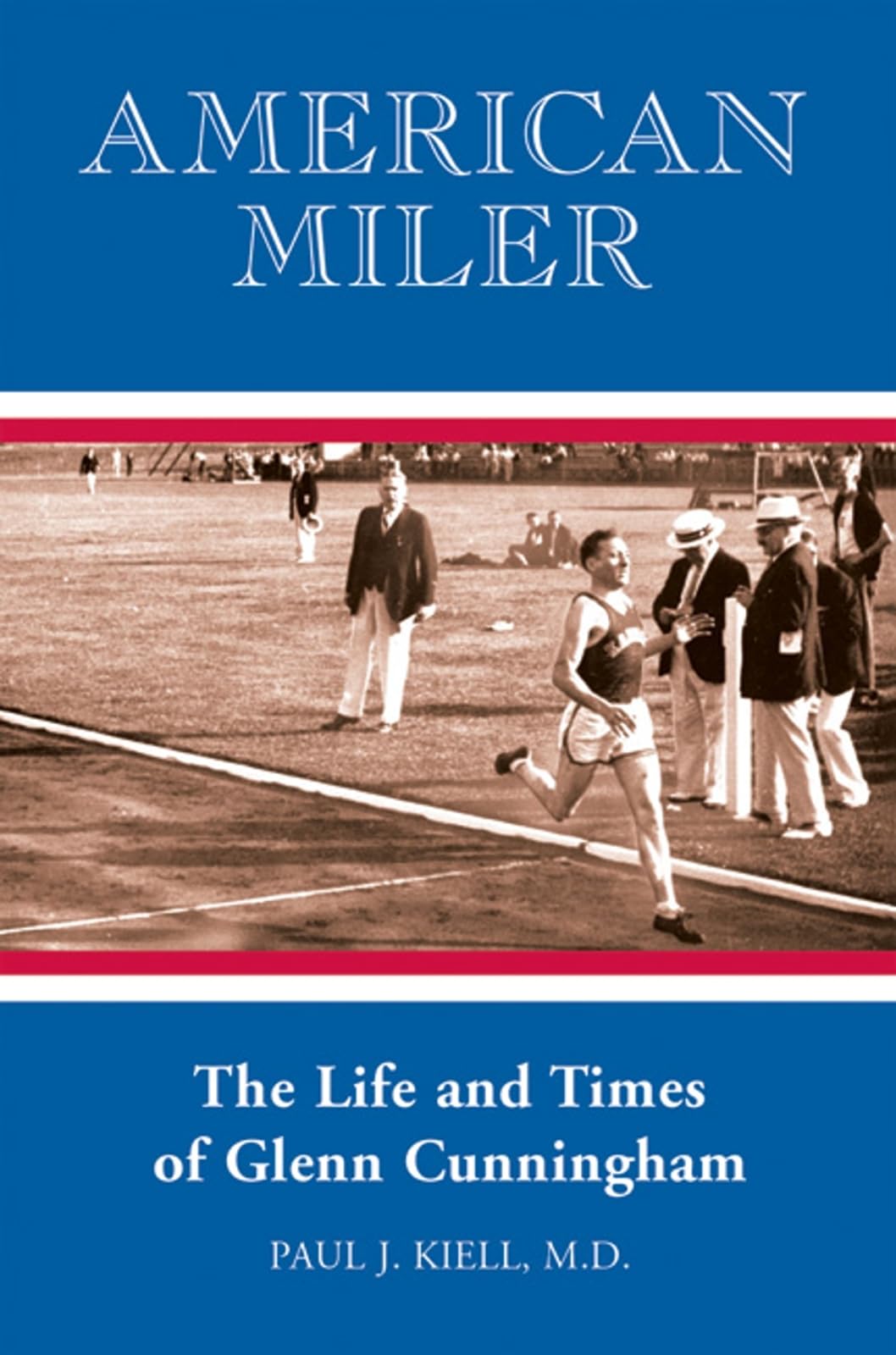



Glenn Cunningham nearly died in a schoolhouse fire that claimed his brother’s life and left the seven-year-old’s legs so badly burned his doctor wanted to amputate them. But Cunningham endured the incredible pain and horrible scars; after nearly a year he learned to walk again. He went on to become one of the greatest track stars of all time, and a national hero. “The Kansas Flyer” set world records in the mile in 1934 and 800m in 1936. A comprehensive biography, with extraordinary depth of detail, fascinating anecdotes, and written with full cooperation and archives from his widow. "American Miler inspires while capturing the power of the human spirit! " -- Trisha Meili, author, I Am the Central Park Jogger: A Story of Hope and Possibility "Dr. Kiell has written the definitive biography of a giant figure in American sport." -- Robert J. Corrigan, author, Tracking Heroes: 13 Track & Field Champions "Enables the reader to appreciate the exploits and character of this great American hero Cunningham the athlete and Cunningham the man." -- Howard Schmertz, Millrose Games Meet Director Emeritus "Glenn's life is an inspiration to anyone with the will to succeed in the face of overwhelming odds." -- Richard Traum, Ph.D., Founder and CEO, Achilles Track Club "I feel again the ache of muscle, the sear of lung, the sting of cinders as we stride. " -- Paul Borel, former classmate and teammate of Glenn Cunningham Paul J. Kiell is a psychiatrist, a former editor of the American Athletic Association Quarterly, a runner and a swimmer. His work has been published in Running Times and Runner's World. --PROLOGUE-- FOND MEMORIES OF A GREAT MILER Such was the headline for a letter-to-the-editor published in the New York Times shortly after Glenn Cunningham s death on March 10, 1988. Here is what Bob Corrigan wrote: With the death of Glenn Cunningham on March 10, America lost one of its authentic sports heroes. I am too young to have seen him compete in his heyday, but as a boy I heard the remarkable story of the athlete who overcame severe burns on his legs to become the greatest miler in the world. Cunningham s duels with rivals Bill Bonthron and Gene Venzke in the 1930 s made the mile track s glamour event. In recent years I learned about Cunningham s devotion to helping troubled children. For most of his adult life, he and his wife guided thousands of abandoned, abused, and delinquent boys and girls to productive lives. Less than two weeks before his death, I had the opportunity to meet Cunningham, who told me his work with young people had given him far more satisfaction than his athletic achievements. I ll never forget his words: "There is nothing as important as a child." Those of us parents, youth workers, teachers, and others who agree with him can only hope in this era of artificial sports heroes that the Glenn Cunningham story will not be forgotten. Robert J. Corrigan, Jackson Heights, Queens In the nearly two decades since that letter, the mile is still pretty much track s glamour event, while track itself has assumed a less glamorous pose. Bob Corrigan and I met and became friends. A video about Cunningham entitled The Iron Man of Kansas, by a now defunct producer, was made. Bob wrote a book titled Tracking Heroes. In it he chronicled the lives of thirteen trackmen of the past, among them Glenn Cunningham. Glenn s widow, Ruth, became a dear friend of our family. But still, the story of Glenn Cunningham lies fallow, virtually forgotten, yet to be truly told. It is, however, a story that must be told, told in terms of his running but only as this was an extension of the man, reflecting the timeless values he lived by. It is a tale not only of his deeds on and off the track, but of an attitude, a philosophy and a prescience that wears well for all times. That he was an authentic sports hero was determined, in part, by the era of the 1930s, the time of the Great Depression. In Cunningham the public found its idol in a man who had been scarred and suffered a loss through trauma, yet whose person literally and figuratively soared above the ashes. He was exemplar of the American Dream. His work with abandoned, abused, and delinquent boys and girls evolved first from his empathy, augmented by his example a product of his character. From his empiric understanding of animals and his education (he had earned a Ph.D. in biology, health, and physical education) he presaged the practice of animal therapy; his intuition, the biblical scholarship upon which his philosophy of life was based, foretold the science of cognitive behavioral psychotherapy. His was a way of life forged in tragedy yet caressed by love of family and friends. Among the basics that his recovery and evolving outlook were founded upon were a joy in physical activity that was reinforced by a love of animals, with whom he learned to play and to communicate. Such was an extension of his love for family and friends, particularly friends and others al