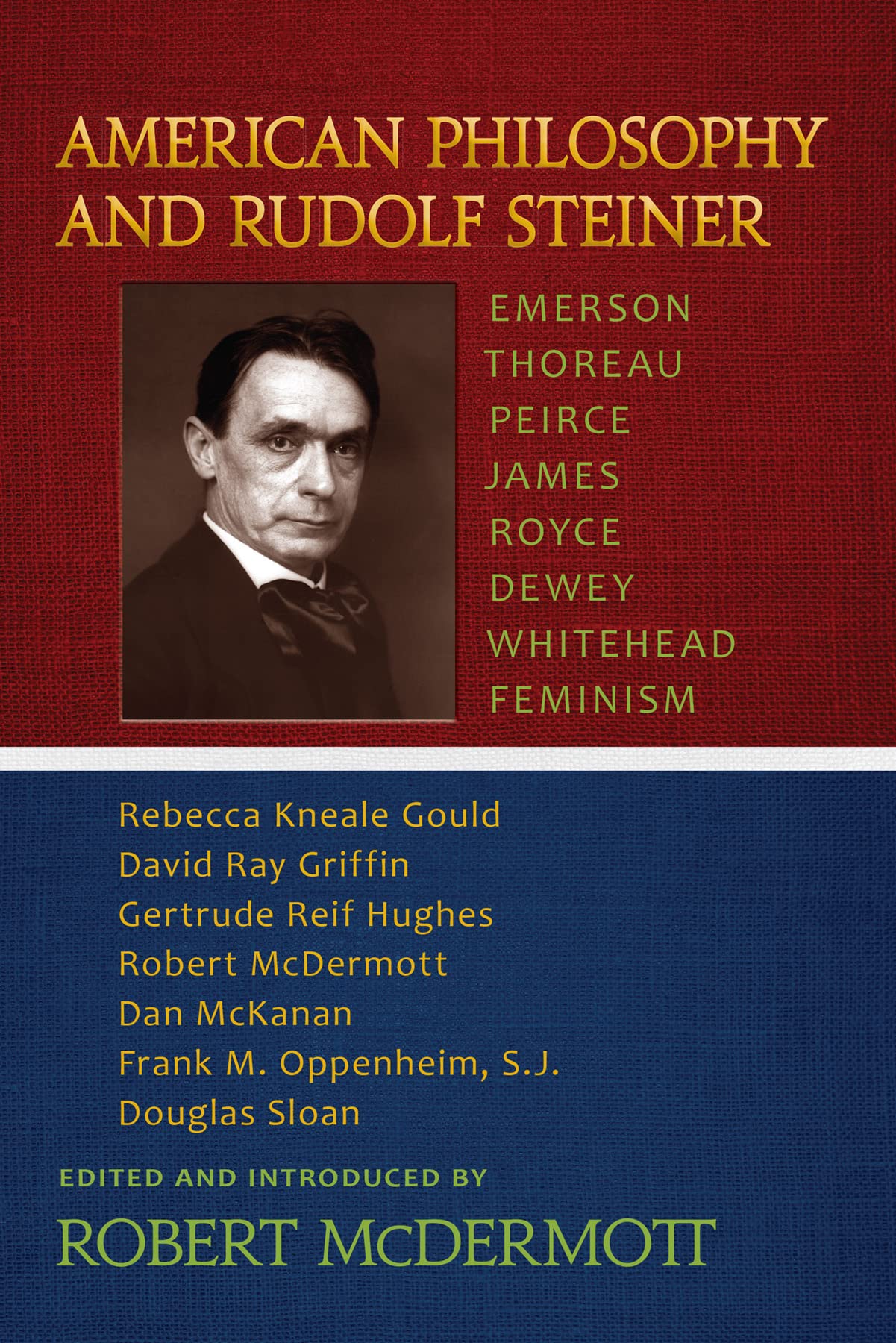
American Philosophy and Rudolf Steiner: Emerson – Thoreau – Peirce – James – Royce – Dewey – Whitehead – Feminism
$33.25
by Robert A. McDermott



“Few thinkers from outside the United States have touched American culture in as many ways as Rudolf Steiner. Agriculture, education, spirituality, and medicine―or more precisely, alternative practices in these fields―all bear clear marks of his influence, for those with eyes to see. Yet the very breadth of Steiner’s impact has perhaps made him harder, not easier, for observers of American culture to notice.” ― Dan McKanan (from the foreword) American Philosophy and Rudolf Steiner aspires to raise Steiner’s profile by digging into just one field of inquiry―philosophy. Before he became known to the world as a transmitter of clairvoyant wisdom, Steiner was an academic philosopher, editor of the scientific writings of Goethe and author of a foundational work in philosophy, The Philosophy of Freedom: The Basis for a Modern Worldview , published in 1894. That book expressed in philosophical terms many of the ideas that would later emerge as integral to the spiritual science of Anthroposophy. Though the authors cover a wide range of topics, most share an elegiac tone. They see great potential for dialogue between Rudolf Steiner and the great American philosophers of the nineteenth and early twentieth centuries. American philosophy may have taken a wrong turn in the mid-twentieth century, when pragmatism gave way to a tradition of analytical philosophy that eschewed metaphysics as inherently meaningless and focused on the coherence or incoherence of linguistic structures. Nonetheless, many new sites of potential dialogue exist between Steiner and American philosophy. Five of the articles in this volume were written as part of a seminar on Rudolf Steiner and American Thought as part of a Project for the Renewal of Philosophy, Science, and Education sponsored by Laurance S. Rockefeller. The contributors―David Ray Griffin, Gertrude Reif Hughes, Frank M. Oppenheim, S. J., Douglas Sloan, and Robert McDermott―were originally published in ReVision: A Journal of Consciousness and Transformation (spring and summer 1991). Few thinkers from outside the United States have touched American culture in as many ways as Rudolf Steiner. Agriculture, education, spirituality, and medicine--or more precisely, alternative practices in these fields--all bear clear marks of his influence, for those with eyes to see. Yet the very breadth of Steiner's impact has perhaps made him harder, not easier, for observers of American culture to notice. The terms Waldorf education and biodynamic agriculture are more widely recognized than Rudolf Steiner himself or Anthroposophy. Anthroposophic initiatives are commonly understood in relation to parallel initiatives with different spiritual roots, rather than in relation to the rich fabric of Steiner's worldview. Americans typically imagine biodynamic agriculture as a more intense form of organics and Waldorf schools as 'like Montessori schools only more so.' When I describe the Camphill movement, most interlocutors respond with 'Is that like the L'arche movement?' And thousands of shoppers at health food cooperatives and Whole Foods supermarkets purchase Weleda skin lotion, diaper cream, or homeopathic remedies with little sense of connection to Steiner's vision of spirit active in the world. --Dan McKanan, Harvard Divinity School (from the foreword) Rebecca Kneale Gould is Associate Professor of Religion and Environmental Studies at Middlebury College in Vermont. Gould’s first book, At Home in Nature: Modern Homesteading and Spiritual Practice in America (University of California, 2005) is an ethnographic and historical study of back-to-the-land experiments based on research she conducted while living and working at the homestead of Helen and Scott Nearing. Gould’s more recent publications (in Jon Isham’s, Ignition; Whitney Bauman’s Grounding Religion; Cecile Andrew’s Less is More; and Tufts University Press/Mildred’s Lane Press, Renovating Walden) reflect two of her current research and writing projects: religiously based environmental action and the impact “time-famine” on physical, spiritual, and ecological wellbeing. Gould is the co-creator and coproducer (with director Phil Walker) of the documentary film, The Fire Inside: Place, Passion, and the Primacy of Nature (2012), which premiered in at the Yale Divinity School. She lives in Vermont, with her partner and six well-loved sheep. David Ray Griffin is Professor of Philosophy of Religion and Theology, Emeritus, Claremont School of Theology and Claremont Graduate University in Claremont, Cali-fornia, where he remains a co-director of the Center for Process Studies. He is a major exponent of the thought of Alfred North Whitehead and Constructive Postmodernism. He has published (as author or editor) thirty-four books, primarily in theology, philosophy, and philosophy of religion, with special emphases on the problem of evil and the relation between science and religion, including The Reenchantment of Science (1988); Unsnarlin