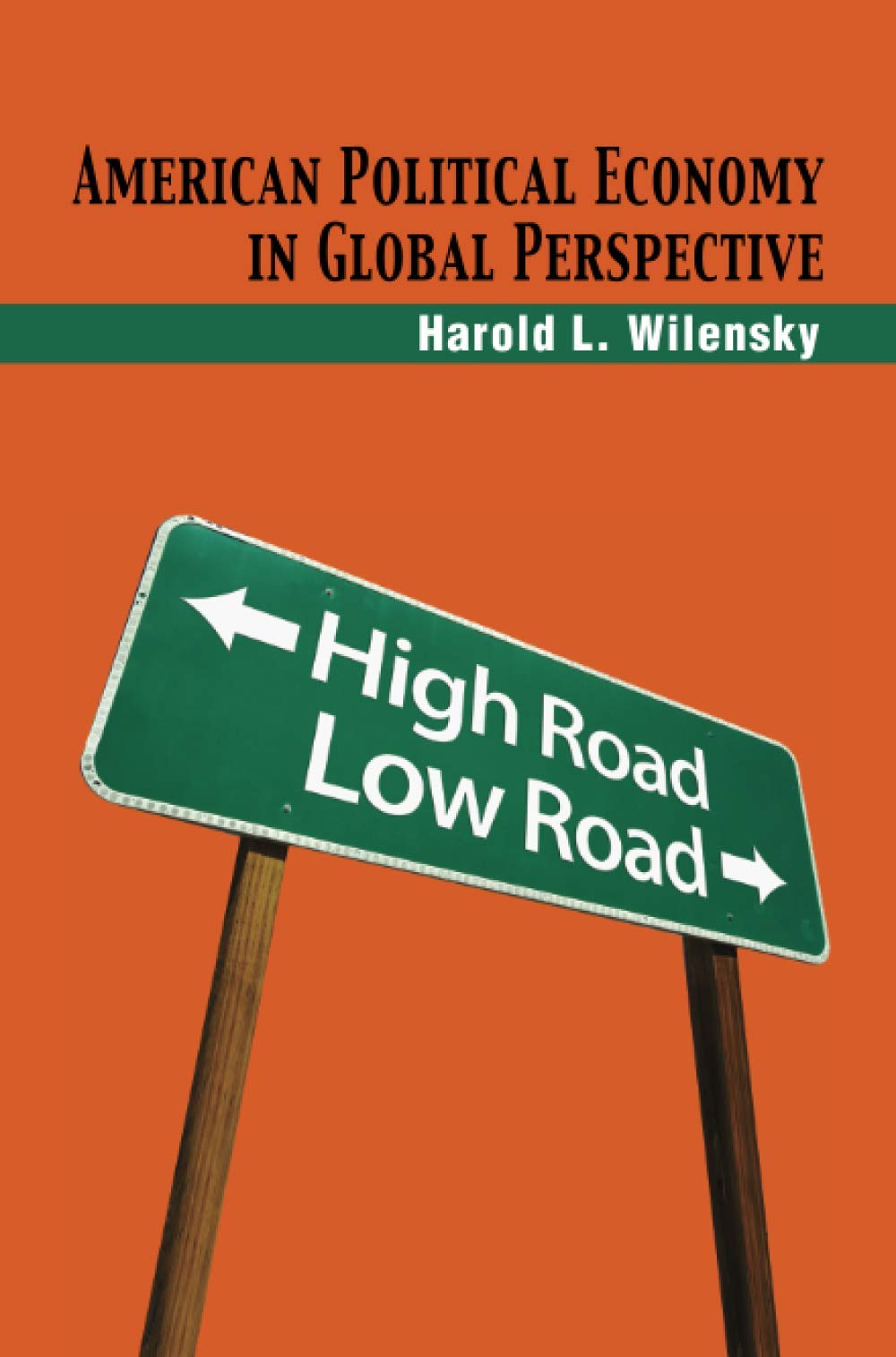



This book is a guide to claims about the proper role of government and markets in a global economy. Moving between systematic comparison of 19 rich democracies and debate about what the United States can do to restore a more civilized, egalitarian, and fair society, Harold L. Wilensky tells us how six of these countries got on a low road to economic progress and which components of their labor-crunch strategy are uniquely American. He provides an overview of the impact of major dimensions of globalization, only one of which – the interaction of the internationalization of finance and the rapid increase in the autonomy of central banks – undermines either national sovereignty or job security, labor standards, and the welfare state. Although Wilensky views American policy and politics through the lens of globalization, he concludes that the nation-state remains the center of personal identity, social solidarity, and political action. He concentrates on what national differences mean for the well-being of nations and their people. Drawing on lessons from abroad and from America's own past successes, Wilensky shows how we can reverse our three-decade decline. He argues that, in order to get off the low road, we must overcome the myths of “moderation,” the rise of the “independent voter,” and a rightward shift of the electorate. He specifies a feasible domestic agenda that matches majority sentiments in all rich democracies. “Professor Wilensky has produced the ultimate study of globalization’s impact on nation-states, an urgent must-read guide for students, policy experts and public officeholders alike. Using comparative analysis, he shreds the notion that creating a healthy economy or citizenry requires that government shrink itself into oblivion; indeed, quite the opposite. The most successful countries with the highest quality-of-life, the most robust economies and healthiest democracies are ones that have an efficient-but-active government armed with smart economic and social policies. The wisdom and prescriptions in American Political Economy in Global Perspective ought to be required reading for every single member of Congress today." ―Jennifer M. Granholm, former Governor (D, Michigan) “This is a remarkable, comprehensive, prodigious and insightful piece of scholarship that analyses the wrong headed economic and policy choices that have contributed so pervasively to the eroding standard of living inflicted on the American middle class. It makes clear there are other paths that can lead to a greater chance for broadly shared prosperity and national recovery than the simplistic, one dimensional, and zealously ideological dogma aimed at keeping government so weak it has little chance to make markets work for the broader society." ―David R. Obey, former Member of Congress (D, Wisconsin) “This book illuminates the most important policy disputes that mark American―and Western European―politics. It is remarkable as a careful, detailed, and clearly written synthesis of arguments and evidence. It will be a perfect foil for scholars and practitioners who strongly agree or disagree with Wilensky’s conclusions about the impact of politics and public policies focused on the welfare state, jobs, equality, labor standards. energy, and public finance. A powerful contribution.” ―Ted Marmor, Yale University “Once again Harold Wilensky proves to be one of the grand masters of comparative social research. Based on a great wealth of data showing what rich democracies have in common and where they differ, he not only dismantles the myth of American exceptionalism, but also draws a number of specific policy conclusions which are of relevance for U.S. elections: Far from being a ‘Ponzi scheme,’ social security is a most effective tool of poverty prevention, a universal health insurance program is the best way to ensure access to health care services as well as effective cost containment, and industrial relations that integrate workers and unions into economic decision-making enhance not only social cohesion, but also productivity and growth.” ―Jens Alber, Social Science Research Center Berlin “Hal’s last book will not restore US political debates to sanity. No single book can do that. But it makes a heroic effort to re-introduce level-headed, empirically informed pragmatism in a country that to a worried outsider seems bent on self-destruction as a great power. Small nations like mine officially advocate multilateralism, since multilateralism ties the strong and the weak together in a web of mutual agreements, where the strong have to listen to the weak. But many of us who were foreign colleagues of Hal are more-or-less secretly of the opinion that multilateralism works best if one major power, provided it is a sane and civilized one, carries a larger stick than the rest. I hope Hal’s last book will help cool ideological disputes down and widen the room for informed, pragmatic argument in US policy-level political discourse