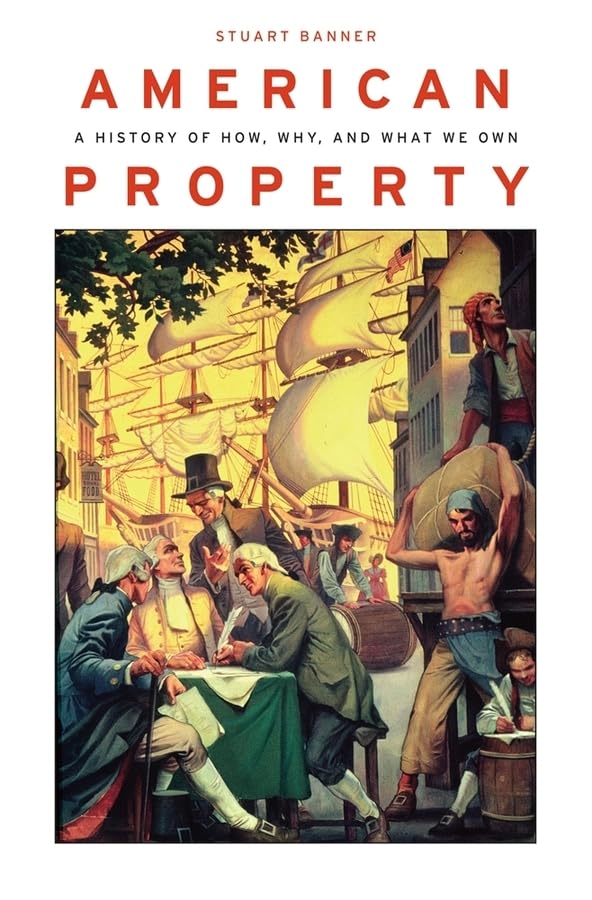



In America, we are eager to claim ownership: our homes, our ideas, our organs, even our own celebrity. But beneath our nation’s proprietary longing looms a troublesome question: what does it mean to own something? More simply: what is property? The question is at the heart of many contemporary controversies, including disputes over who owns everything from genetic material to indigenous culture to music and film on the Internet. To decide if and when genes or culture or digits are a kind of property that can be possessed, we must grapple with the nature of property itself. How does it originate? What purposes does it serve? Is it a natural right or one created by law? Accessible and mercifully free of legal jargon, American Property reveals the perpetual challenge of answering these questions, as new forms of property have emerged in response to technological and cultural change, and as ideas about the appropriate scope of government regulation have shifted. This first comprehensive history of property in the United States is a masterly guided tour through a contested human institution that touches all aspects of our lives and desires. Stuart Banner shows that property exists to serve a broad set of purposes, constantly in flux, that render the idea of property itself inconstant. Despite our ideals of ownership, property has always been a means toward other ends. What property signifies and what property is, we come to see, has consistently changed to match the world we want to acquire. This is one of those books whose title doesn�t really give you much of a clue about the wonders within. What sounds like it might be a staid look at a dry subject turns out, in fact, to be an exciting and captivating journey along a fascinating side road in American history: property and its ownership. Around the time of the American Revolution, when the country was divorcing itself from England, a massive change took place: the old British laws concerning property were not merely tweaked but, instead, demolished and rebuilt from the ground up. From the fundamentals�ownership of land, which was a revolutionary idea in the eighteenth century�to more esoteric subjects, such as whether it�s possible to own less-tangible kinds of property (sounds or the news or parts of your own body), the author, a professor of law at the UCLA, explores the occasionally labyrinthine legal and political processes that, as America was defining itself as a country, began to define one of its residents� most basic (yet complex) rights. --David Pitt “In this masterful survey, Stuart Banner documents the evolution of property rights. Brimming with fresh vignettes and insights, American Property will enlighten and delight both general readers and specialists in these issues.” ― Robert Ellickson, Yale Law School “ American Property deftly explores the many ways that we rely on property to achieve human ends, tailoring the law to suit new places and changing technology.” ― Sarah Barringer Gordon, author of The Spirit of the Law “Stuart Banner's elegantly written tour of American property law leads its reader to a startling conclusion. There is no such thing as a unified singular law of property. There are only laws of property that have shaped where we live, the news we read, the inventions we use, the celebrities we watch, and the music we listen to. Our ideas of property won't ever look quite the same.” ― John Fabian Witt, author of Patriots and Cosmopolitans: Hidden Histories of American Law “We have never had a comprehensive synthesis of the history of property and property law in the United States. Now Stuart Banner fills this major gap with an original and insightful work.” ― Gregory S. Alexander, Cornell University “In this tightly written book, Banner tackles an admittedly expansive topic, illustrating that our ideas about what property is, how it is regulated, and what it is meant to do are in constant flux and have been historically contested. Partly an examination of law, partly of culture, politics, economics, and even religion, Banner successfully shows how our notions of property and so-called "natural property" in essence sketch the shifting borders of what Americans deem appropriate government regulation. "Our conceptions of property have always been molded to serve our particular purposes," Banner writes, using examples ranging from zoning laws (which were often used to enforce racial and economic boundaries); eminent domain and personal property disputes; as well as new, thorny notions of intellectual property in the digital age (digital copying makes some property rights harder to enforce, he notes, but creates new opportunities as well). Banner even addresses biological breakthroughs (can a company own a genetically engineered hybrid or a cell line?).” ― Publishers Weekly “What sounds like it might be a staid look at a dry subject turns out, in fact, to be an exciting and captivating journey along a fascinating si