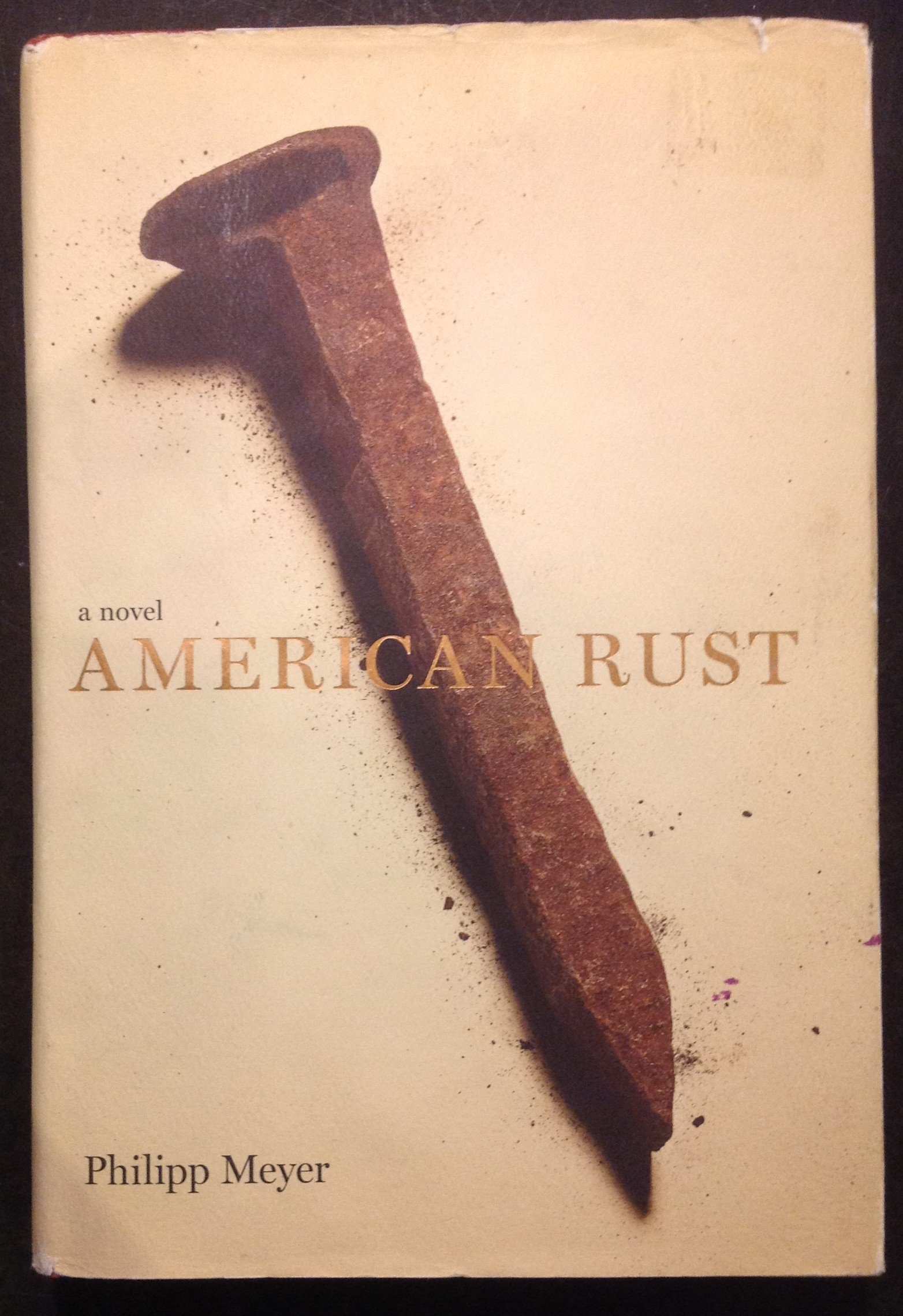



Set in a beautiful but economically devastated Pennsylvania steel town, American Rust is a novel of the lost American dream and the desperationâ as well as the acts of friendship, loyalty, and loveâ that arise from its loss. From local bars to trainyards to prison, it is the story of two young men, bound to the town by family, responsibility, inertia, and the beauty around them, who dream of a future beyond the factories and abandoned homes. Left alone to care for his aging father after his mother commits suicide and his sister escapes to Yale, Isaac English longs for a life beyond his hometown. But when he finally sets out to leave for good, accompanied by his temperamental best friend, former high school football star Billy Poe, they are caught up in a terrible act of violence that changes their lives forever. Evoking John Steinbeck’s novels of restless lives during the Great Depression, American Rust takes us into the contemporary American heartland at a moment of profound unrest and uncertainty about the future. It is a dark but lucid vision, a moving novel about the bleak realities that battle our desire for transcendence and the power of love and friendship to redeem us. Newsweek's list of "Best. Books. Ever" Amazon Top 100 book of 2009 A Washington Post Top Ten Book of 2009 A New York Times Notable Book of 2009 An Economist Best Book of 2009 A Kansas City Star Top 100 book of 2009 Pittsburgh Post-Gazette's Best Books of 2009 Idaho Statesman's Best Books of 2009 Amazon Best of the Month, February 2009 : Buell, Pennsylvania lies in ruins, a dying--if not already dead--steel town, where even the lush surrounding country seethes with concealed industrial toxins. When Isaac English and Billy Poe--a pair of high-school friends straight out of Steinbeck--embark on a starry-eyed cross-country escape to California, a violent encounter with a trio of transients leaves one dead, prying the lid off a rusted can of failed hope and small-town secrets. American Rust is Philipp Meyer's first novel, and his taut, direct prose strikes the perfect tone for this kaleidoscope of fractured dreams, elevating a book that otherwise might be relentlessly dour to the level of honest and unflinching storytelling. (Interestingly, Meyer has a fan in Patricia Cornwell, who name-checked American Rust in her latest novel, Scarpetta , even though Meyer's book hadn't been released yet.) -- Jon Foro Amazon Exclusive: Philipp Meyer on American Rust In the late seventies, when I was five, my parents moved us to a blue-collar neighborhood in Baltimore. As was the case with most of the old cities of the northeast, Baltimore was in the throes of a serious social collapse. Any industry you could name was falling apart--steel, ship-building, textiles--not to mention the docks and the port. The middle class was evaporating. Even among the neighborhood kids, there was a sense that things were getting worse, not better. That neighborhood was called Hampden, a place since immortalized in many of John Waters’s films. Back then, even in Baltimore’s often shoddy public schools, Hampden was not a place you wanted to admit you were from--my brother and I often lied when asked where we lived. There were police cars and ambulances on our street with some frequency, men passed out on the sidewalk. My father, a graduate student, once went outside with his pistol to check on a man whom he thought had been murdered near our house. Even so, there was a strong community and the people who were able did their best to watch out for each other. These were good people, working people, but in the end that didn’t matter--their jobs had disappeared and they tumbled from the middle class into the ranks of what we now call the “working poor.” It was an early lesson into the way life worked for certain segments of our society. Many years later, after a long and roundabout route to get into and eventually graduate from college, I ended up taking a job on Wall Street. I was proud of my new job, proud I’d gone from high school dropout to Cornell University graduate to Wall Street trader. Naturally, complications soon arose. One surprising thing was that while in most of the country the closing of a factory was seen as tragic, on Wall Street it was nearly a cause for celebration. Whatever the company in question, closing an American factory caused their stock price to go up. The more jobs were outsourced, the more the company executives made on their stock options, the more investment bankers racked up multi-million dollar bonuses. Meanwhile, a short distance away, thousands of families were being devastated. While I still have many close friends on Wall Street, after a few years there I knew it was the wrong path. I cared about people, I cared about their stories, I’d stopped caring about money. After leaving the bank I spent my time writing and working jobs in construction and as an EMT; I moved back in with my parents and lived in their basemen