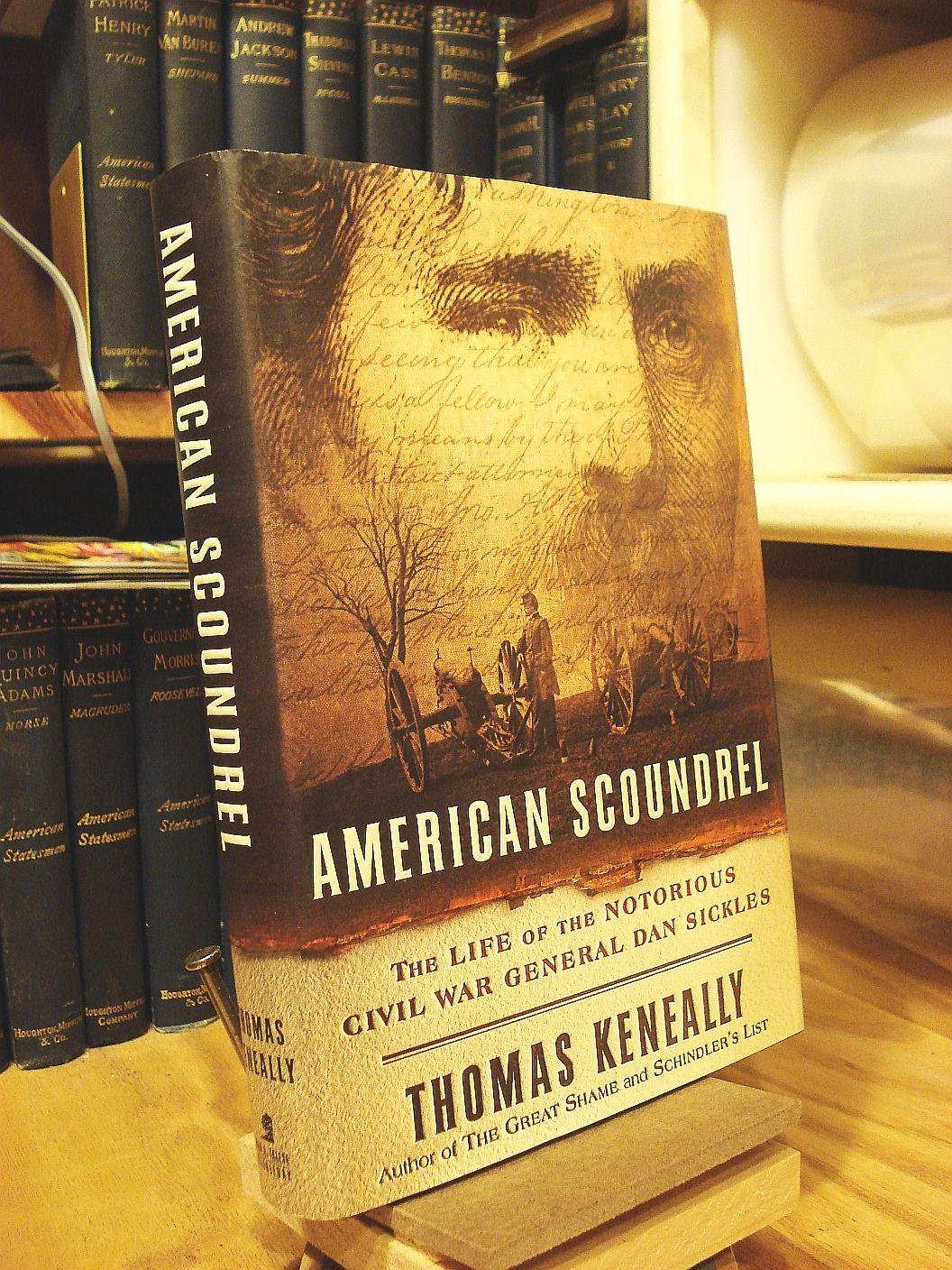
American Scoundrel: The Life of the Notorious Civil War General Dan Sickles
$20.12
by Thomas Keneally



On the last Sunday of February 1859, Dan Sickles, a charming young congressman from New York, murdered his good friend Philip Barton Key (son of Francis Scott Key)–who was also his wife’s lover–in Washington’s Lafayette Square. The shooting took place directly across the street from the White House, the home of Sickles’s friend and protector, President James Buchanan. Sickles turned himself in; political friends in New York’s Tammany Hall machinery, including the dynamic criminal lawyer James Brady, quickly gathered around. While his beautiful young wife was banned from public life and shunned by society, Dan Sickles was acquitted. American Scoundrel is the extraordinary story of this powerful mid-nineteenth century politician and inveterate womanizer, whose irresistible charms and rock-solid connections not only allowed him to get away with murder — literally — but also paved the way to a stunning career. Once free to resume his life, Dan Sickles raised a regiment for the Union political elite and went on to become a general in the army, rising to the rank of brigadier general and commanding a flank at the Battle of Gettysburg in a maneuver so controversial it is still argued over by scholars today. After losing a leg in that battle, Sickles fought on and after the war became military governor of South Carolina, and later was named minister to Spain, where he continued astonishingly to conduct his amorous assignations. With great brio and insight — and a delight in bad behavior — Thomas Keneally has brought to light a tale of American history that resonates with uncomfortable truths about our politics, ethics, and morality. Politician, man about town, war hero, and murderer: Dan Sickles led many lives, some of them improbable, turning disaster to advantage. Thomas Keneally, whose novels have been populated by heroes and outlaws alike, vividly captures Sickles's life and times. A Tammany politician, for good and ill, Sickles earned national notoriety for gunning down his friend Philip Barton Key, the son of Francis Scott Key, in what his peers in Congress took to be an excusable crime of passion. Sickles made a glorious comeback with the Civil War, when the regiment he raised distinguished itself time and again under fire at places such as Chancellorsville and Gettysburg--where, defying orders in a bold maneuver, Sickles helped secure the Union victory. "His tendency toward berserk and full- blooded risk was partly characteristic of the city he had grown up in, the age he lived in, and his own soul," writes Keneally. Admired by no less than Mark Twain, Sickles figures only as a footnote in many histories. Ably recounting his triumphs and defeats, Thomas Keneally brings him front and center in a tale that will delight Civil War buffs. --Gregory McNamee The author of Schindler's List tells the real-life story of New York Congressman Dan Sickles, who in 1859 murdered his best friend (and his wife's lover), was acquitted, and rose to fame as a Union general. Copyright 2001 Reed Business Information, Inc. This well-respected Australian writer could have easily turned the subject of his latest book into another of his admired and avidly read historical novels, a list that includes The Confederates (1980) and Schindler's List (1982). Instead Keneally has chosen to present his material as a biography, but he brings to it an unerring instinct for letting colorful characters shine in all their created or--as in this case--natural vibrancy. Dan Sickles was "urbane, intellectually gifted, a skillful lawyer." In 1853, at the age of 33, he was appointed first secretary to the American legation in London, under the wing of the new American minister to the court of Queen Victoria, future president James Buchanan. Sickles represented lower Manhattan in Congress and later was drawn into the circle of Mary Todd Lincoln's favorites; President Lincoln himself stood behind Sickles' appointment as a brigadier general in the Union forces. After the war, Sickles served as the military governor of South Carolina and American minister to the court of Spain. Certainly an interesting resume, but what makes the story of his life doubly interesting is his volatile personality, which led him to make "extreme gestures." The worst consequence of his overly excitable nature was his murder of his wife's lover, Philip Barton Key, the federal district attorney for Washington, D.C. (and son of Francis Scott Key of "Star-Spangled Banner" fame). Yet throughout Sickles' life, despite whatever trouble he got into, no one could help but "forgive him everything." Brad Hooper Copyright © American Library Association. All rights reserved “Spellbinding. . . . Riveting. . . . Mesmerizing.” — The New York Times Book Review “Brilliant. . . . Rollicking, captivating. . . . Engrossing, entertaining. . . . Keneally brings Sickles back to life in every colorful and scandalous detail.” — Chicago Sun-Times “Panoramic. . . . For anybody who savor