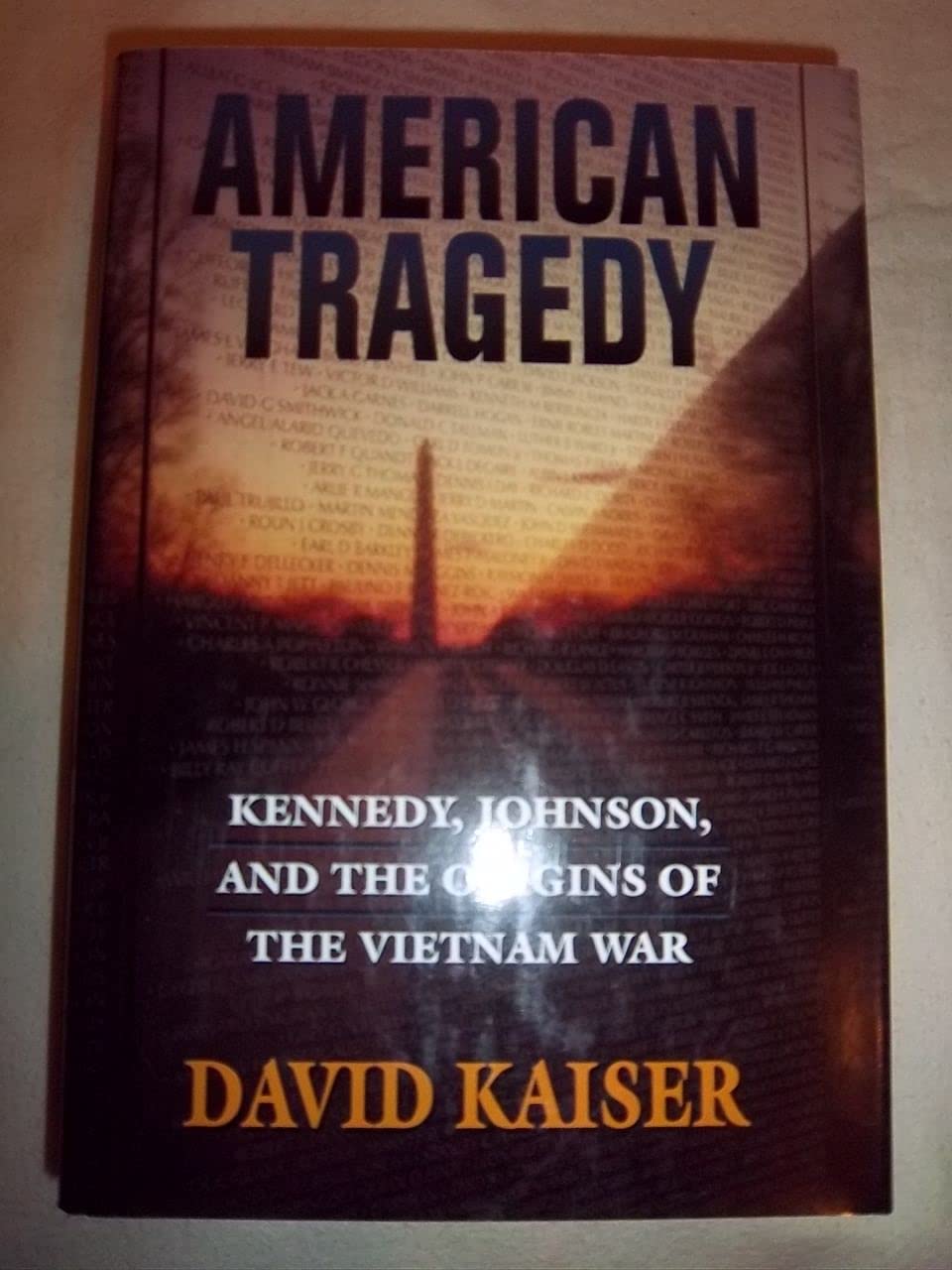
American Tragedy: Kennedy, Johnson, and the Origins of the Vietnam War
$12.17
by David Kaiser



Fought as fiercely by politicians and the public as by troops in Southeast Asia, the Vietnam War--its origins, its conduct, its consequences--is still being contested. In what will become the classic account, based on newly opened archival sources, David Kaiser rewrites what we know about this conflict. Reviving and expanding a venerable tradition of political, diplomatic, and military history, he shows not only why we entered the war, but also why our efforts were doomed to fail. American Tragedy is the first book to draw on complete official documentation to tell the full story of how we became involved in Vietnam--and the story it tells decisively challenges widely held assumptions about the roles of Eisenhower, Kennedy, and Johnson. Using an enormous range of source materials from these administrations, Kaiser shows how the policies that led to the war were developed during Eisenhower's tenure and nearly implemented in the closing days of his administration in response to a crisis in Laos; how Kennedy immediately reversed course on Laos and refused for three years to follow recommendations for military action in Southeast Asia; and how Eisenhower's policies reemerged in the military intervention mounted by the Johnson administration. As he places these findings in the context of the Cold War and broader American objectives, Kaiser offers the best analysis to date of the actual beginnings of the war in Vietnam, the impact of the American advisory mission from 1962 through 1965, and the initial strategy of General Westmoreland. A deft re-creation of the deliberations, actions, and deceptions that brought two decades of post-World War II confidence to an ignominious end, American Tragedy offers unparalleled insight into the Vietnam War at home and abroad--and into American foreign policy in the 1960s. Kaiser (strategy and policy, Naval War Coll.; Politics and War) offers the second excellent investigation of the roots of the Vietnam War in as many years, following Fredrik Logevall's Choosing War (LJ 7/99). Having spent nine years researching recently declassified documents, the author describes in exacting detail the evolution of Vietnam policies from 1961 to 1965, the year that Johnson committed the United States to a war it couldn't win. Kaiser differs from Longevall by portraying Kennedy as skilled at keeping under control the prowar instincts of top cabinet members. The first-rate research is complemented by an intriguing model of intergenerational policy-making, whereby Kaiser attributes much of the failure to the heavy-handed actions of the "GI generation," the successful leaders of World War II. Highly recommended for specialized academic and larger public collections. -Karl Helicher, Upper Merion Twp. Lib., King of Prussia, PA Copyright 2000 Reed Business Information, Inc. An important addition to the sadand growinglibrary devoted to the Vietnam war. Kaiser is a longtime professor of strategy and policy at the Naval War Collegean important qualification, given the provocative news he brings in this heavily documented tome. Kaiser's argument runs counter to what in some quarters is now received wisdom: that Eisenhower was reluctant to involve Americans in Vietnam; that his successor, Kennedy, was a hawk in liberal's clothing. Kaiser modifies that view, writing that military commitment in Vietnam was a natural result of the Eisenhower administration's policy of global anticommunist containmentand that Kennedy, himself a former officer, was a cautious critic of the Pentagon, which had gladly taken on the opportunity to flex its military muscle and test out new ordnance in a faraway place. After Kennedy's assassination, Kaiser continues, Lyndon Johnson followed Eisenhower's lead to give the military essentially free rein, trusting Kennedy administration alumnus Robert McNamara to guide him truthfullysomething, Kaiser and many other historians tell us, that McNamara willfully failed to do. As a result, Kaiser writes, ``Johnson undertook the war without giving much consideration to the damage it would do to other aspects of American foreign policy'' and indeed allowed it to dominate his presidency, despite frequent warnings from confidants such as Hubert Humphrey that the time had come to cut and run. Critical of the Pentagon, and convinced that Eisenhower's policy was doomed to fail, Kaiser warns that until North Vietnamese archives are available to scholars we can have no way of knowing how closely Ho Chi Minh's policy was bound to dictates from Moscow or Beijingthe fear of which provided the argument for containment in the first place. Highly useful to scholars, and certain to excite discussion and even controversy, Kaiser's book is a valuable contribution. -- Copyright ©2000, Kirkus Associates, LP. All rights reserved. Kaiser has worked his way through the archives and emerged with an impressive account of what he terms 'the greatest policy miscalculation in the history of American foreign