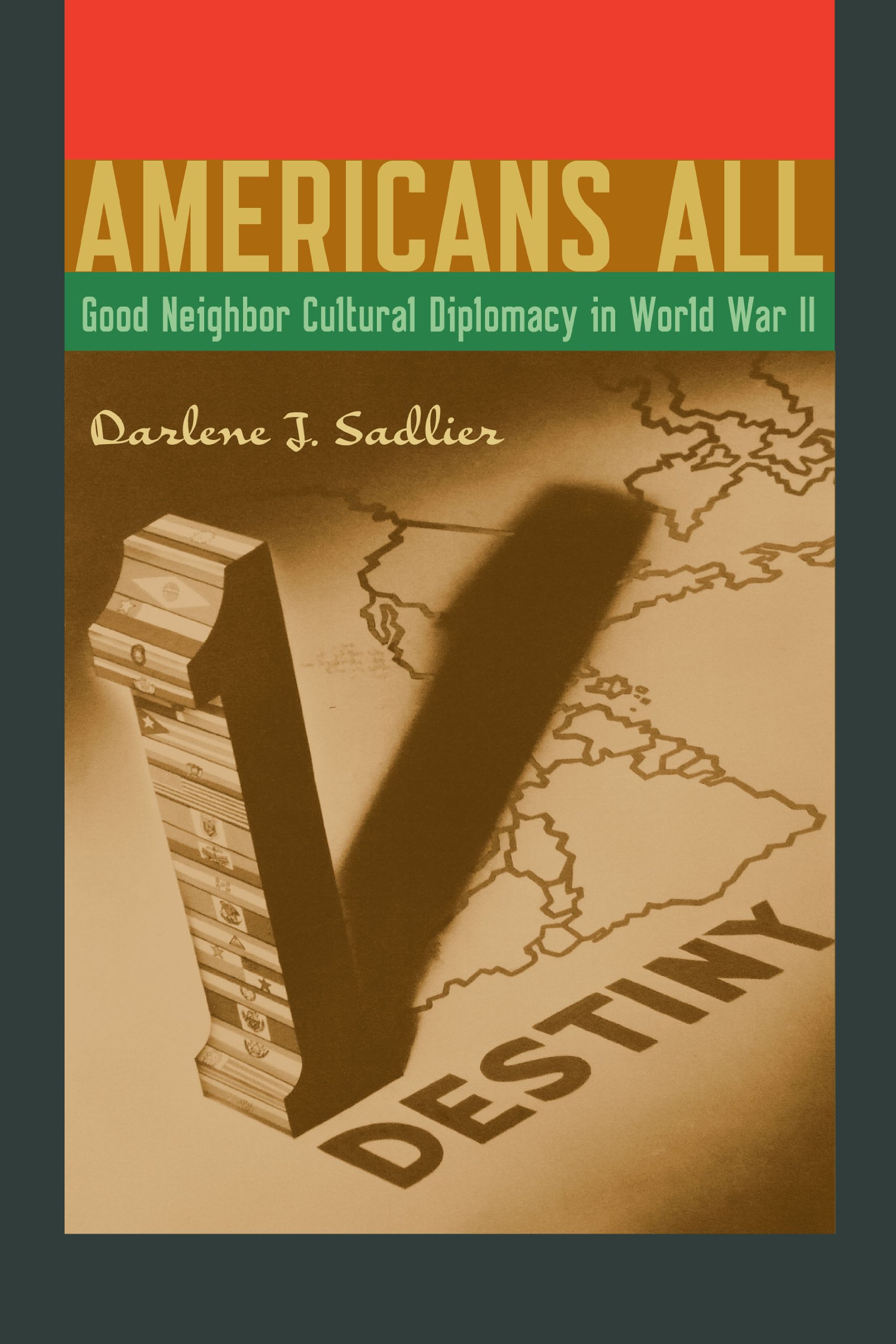
Americans All: Good Neighbor Cultural Diplomacy in World War II (Joe R. and Teresa Lozano Long Series in Latin American and Latino Art and Culture)
$25.00
by Darlene J. Sadlier



Cultural diplomacy—“winning hearts and minds” through positive portrayals of the American way of life—is a key element in U.S. foreign policy, although it often takes a backseat to displays of military might. Americans All provides an in-depth, fine-grained study of a particularly successful instance of cultural diplomacy—the Office of the Coordinator of Inter-American Affairs (CIAA), a government agency established by President Franklin D. Roosevelt in 1940 and headed by Nelson A. Rockefeller that worked to promote hemispheric solidarity and combat Axis infiltration and domination by bolstering inter-American cultural ties. Darlene J. Sadlier explores how the CIAA used film, radio, the press, and various educational and high-art activities to convince people in the United States of the importance of good neighbor relations with Latin America, while also persuading Latin Americans that the United States recognized and appreciated the importance of our southern neighbors. She examines the CIAA’s working relationship with Hollywood’s Motion Picture Society of the Americas; its network and radio productions in North and South America; its sponsoring of Walt Disney, Orson Welles, John Ford, Gregg Toland, and many others who traveled between the United States and Latin America; and its close ties to the newly created Museum of Modern Art, which organized traveling art and photographic exhibits and produced hundreds of 16mm educational films for inter-American audiences; and its influence on the work of scores of artists, libraries, book publishers, and newspapers, as well as public schools, universities, and private organizations. Americans All tells the most complete story to date of the motives and modus operandi of the sustained US effort, embodied in the Office of the Coordinator of Inter-American Affairs—usually known by the acronym OCIAA but shortened in this book to the rather sinister sounding CIAA—under the direction of Nelson A. Rockefeller, to promote the unity of the western hemisphere in order to counter the supposedly imminent Nazi threat…Sadlier’s accessible book highlights the value of cultural history for the study of international relations. It is an important complement to other more diplomatically oriented works on inter-American relations during these years. ― International Affairs [Sadlier] provides a highly readable and beautifully illustrated account of U.S. cultural diplomacy during World War II that will find its way into the course syllabi on all levels of teaching. ― Anuario Colombiano de Historia Social y de la Cultura As the United States prepared for World War II, President Franklin D. Roosevelt took the unusual step of creating an extensive program to further understanding between North Americans and their Latin American neighbors. Artists, writers, filmmakers, musicians, and intellectuals of all stripes were enlisted in this huge effort of two-way cultural exchange. Roosevelt placed Nelson Rockefeller at the head of the governing body of this program, the Office of the Coordinator of Inter-American Affairs. Darlene Sadlier has written the definitive study of this program, taking readers inside the OCIAA. Her deep archival research and lively writing provides a groundbreaking model study and delves into the problems, difficulties, and even failures of the program. Americans All should be read not only by scholars interested in cultural exchange but also, and perhaps especially, by diplomats seeking to improve the nation’s image abroad. -- Frank D. McCann, Professor of History Emeritus, University of New Hampshire Americans All tells the most complete story to date of the motives and modus operandi of the sustained US effort, embodied in the Office of the Coordinator of Inter-American Affairs—usually known by the acronym OCIAA but shortened in this book to the rather sinister sounding CIAA—under the direction of Nelson A. Rockefeller, to promote the unity of the western hemisphere in order to counter the supposedly imminent Nazi threat…Sadlier’s accessible book highlights the value of cultural history for the study of international relations. It is an important complement to other more diplomatically oriented works on inter-American relations during these years. ― International Affairs [Sadlier] provides a highly readable and beautifully illustrated account of U.S. cultural diplomacy during World War II that will find its way into the course syllabi on all levels of teaching. ― Anuario Colombiano de Historia Social y de la Cultura Darlene J. Sadlier is Professor of Spanish and Portuguese and Adjunct Professor of American Studies and Communication and Culture at Indiana University–Bloomington. She is the author of the cultural history, Brazil Imagined: 1500 to the Present (2008).