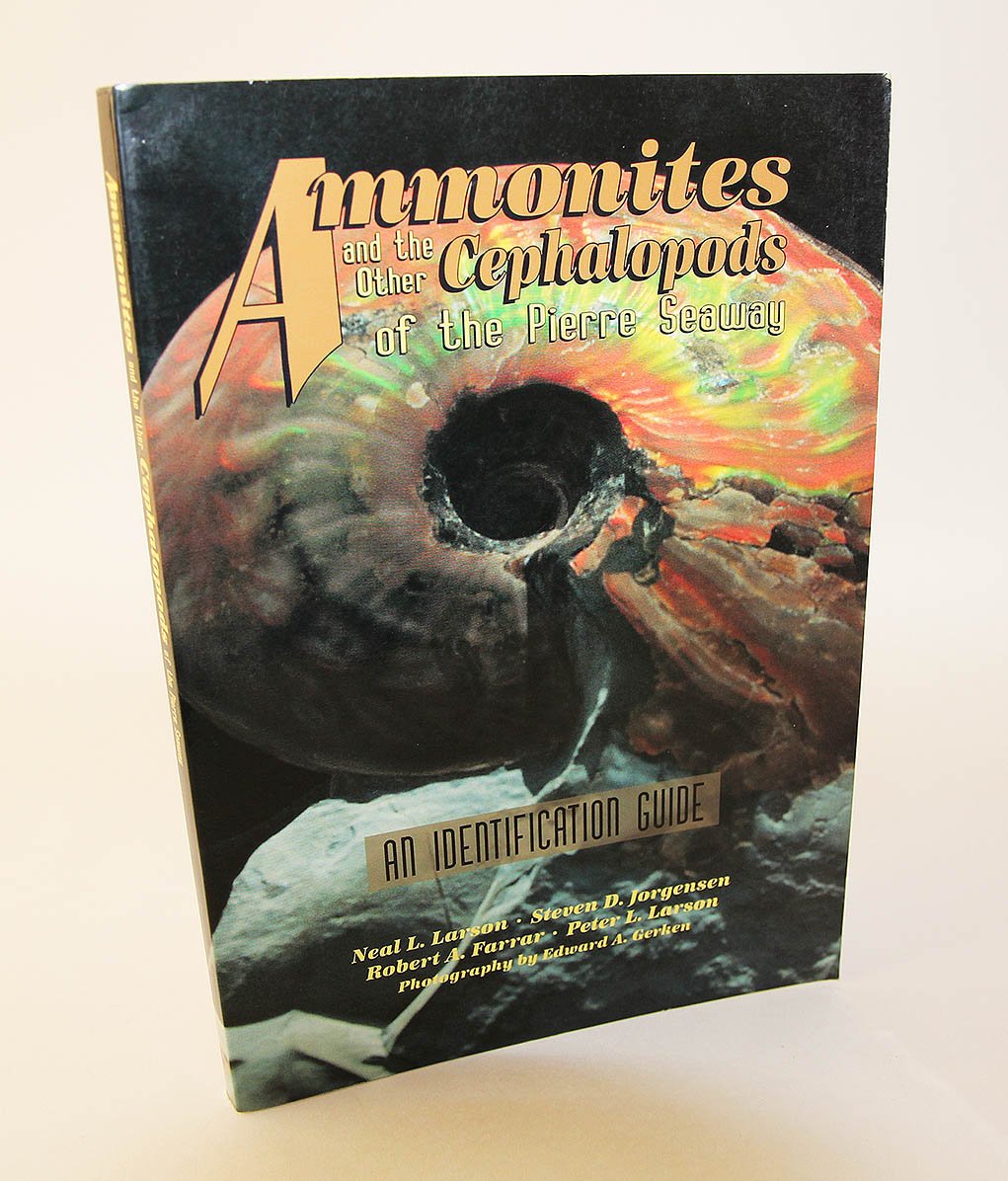
Ammonites and the Other Cephalopods of the Pierre Seaway: Identification Guide
$54.00
by Neil L. Larson



This volume provides easily-understood descriptions of some 90 species, 32 genera, and 13 families of cephalopods that lived for 12 million years in the Pierre Seaway, which extended through the interior of North America connecting the Arctic Ocean with the Gulf of Mexico. B&w photographs. Geoscience Press, Inc. is at PO Box 42948, Tucson, AZ 85733-2948. Distributed to the trade by Mountain Press. Annotation c. by Book News, Inc., Portland, Or. As an identification guide to these beautiful and long-admired fossils, this book is the first of its kind. Excellent photographs by Edward A. Gerken, drawings and diagrams by John Stacy and D.S. Norton, and original identification charts by Neal Larson make this a book that ever collector of invertebrate fossils will enjoy. Although the book presents new and sometimes technical information, it is written so that anyone with an interest in science can understand it. The authors are all successful scientists who started as enthusiastic amateurs, and an ebullient love for their subject matter is evident. The authors have hands-on experience with many of the finest specimens of cephalopods ever found, since their home state, South Dakota, is known for a great variety of superb species. Over 90 species, 32 genera, and 13 families are described. The ancient Pierre Seaway had occupied a large part of the interior of North America, stretching from the Arctic Ocean to the Gulf of Mexico. Cephalopods inhabited the sea for 12 million years. The only contemporary survivor of the shelled cephalopod is the nautilus. Ammonoidea is an extinct order. Many people thing of Ammonoidea as having the same graceful coil as the nautilus or the well-known fossil placenticeras. However, there is an amazing variation in shape from the straight and tapered baculites, to bent shafts and tall, loose coils, and the bullet-shaped belemnites, which resemble modern squid. After the introductions, maps, charts and geology, the organization of species is alphabetical, beginning with the family Baculitidae of the class Ammonoidea. following the orders and families there is a macro-faunal list, a glossary, a bibliography, index, and several charts. The bibliography is probably the most complete ever compiled on this subject. The book has already won praise from museum, Geological Survey, and university scientists as well as from amateur fossil collectors and students. The research uncovered so much new information with so many facts, as well as inspiring new, unanswered questions, that author Neal Larson is already thinking about the next edition. -- Lapidary Journal, August, 1997 This fascinating little book is quite unlike others that academics are asked to review. It is an identification handbook to the fossil fauna of a particular group, the Cephalopods, in a particular area, the shale fossil beds that contain remnants of the fauna and flora of the Pierre seaway that divided what we now know as North America in the Cretaceous period. It is an important resource to have on hand because his extensive phylogenetic group dominated the seas in that period, yet it is essentially extinct, leaving only the very different modern Coleolid Cephalopods and the remnant genus Nautilus. The coverage of the subject area is fairly thorough, including an introduction to the group, time, and place. The gook spacing, clear pictures, and descriptions should make identification of these animals easy....There is no doubt that this is a very specialized book, though pleasingly low priced. For those who have an interest in the area, however, it will be a very useful one. -- Choice, September 1997 Ammonites are extinct marine animals related to present day squid, octopi and chambered nautilus. The have been collected and prized for centuries, yet they often remain unidentified in many collections due to a lack of published information. Ammonites and the Other Cephalopods of the Pierre Seaway will change that. This book is written for general understanding and consolidates the latest cephalopod information available in technical journals. The book includes easily understood descriptions of over 90 species, 32 genera, and 13 families of cephalopods that lived for about 12 million years in the Pierre Seaway, which extended through the interior of North America connecting the Arctic Ocean with the Gulf of Mexico.