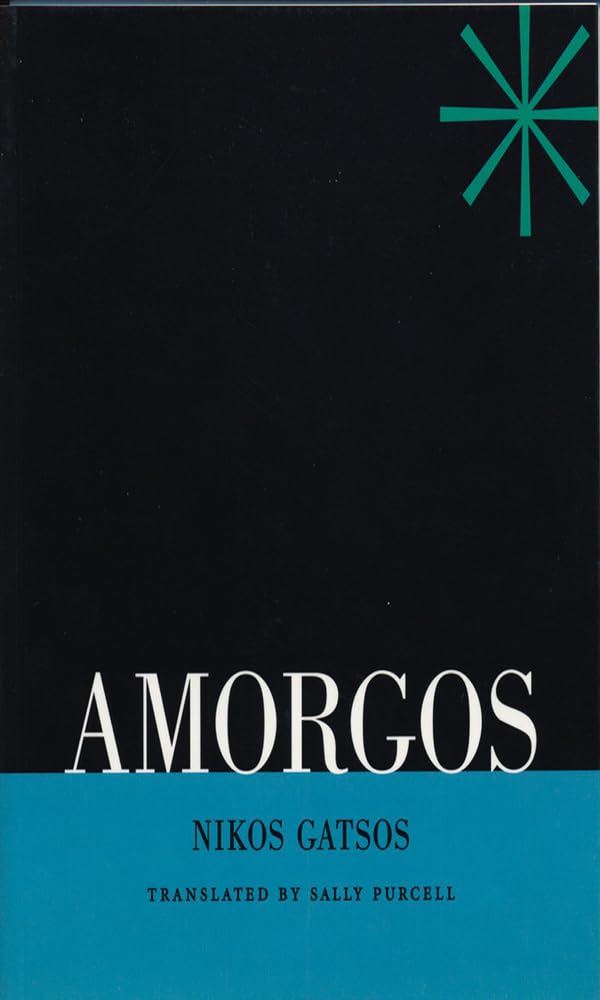



Nikos Gatsos's profoundly mysterious and magnetic poem ` Amorgos ', named after a Greek island he never visited and written during the Nazi occupation, is the single work on which his reputation rests. It is a wonderful incantation on the theme of loss and hope - a unique blend of surrealism, symbolism and folk song - lyrical and erotic, sometimes celebratory, sometimes bitter. It was much admired by the Nobel laureates Odysseus Elytis and George Seferis, and was hugely influential on the postwar generation of Greek poets. However, after its publication in 1943, Gatsos abandoned poetry, and wrote only popular songs, for which he was later renowned. Nikos Gatsos was born in Arcadia in 1914, and educated in Athens from the age of 16, studying Literature, Philosophy and History at Athens University. Well versed in English, French and Spanish, he translated poetry and plays by Lorca, O'Neill, Strindberg, Lope de Vega, Genet and Tennessee Williams into Greek. He died in 1992. Sally Purcell (1944-1998) was the author of ` The Holly Queen ' (1971), `Dark of Day' (1977) and `Fossil Unicorn' (1997), all published by Anvil. A specialist in mediaeval literature, she edited selections of George Peele and Charles d'Orléans and was the translator of a selection of Provençal Poems. There are certain lucky poets who manage to make and keep their reputations with a single poem or collection that, even if carefully refined over the long course of their careers, stands permanently as the sudden and complete distillation of their entire poetic life. This may well be such a work, and while no one is going to put Gatsos on the same shelf with Walt Whitman or Saint John of the Cross, he is a part of their honorable company all the same. One of the leading Greek modernists, Gatsos was a poet- scoundrel in the tradition of Richard Savage: persistently unemployed, apparently unprincipled, and largely unpublished. Bright and ambitious, he made his way from the provincial village of his birth to Athens in 1930, where he seduced the daughter of one of his professors, dropped out of the university, and made the acquaintance of the small literary circle that congregated in the Caf Brazil. (It was at the Brazil, in 1939, that Gatsos was to introduce Henry Miller to George Katsimbalis, later to be immortalized in The Colossus of Maroussi.) Although he made some money during the 1950s writing songs for Columbia Records and the Greek state radio, for most of his life Gatsos supported himself by gambling. Amorgos, his only poetic work of any length, is an intensely introspective and highly imagistic work, and clearly shows the influence of Eliot, Joyce, and Pound, as well as Gatsoss own diffidence about the place of Greece in the world of modern letters: Travellers from the Indies have more to tell you than Byzantine chroniclers. Nicely translated from the Greek in a facing-pages edition, its blessed with a succinct and readable introduction by Peter Levi that situates Gatsos nicely as both a historical and a literary figure. A poet of real clarity and elegance, Gatsos deserves to be rescued from his own shadows. -- Copyright ©2000, Kirkus Associates, LP. All rights reserved. NIKOS GATSOS'S profoundly mysterious and magnetic poem Amorgos, named after a Greek island he never visited and written during the Nazi occupation, is the single work on which his reputation rests. It is a wonderful incantation on the theme of loss and hope -- a unique blend of surrealism, symbolism and folk song -- lyrical and erotic, sometimes celebratory, sometimes bitter. It was much admired by the Nobel laureates Odysseus Elytis and George Seferis, and was hugely influential on the postwar generation of Greek poets. However, after its publication in 1943, Gatsos abandoned poetry, and wrote only popular songs, for which he was later renowned. Nikos Gatsos was born in Arcadia in 1914, and was educated in Athens. Well versed in English, French and Spanish, he translated widely into Greek. He died in 1992. Sally Purcell (1944-1998), a specialist in medieval literature, published her own poetry with Anvil in several volumes, all of which are included in the posthumous 'Collected Poems' (2002).