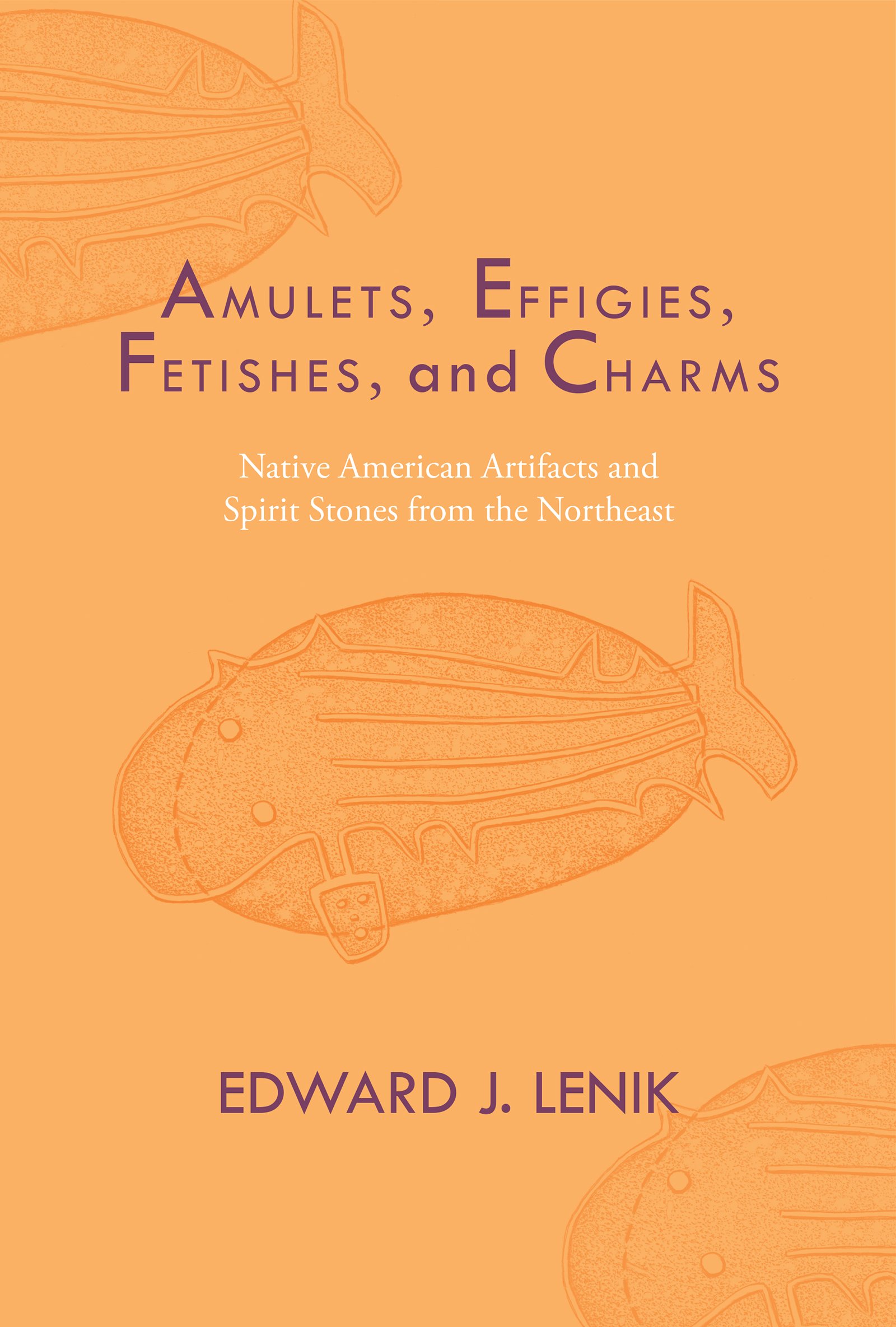
Amulets, Effigies, Fetishes, and Charms: Native American Artifacts and Spirit Stones from the Northeast
$49.95
by Edward J. Lenik



Rounds out Edward J. Lenik’s comprehensive and expert study of the rock art of northeastern Native Americans Decorated stone artifacts are a significant part of archaeological studies of Native Americans in the Northeast. The artifacts illuminated in Amulets, Effigies, Fetishes, and Charms: Native American Artifacts and Spirit Stones from the Northeast include pecked, sculpted, or incised figures, images, or symbols. These are rendered on pebbles, plaques, pendants, axes, pestles, and atlatl weights, and are of varying sizes, shapes, and designs. Lenik draws from Indian myths and legends and incorporates data from ethnohistoric and archaeological sources together with local environmental settings in an attempt to interpret the iconography of these fascinating relics. For the Algonquian and Iroquois peoples, they reflect identity, status, and social relationships with other Indians as well as beings in the spirit world. Lenik begins with background on the Indian cultures of the Northeast and includes a discussion of the dating system developed by anthropologists to describe prehistory. The heart of the content comprises more than eighty examples of portable rock art, grouped by recurring design motifs. This organization allows for in-depth analysis of each motif. The motifs examined range from people, animals, fish, and insects to geometric and abstract designs. Information for each object is presented in succinct prose, with a description, illustration, possible interpretation, the story of its discovery, and the location where it is now housed. Lenik also offers insight into the culture and lifestyle of the Native American groups represented. An appendix listing places to see and learn more about the artifacts and a glossary are included. The material in this book, used in conjunction with Lenik’s previous research, offers a reference for virtually every known example of northeastern rock art. Archaeologists, students, and connoisseurs of Indian artistic expression will find this an invaluable work. “Rock art is a sacred, spiritually potent part of Indian lifeways. Native groups saw spirit in all things. They saw and depicted spirit in these images. Indian myths and legends inform us, providing greater understanding of these images. Images of mythical creatures such as serpents and thunderbirds, for example, are found throughout North America. Each tribe sees these mythical figures differently and depicts them in rock art. The myths and stories surrounding these beings also differ in detail but hold a common element of what these spirit beings mean to the various Indian peoples.” — from the Introduction “A must for those interested in Native American art and culture. Essential.” — CHOICE Edward J. Lenik is the president and principal investigator of Sheffield Archaeological Consultants, a cultural resource management firm in Wayne, New Jersey. An authority on rock art in the Northeast, he has led workshops on artifact analysis and archaeology lab work at New Jersey museums. He is the author of Making Pictures in Stone: American Indian Rock Art of the Northeast and Picture Rocks: American Indian Rock Art in the Northeast Woodlands and is co-author of Rock Art in an Indigenous Landscape: From Atlantic Canada to Chesapeake Bay . Amulets, Effigies, Fetishes, and Charms Native American Artifacts and Spirit Stones from the Northeast By Edward J. Lenik The University of Alabama Press Copyright © 2016 University of Alabama Press All rights reserved. ISBN: 978-0-8173-1923-6 Contents List of Illustrations, Preface, Acknowledgments, Introduction, 1. Northeastern Cultural History, 2. Anthropomorphic or Human Images, 3. Terrestrial Mammals, 4. Fish, Shellfish, and Sea Mammals, 5. Reptiles and Amphibians, 6. Birds and Insects, 7. Geometric and Abstract Designs, 8. Retrospective Summary: Marking Places and Things, Appendix: Seeing Portable Rock Art, Glossary, References, Index, CHAPTER 1 Northeastern Cultural History People When the first European explorers arrived on the coast of northeastern North America in the sixteenth century, they were met by Indians who spoke Algonkian. These Indians occupied a wide area, extending from the eastern maritime provinces of Canada along the east coast and adjacent inland regions to North Carolina. During this early Historic Contact period, the Indians in what is now Nova Scotia and New Brunswick were referred to as the Mi'kmaq. In New England they were referred to as the Eastern Abenaki, Western Abenaki, Maliseet, Passamaquoddy, Pennacook, Soloki, Pocumtuck, Massachusetts, Narragansett, Pequot, Nipmuck, and Wampanoag. In east-central New York, southwestern Massachusetts, and northern Connecticut, they were known as the Mahicans. Southeastern New York, New Jersey, eastern Pennsylvania, and northern Delaware were the homeland of the Lenape, later called the Delaware Indians. Within each of these broad tribal