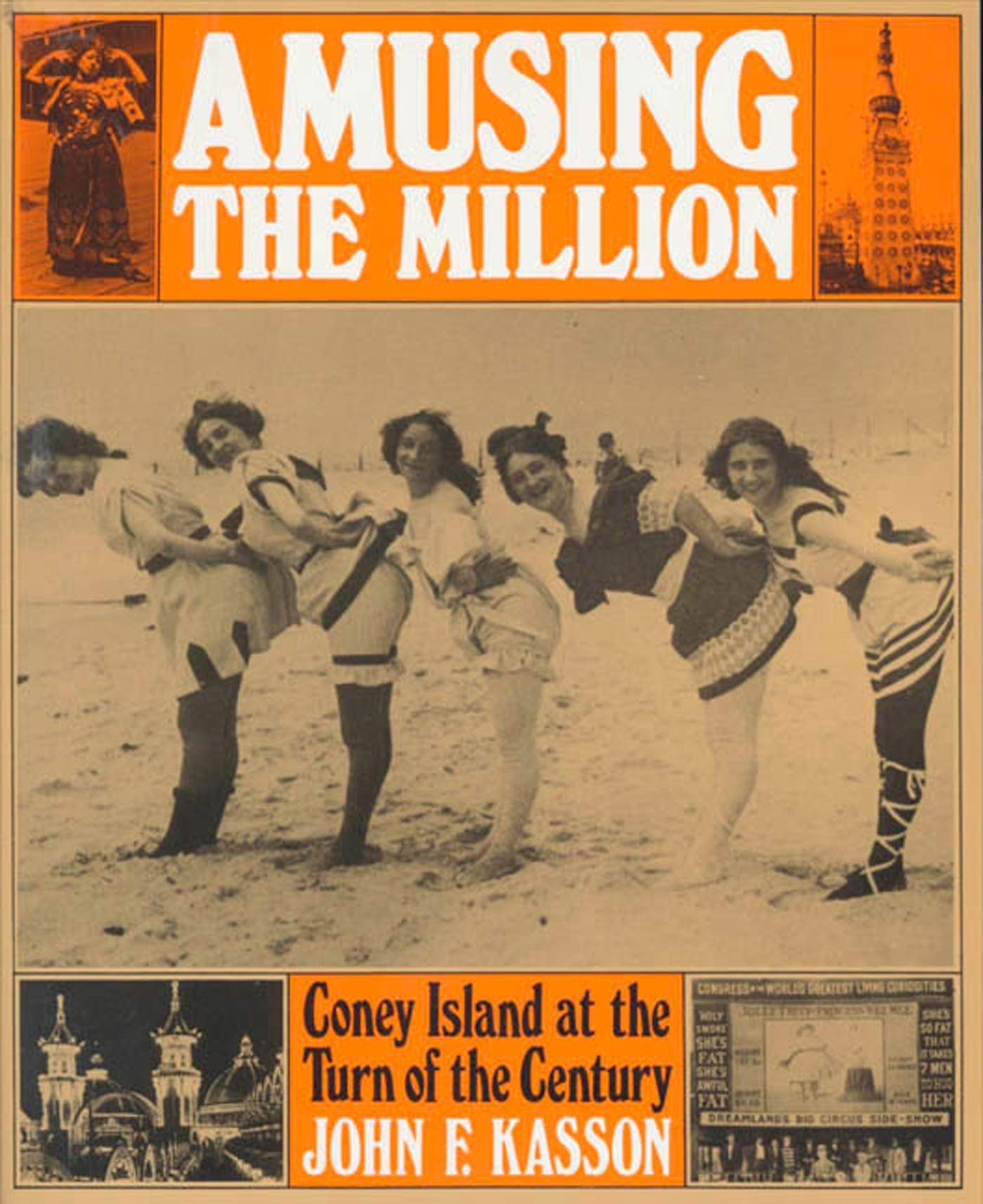
Amusing the Million: Coney Island at the Turn of the Century (American Century)
$11.38
by John F. Kasson



Coney Island: the name still resonates with a sense of racy Brooklyn excitement, the echo of beach-front popular entertainment before World War I. Amusing the Million examines the historical context in which Coney Island made its reputation as an amusement park and shows how America's changing social and economic conditions formed the basis of a new mass culture. Exploring it afresh in this way, John Kasson shows Coney Island no longer as the object of nostalgia but as a harbinger of modernity--and the many photographs, lithographs, engravings, and other reproductions with which he amplifies his text support this lively thesis. “This is what a history of popular culture should be: a delightful account of a fascinating subject and a serious contribution to our understanding of major transition in American culture.” ― John G. Cawelti, University of Chicago “Because he treats our frivolities seriously, John Kasson has produced an important book which helps us all understand ourselves. His inquiry into the nature and significance of Coney Island as part of the American experience provides a brilliant device for understanding major transformations in American culture at the turn of the century...A delight to read, look at, and ponder...itself a great amusement for the mind.” ― Warren Susman, Rutgers University “Not only delightful reading but a perceptive look at a familiar American institution..Social-cultural history ought to be done this way more often.” ― Russel B. Nye, Michigan State University Amusing the Million examines the historical context in which Coney Island made its reputation as an amusement park and shows how America's changing social and economic conditions formed the basis of a new mass culture. John F. Kasson , who teaches history and American studies at the University of North Carolina at Chapel Hill, is the author of Houdini, Tarzan and the Perfect Man; Amusing the Million; Rudeness and Civility; and Civilizing the Machine . Amusing the Million Coney Island at the Turn of the Century By John F. Kasson Hill and Wang Copyright © 1978 John F. Kasson All right reserved. ISBN: 9780809001330 Amusing the Million C oney Island: the name still resonates with a sense of excitement, the echo of an earlier age. Once commanding two miles of beach on the southwestern end of Long Island, the amusement center has seen its domain dwindle to an area sixteen blocks long and two wide. Coney now lives largely on the borrowed capital of its past. It wears an air of faded glory, making it a favorite subject of Sunday-supplement articles and anecdotal tributes. But despite the nostalgia Coney Island arouses, the historical context in which it established its enduring national reputation remains neglected. As a result, Coney's true significance has scarcely been grasped. The era of Coney Island's famous amusement parks began in 1895, and they flourished in the years before the First World War. Coney's heyday thus coincided with a critical period in American history, when the nation came of age as an urban-industrial society and its citizens eagerly but painfully adjusted to the new terms of American life. Changing economic and social conditions helped to create the basis of a new mass culture which would gradually emerge in the first decades of the twentieth century. At the turn of the century this culture was still in the process of formation and not fully incorporated into the life of society as a whole. Its purest expressionat this time lay in the realm of commercial amusements, which were creating symbols of the new cultural order, helping to knit a heterogeneous audience into a cohesive whole. Nowhere were these symbols and their relationship to the new mass audience more clearly revealed than at turn-of-the-century Coney Island. So major was the cultural upheaval Coney Island dramatized that it is difficult to recapture the age that went before it. Nineteenth-century America was governed by a strikingly coherent set of values, a culture in many respects more thoroughly "Victorian" than the England over which Victoria reigned. Beginning in the antebellum period, a selfconscious elite of critics, ministers, educators, and reformers, drawn principally from the Protestant middle class of the urban Northeast, had arisen to assume cultural leadership. In the wake of the disintegration of the old colonial gentry class, these genteel reformers took as their mission to discipline, refine, and instruct the turbulent urban-industrial democracy. American apostles of culture strenuously labored to inculcate the Victorian virtues of "character"--moral integrity, self-control, sober earnestness, industriousness--among the citizenry at large. Ideally, they believed, all activities both in work and in leisure should be ultimately constructive. Hard work improved the individual as well as society, curbing men's animal passions, which if unchecked would bring about social collapse. Leisure, too