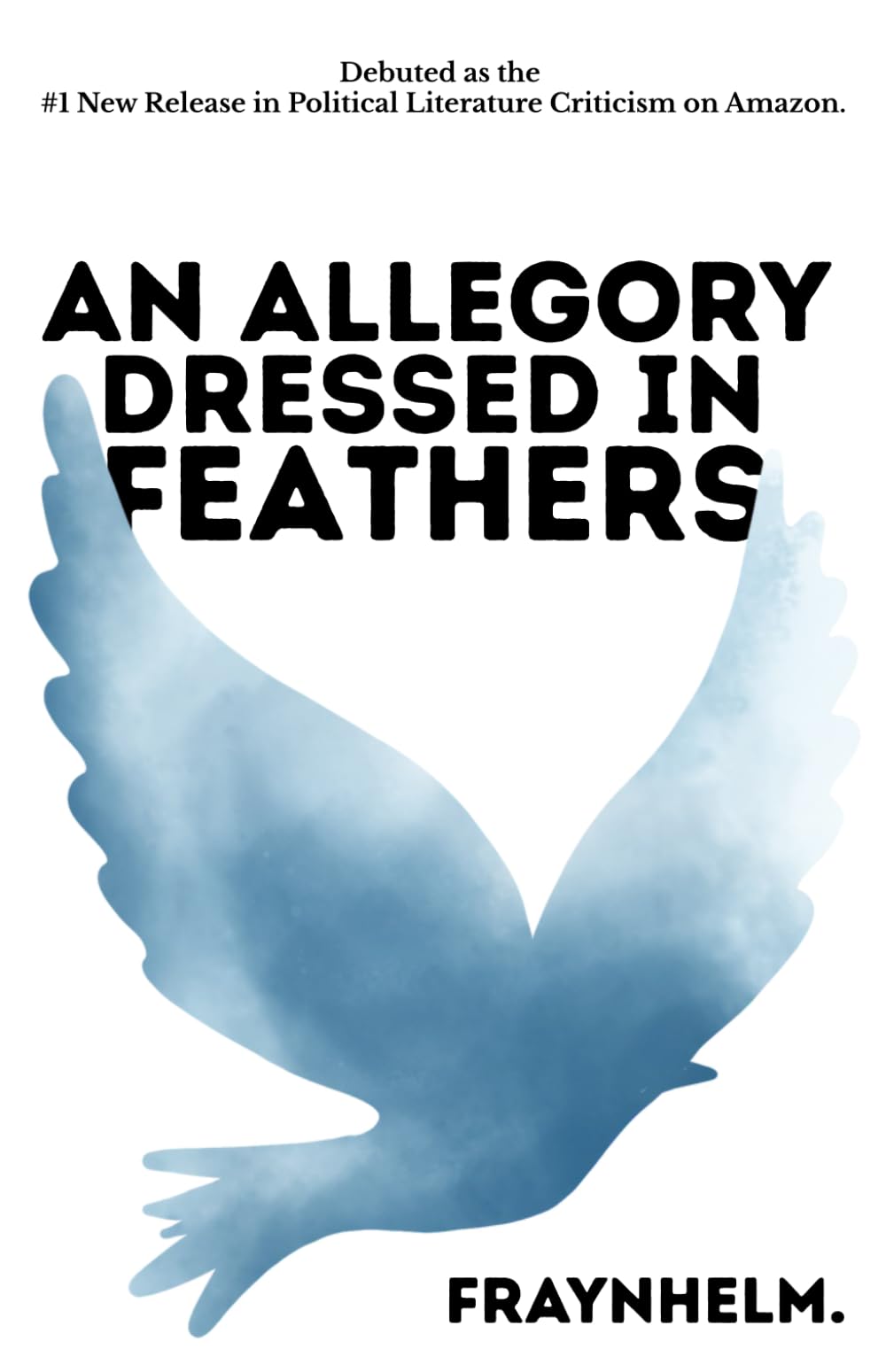



Debuted as the #1 New Release in Political Literature Criticism on Amazon. “Those who forget the sky soon serve those who remember it.“ In an abandoned train station called the Roost , a flock of pigeons lives by order — work, watch, and share. But when a radiant newcomer named Glimmer brings stories of a city where food falls from human hands, the flock begins to forget what built its peace. What follows is a slow unraveling. Rules are renamed “restrictions.” Theft becomes “fairness.” Watch duty turns optional. And as comfort replaces discipline, the sky itself grows hungry. From the first spark of temptation to the ash of collapse, An Allegory Dressed in Feathers traces the fall and rebirth of a world that traded effort for ease. Through the eyes of Grain , a young pigeon who learns too late that freedom without duty is ruin, the story becomes both myth and mirror — a reflection of every civilization that mistook decay for progress. When law is forgotten, hunger writes its own. And when the smoke clears, only those who remember the sky will know how to fly. "Fraynhelm's prose burns away excess until only truth remains. A stunning allegory of vigilance and decay." — Books United "An Allegory Dressed in Feathers isn't just a story about birds or order; it's about the quiet mathematics of survival. Every line feels carved from restraint, every silence deliberate. Fraynhelm/Ilya writes with the precision of someone who's seen systems fail and still believes discipline can rebuild them. It's haunting, unsentimental, and strangely hopeful -- a mirror held to anyone who's ever watched order decay and tried to hold it together anyway." — David Ochildiyev "There's something weirdly precise about An Allegory Dressed in Feathers. It has that Breaking Bad / Better Call Saul thing — where every action folds into its own consequence, where repetition isn't laziness but design. The story breathes like a system that knows when to collapse. It's not just good writing, it's engineered storytelling." — Declan Montgomery An Allegory Dressed in Feathers was written in fragments, the way memory arrives—quietly, then all at once. It began as a story about birds and became a story about people: the way order collapses when comfort replaces vigilance, how language can be used to build or destroy, and how truth is often the first thing to starve. Every beam, watch, and grain in this book mirrors something human—our routines, our politics, our fragile faith in systems we no longer understand. The Roost was never meant to feel distant; it was meant to feel familiar. This is not a fable that asks you to choose sides. It asks you to watch , to listen , and to decide when silence stops being moral. Fraynhelm is a writer who studies the quiet relationship between order and decay. His work explores how civilizations rise, fracture, and rebuild—how the same instincts that make us cooperative can, when unchecked, lead to collapse. An Allegory Dressed in Feathers is his first major work of fiction. It uses the world of pigeons as a lens through which to examine human nature: our hunger for comfort, our resistance to discipline, and the consequences of mistaking ease for progress. Influenced by moral philosophy, history, and observation, Fraynhelm approaches writing as an experiment in truth rather than ideology. His style is measured, reflective, and deliberate, favoring clarity over spectacle. He lives quietly, believing that ideas should be seen more clearly than the person who writes them.