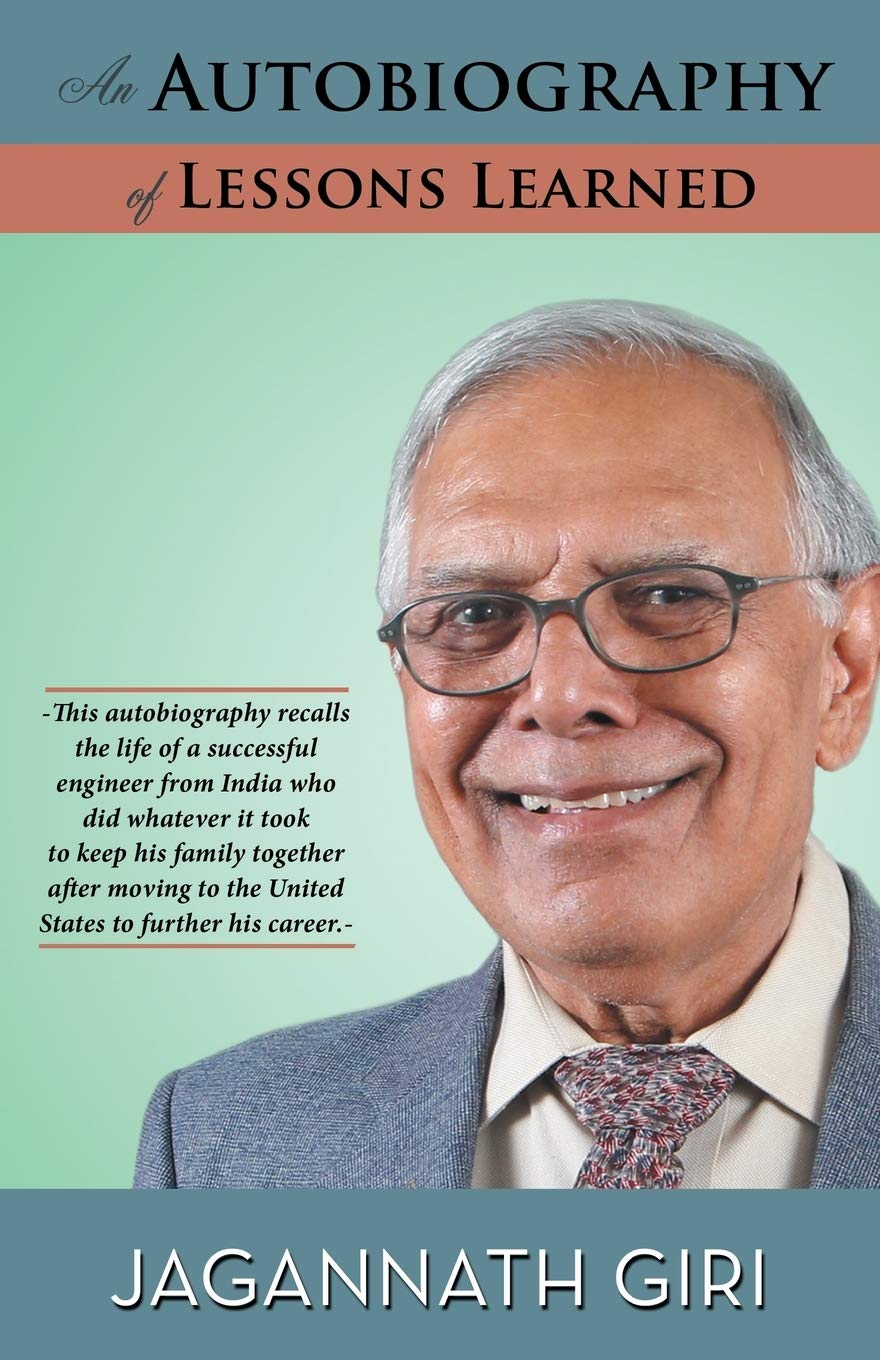



When Jagannath Giri left India to seek a better future in the United States, he thought his wife and children would join him in short order. Just leaving his homeland was a big step. He had lived there all of his thirty-eight years, but he desperately wanted to further his education-and the best place to do that was in the United States. Even though he arrived in the United States with just $8 in his pocket, he earned a doctoral degree in engineering from the Georgia Institute of Technology in Atlanta. He became the first man in the world to prove that composite material is lighter and stronger than the conventional aluminum used to make airplanes, and his temporary separation from his family became more permanent when he accepted a job at his alma mater. Giri fought valiantly to get his family visas to join him in the United States, but the paperwork was tedious, and his native country was fighting a 'brain drain' After nine long years, however, the family was finally reunited. In his autobiography, Giri looks back at how he fought to earn an education, keep his family together, and live a moral life. An Autobiography of Lessons Learned By Jagannath Giri iUniverse, Inc. Copyright © 2013 Jagannath Giri All rights reserved. ISBN: 978-1-4759-8511-5 CHAPTER 1 Family Background I was born on January 16, 1933, in a large village calledBharahopur, Mohalla Mathia, which was one of seven mohallas (subparts) of the big village in the Saran District of Bihar. Therewas no running water in the entire village. The only source ofwater was the village well; people used to pull water throughbuckets with rope. A regular toilet and electricity were out of the question. Infact, even in 2006—when I last visited for a few hours—therewas no electricity. The nearest train station, Ekma, was abouttwo miles from my home. It was connected by a dirt road. My father, Deo Dutta Giri, was the eldest of three brothers.The names of the other two brothers were Sheo Nandan Giriand Ram Sharan Giri. Sheo Nandan had a large family with threesons, a daughter, grandchildren, and great-grandchildren—allof them living in one big house. Ram Sharan Giri had two marriages but no issues ofhis own. He had studied until high school. He had been awrestler until he was twenty-five. He had a fair complexion,an impressive physique, and a grand personality. Later on, hewas appointed a government officer to collect revenues fromthe adjoining villages. My grandfather's name was NarayanGiri. All three brothers had their own houses. Childhoodmarriage was common in those days—God only knows why,how, and when this practice started. Accordingly, my fathermarried at an early age; the exact age is not on record withme. He had two daughters during this marriage, but his wifedied when the two daughters were not more than ten. For four or five years after the death of his wife, NarayanGiri tried his best to convince and force his eldest son toremarry. My father was adamant about not marrying again;he would not budge on the idea that the sole purpose ofmarriage was to help the generations continue. He alreadyhad two daughters and was not going to remarry. My grandpa used to tell him that there would be nobodyto look after him when he was old. When my father did notlisten, my grandpa became so mad that he threw him out ofhis house, telling him that he was not going to give him hisdue share of property. For a couple of years, my father waspractically starving. Finally, my grandfather gave an ultimatumto his son to marry or forfeit getting even one penny from thejoint property. Grandpa forcibly got him married to a girl froma family he knew closely. Consequently, with no alternativeleft, my father had a second marriage. In this marriage, hehad two sons, Ram Lakshan and Mewa Lal; two daughters,Ful Kuwari and Ram Pati; and me. Grandpa was a Zamindar (landlord) with a large, inheritedtract, and he bought cultivatable land in the Saran District,north of the famous Ganges River, as well as in the ShahabadDistrict, south of the Ganges. There were also a couple ofstations around Arrah—Sasaram Light (Narrow Gage)Railways. When grandpa practically threw him out of the family, hepleaded to the Shahabad District tenants who managed theproperty, telling them how his father had thrown him out ofthe house and family without giving him his due share. Theyall supported him, wholeheartedly giving him his due share. My father used to snack on samosas and pakoras in theArrah railway station. Once per year, he used to go with fouror five helpers and bodyguards on the train. They would crossthe Ganges on a commercial steamer and bring produce. Hewould bring fifteen or twenty big sacks of paddy and rice forconsumption back in Bharahopur. The sacks would be stackedin a large storeroom. I still remember climbing on them as achild. During one of these trips, the four accompanying peoplesaw a restaurant preparing fresh samosas, pakoras , and jalebi .They were tempted to