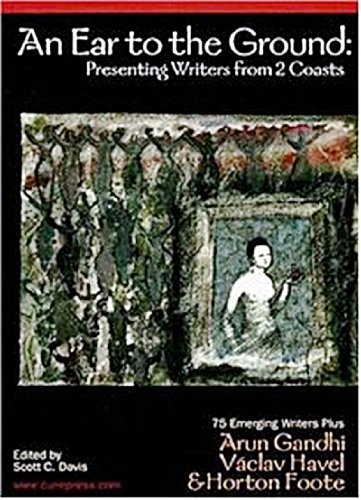



This work features personal essays on the theme 'local truth'. It includes piquant, surprising, unpredictable proses from 75 of the finest emerging writers of the East and West Coasts. These men and women speak to particular subcultures and localities. Their words have sharp edges. Their thinking is strong, deeply felt, rooted - a welcome change from the pabulum that is produced for a mass audience. Learn of our future as is passes from the heat and passion of local discourse into national debate. Listen to men and women who, for all their individuality, share Cune's notion that literature, by its excellence as art tends to orient, heal, and uplift. Seventy-eight brief essays on the theme of "local truth" written by "emerging writers" plus three guests, including Vaclav Havel, are packed here into one volume. This innovative book was cooperatively published with the help of volunteers and donated writing and artwork; a call for publishing reforms appears in the afterword, written by editor Davis (The World of Patience Gromes: Making and Unmaking a Black Community, Univ. Pr. of Kentucky, 1988). Considerable ground is covered, from cross- and multiculturalism, marginalized writers, and literary genres (e.g., travel writing, poetry, tall tale) to a heartening remedy to the trend in ever-merging corporate megapublishers. With place, proper-name, subject, and even favorite-book indexes; a genre guide for teachers; author portraits; and biographical information, this is a reference librarian's dream. Highly recommended for public and academic libraries.?Janice E. Braun, Mills Coll., Oakland, Cal. Copyright 1997 Reed Business Information, Inc. Designed ``as a salon'' for new writers from the East and West coasts, according to editor Davis (The World of Patience Gromes, 1988), this wildly uneven collection of essays claims ``local truth'' as its unifying theme, though many of the 78 entries have nothing to do with coastal locales. Davis's emphasis on ``local truth'' is perplexing: Sean Bentley's ``Night Train to Pisa'' describes a frightening episode during his first trip to Europe. Sande Smith of Philadelphia chips in a piece on France, while another writer describes her 1979 sojourn in Italy with an ex-husband. Many pieces have no ``place'' at all. There's a good bit by Lance Carden on roller coasters; Kenneth Carroll examines black anti-Semitism and Jewish racism; and in ``Fury,'' Bruce Duane Martin describes his father beating his dog to death with a bootjack--an incident that occurred in 1963 on a Wisconsin dairy farm. Others do focus on a ``local truth''; Shauna Somers declares, ``I walk Los Angeles,'' out of necessity and love, having survived nine car accidents, and to ``avenge'' the deaths of two grandparents run down by cars. Reba Owen writes of body surfing in winter off the coast of Oregon. Donna Clovis recounts the legend of the New Jersey Devil that haunts the Pine Barrens. And Ronnie Ritts contributes a breezy essay on his years as a Miami taxi driver. An interesting and admirable endeavor by Davis and his independent publishing company, but there's too much that simply isn't good and too little that thematically brings it all together. (78 b&w illustrations) -- Copyright ©1997, Kirkus Associates, LP. All rights reserved. An Ear to the Ground is a genuinely interesting book, one which may chart a new direction for certain cooperatively-organized communities of writers and publishers. Hefty, scrupulously produced and edited, it profiles and prints over 75 writers, each represented by a two to four page essay, generally memoiristic and specific to some moment or string of events in the writer's experience. The prose is tight and purposful and the selections offer meaning, concrete personality and an anthological unity that builds upon and extends from the specificities of individual writers. An Ear to the Ground is at once a good read, a rich book and a publishing vision. What range of subjects: anti-Semitism among D.C. African-Americans; anxiety at the loss of one's passport in the Customs line at the Guatemala City airport; memory in Miami among Afro-Cubans; reflecting upon having had sex with a husband who thought you unfaithful, associating the memory with take-out food; building a home from the bedroom out, and after fire, rebuilding it before divorcing and forever leaving; composting; hustling elderly tourists in Alaska; a club fighter's daughter penetrating bodygards in midtown Manhattan to touch Muhammad Ali's hand; breathing and the Wonder Bra; bigotry, aparthied, cotton, Emmett Till's lynching and growing up in Ruleville, Mississippi. Seventy-five-plus strong personal essays. As with modes of travel where one moves without fixed intention, idling attentively accumulationg stories and complications, pausing, conversing, detouring and retracking, An Ear To The Ground gives the reader entree into many lives that would otherwise pass unknown. Our individual humanity as well as articulate corresp