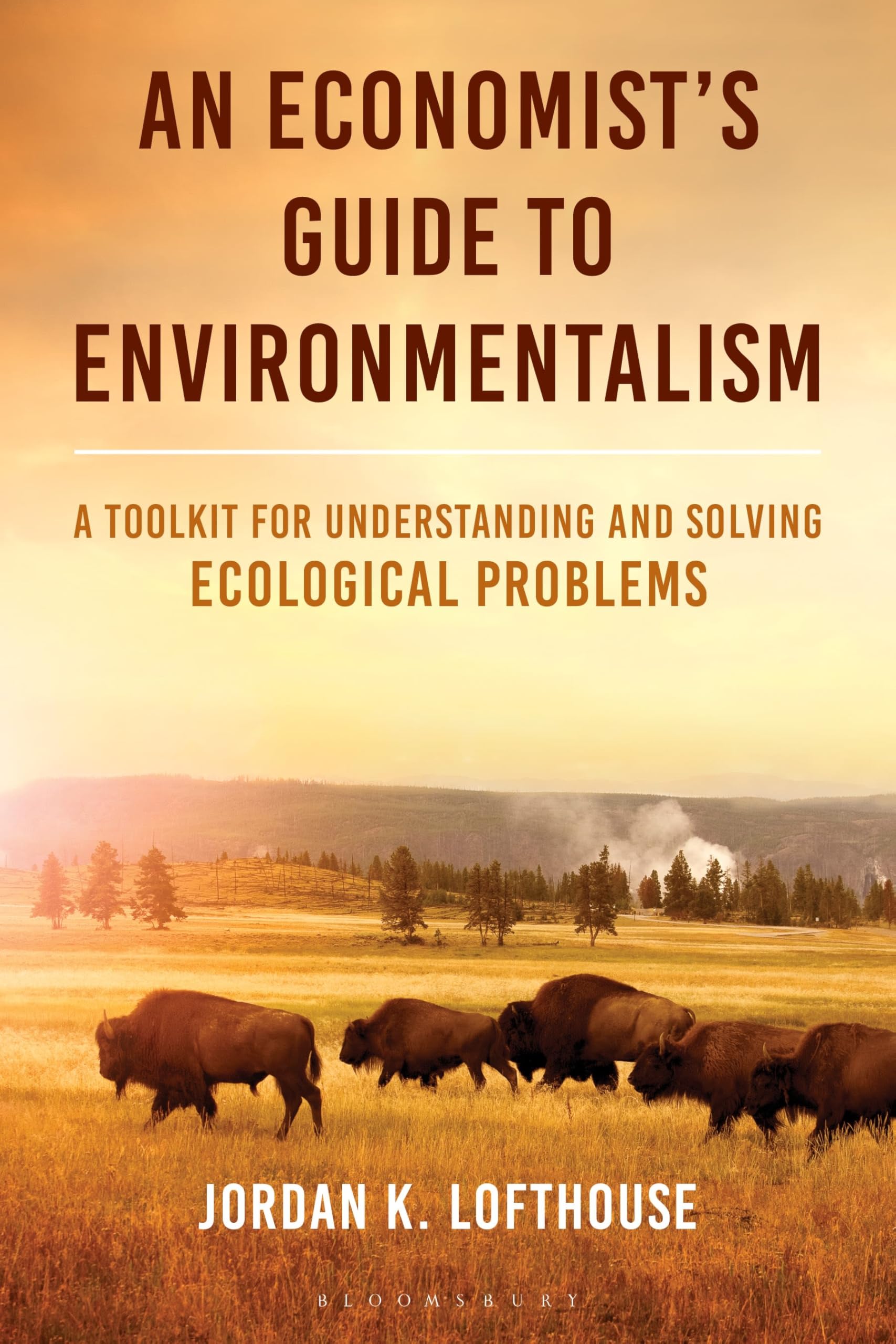
An Economist's Guide to Environmentalism: A Toolkit for Understanding and Solving Ecological Problems
$36.00
by Jordan K. Lofthouse



Explains how economics can be used to solve an array of environmental issues from endangered species to global warming. Many species are threatened with extinction and landscapes are being destroyed. Water is becoming increasingly scarce, harming ecological systems and human societies. Perhaps the most pressing environmental problem is human-caused climate change. What causes these problems, and what can we do about them? In An Economist's Guide to Environmentalism , Jordan K. Lofthouse demonstrates how the field of economics can explain the rise of environmental problems and offers a framework to evaluate the vast array of potential solutions. Lofthouse assembles a “toolkit” of easy-to-understand economic concepts and then applies those tools to a variety of environmental problems. These tools include incentives, constraints, trade-offs, unintended consequences, institutional analysis, and more. The examples in this book highlight how environmental issues often stem from poorly defined or poorly enforced property rights. Lofthouse argues for novel solutions such as assigning property rights to wildlife on the verge of extinction, private approaches to land conservation, and the implementation of water markets. Addressing global-scale problems like climate change requires the innovative and entrepreneurial discoveries of many different people in governments, markets, and civil society. Readers of this book will discover new opportunities and a refreshing, practical approach to protecting the planet through the insights of economics. “This book is an easy read that will make you rethink how we solve environmental problems. Trying on the Lofthouse thinking cap, you will discover how to improve our environment with more cooperation and less conflict.” ―Terry L. Anderson, John & Jean DeNault Senior Fellow, Hoover Institution, Stanford University “Jordan Lofthouse is a serious economic thinker; he is also passionate about the wonders of nature. These are not in conflict with one another in Lofthouse's rendering but instead work hand in hand to not only understand the world and the dysfunctions caused by various policies related to the environment, but how market mechanisms and civil society can work to conserve and protect the wonders of nature, and also improve our ability to appreciate not only the beauty but the power of nature. Trade-offs, incentives, informational feedback, and social cooperation under the division of labor are not in conflict with a deep passion and concern with nature, and in fact in Lofthouse's hands are intellectual tools for environmentalism.” ―Peter J. Boettke, Distinguished University Professor of Economics, George Mason University “As a conservationist, I've often said that one of the great underappreciated and underutilized tools of conservation is economics, oftentimes because people who do conservation are either intimidated by its concepts or turned off by its perceived detached approach. To those people, I would say "Take heart!" Jordan Lofthouse's An Economist's Guide to Environmentalism provides a wonderful bridge from the theoretical to the practical, helping us to better understand how economic concepts explain the real world and can be applied to our most pressing environmental challenges. As Lofthouse demonstrates, markets, property rights, and even improved entrepreneurial incentives in government, the private sector, and civil society are tools that should not be overlooked in our quest to conserve our lands, water and wildlife.” ―Brian Yablonski, CEO, Property and Environment Research Center (PERC) “This enjoyable book distills key insights from a broad array of thinkers in political economy and then applies those insights to today's most pressing environmental challenges in a way that no scholar has previously managed to do. PPE scholars will find a wonderful tour of important questions in environmental economics, while environmental economists will glean new perspective from the elegant synthesis of the key schools of thought in PPE.” ―Bryan Leonard, associate professor, Haub School of Environment and Natural Resources and School of Energy Resources, University of Wyoming Jordan K. Lofthouse is a senior fellow with the FA Hayek Program for Advanced Study in Philosophy, Politics, and Economics at the Mercatus Center at George Mason University. He is the coauthor of The Reality of American Energy: The Hidden Costs of Electricity Policy . He was born and raised in Rexburg, Idaho, and he currently lives in Falls Church, Virginia.