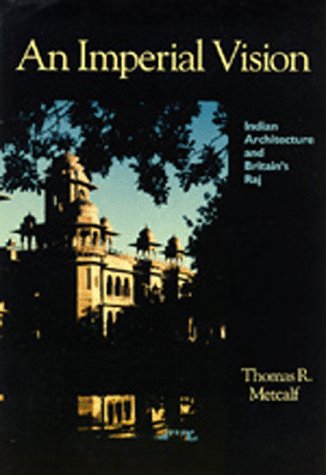



The magnificent buildings constructed by the British in India, many of which may still be seen by the traveller, did not spring simply from the fancy of the architects or from purely aesthetic or administrative concerns: Rather they embodied a vision the British had of themselves as rulers of India. An Imperial Vision examines the relationship between culture and power as expressed in the architectural forms the British employed in India. From the great monuments of New Delhi to the most obscure structures in dusty country towns these buildings visibly represented in stone the choices the British made in politics as imperial rulers. The author illustrates how, in the years after the uprising of 1857, the British constructed a vision of themselves not as mere foreign conquerors, but as legitimate, almost indigenous rulers, linked directly to the Mughals and hence to India's own past. In so doing they created the distinctive forms of so-called Indo-Saracenic architecture. For a half a century this building sustained a new ideology of empire. Yet this self-confidence could not endure forever. By the 1920s, despite the massive building projects underway on the plains of Delhi, the knowledge, and the power, that upheld the Raj had alike begun to slip away. An Imperial Vision , by its focus upon the relationships of culture and power that underlay the colonial order, throws light on the distinctive nature of late nineteenth-century imperialism, and more generally, on the way political authority takes shape in monumental architecture. Metcalf (history, Univ. of California) analyzes one of the many ways the British defined their power in India after 1857, when they assumed an imperial role in the subcontinent. Buildings, especially official ones, had to reflect and inspire respect for authority. Simple use of Western motifs was inappropriate, but how "Indian" could architecture be? Addressing that question, Metcalf shows the influences of contemporary British thought on Indian buildings, including those constructed during the final burst of British building that created New Delhi, an imperial city designed to reflect the Raj forever. A definite first-choice purchase for libraries interested in imperial history or India. - Donald Clay Johnson, Univ. of Minnesota Lib., Minneapolis Copyright 1989 Reed Business Information, Inc. "Not a catalogue raisonné of colonial buildings but a significant step forward into the new discipline of 'political architecture'an important advance in widening our perceptions of colonialism as expressed in one of its most enduring forms."Rosie Llewellyn-Jones, University of London "Metcalf's An Imperial Vision is an important and original contribution to an emergent genre of research. It builds upon a growing interest in the cultures of colonialism, and hence will be read not only by South Asian scholars, but by all who are interested in this burgeoning field. This is the work of a distinguished historian, who has the imagination and knowledge to see the social, political and cultural interrelation across time and space, and it sets a standard for all who are interested in the complex relations between Europeans and the rest of the world."Bernard S. Cohn, University of Chicago "Not a catalogue raisonn of colonial buildings but a significant step forward into the new discipline of 'political architecture' (an important advance in widening our perceptions of colonialism as expressed in one of its most enduring forms." (Rosie Llewellyn-Jones, University of London) Thomas R. Metcalf is Professor of History at the University of California at Berkeley and author of Land, Landlords and the British Raj (California, 1979), among other books.