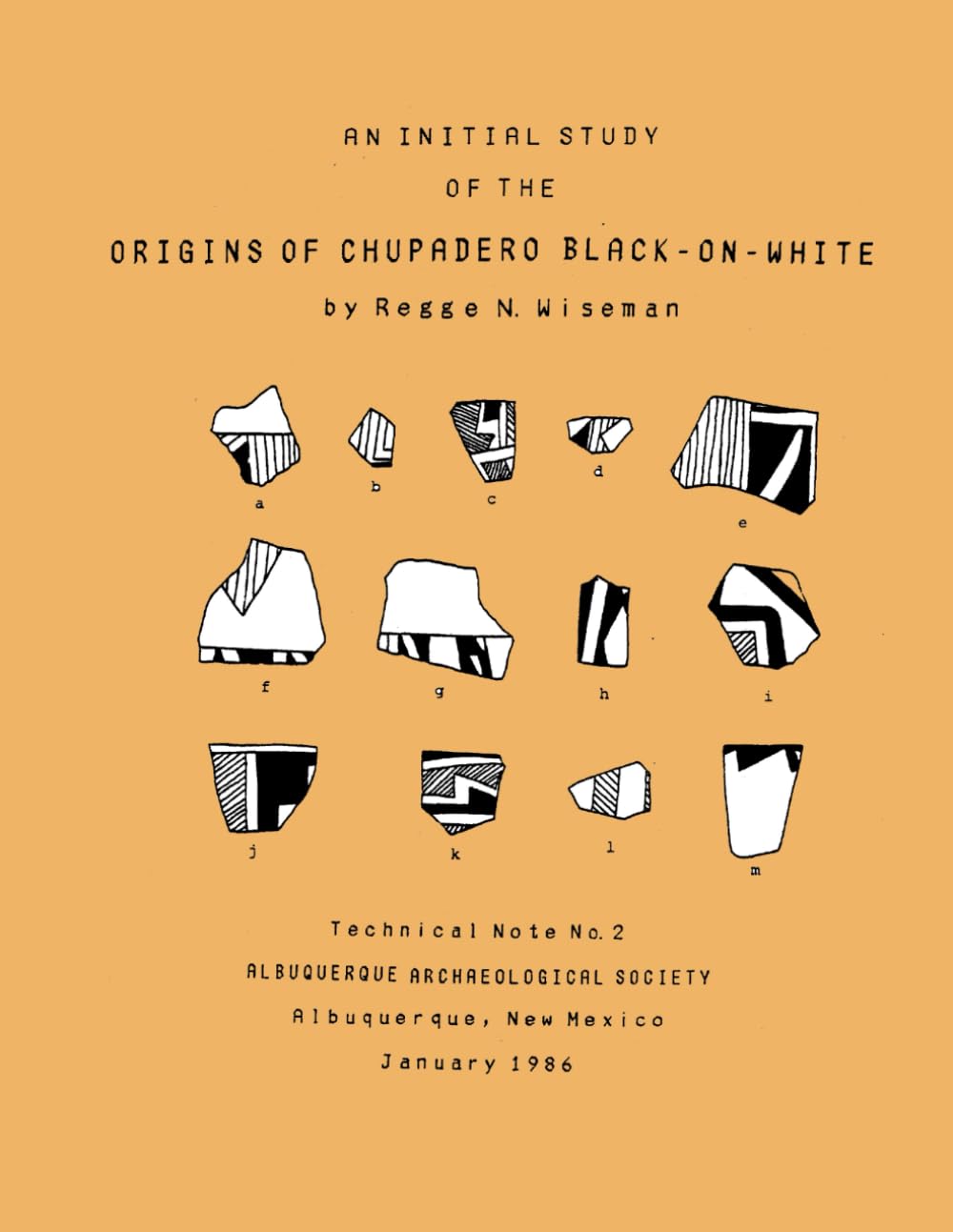
An Initial Study of the Origins of Chupadero Black-on-White Pottery
$5.68
by Regge N Wiseman



Chupadero Black-on-white is one of the most distinctive and most common painted wares of the late prehistoric period in southeastern New Mexico and adjacent parts of Texas and Mexico (Mera, 1931, 1935; Stallings, 1932; Brand, 1935; Hawley, 1936; Runyan and Hedrick, 1973). Its widespread occurrence in quantity indicates that it had functional importance and perhaps aesthetic value as well. Although it was named and described at a relatively early date (Mera, 1931), its origins and temporal parameters (Breternitz, 1966) are poorly understood and virtually unknown. Speculation about these aspects has been diverse, but we seem to have progressed little in the last 50 years. While the present study does not pretend to supply all the answers to these questions, a number of observations and points will be made which, hopefully, will further the process. The history of the investigation of Chupadero has few highlights. H.P. Mera first formally described it (1931) and a few years later suggested that the laboratory working type Casa Colorado BIW was a Chupadero variant with its undecorated surface smoothed (1935). He thought Chupadero's origins ultimately lay in the Chaco I and Chaco II types (now called Kiatuthlanna, Red Mesa, and Escavada B/Ws) through a geographically intermediate type calledSocorro B/W.