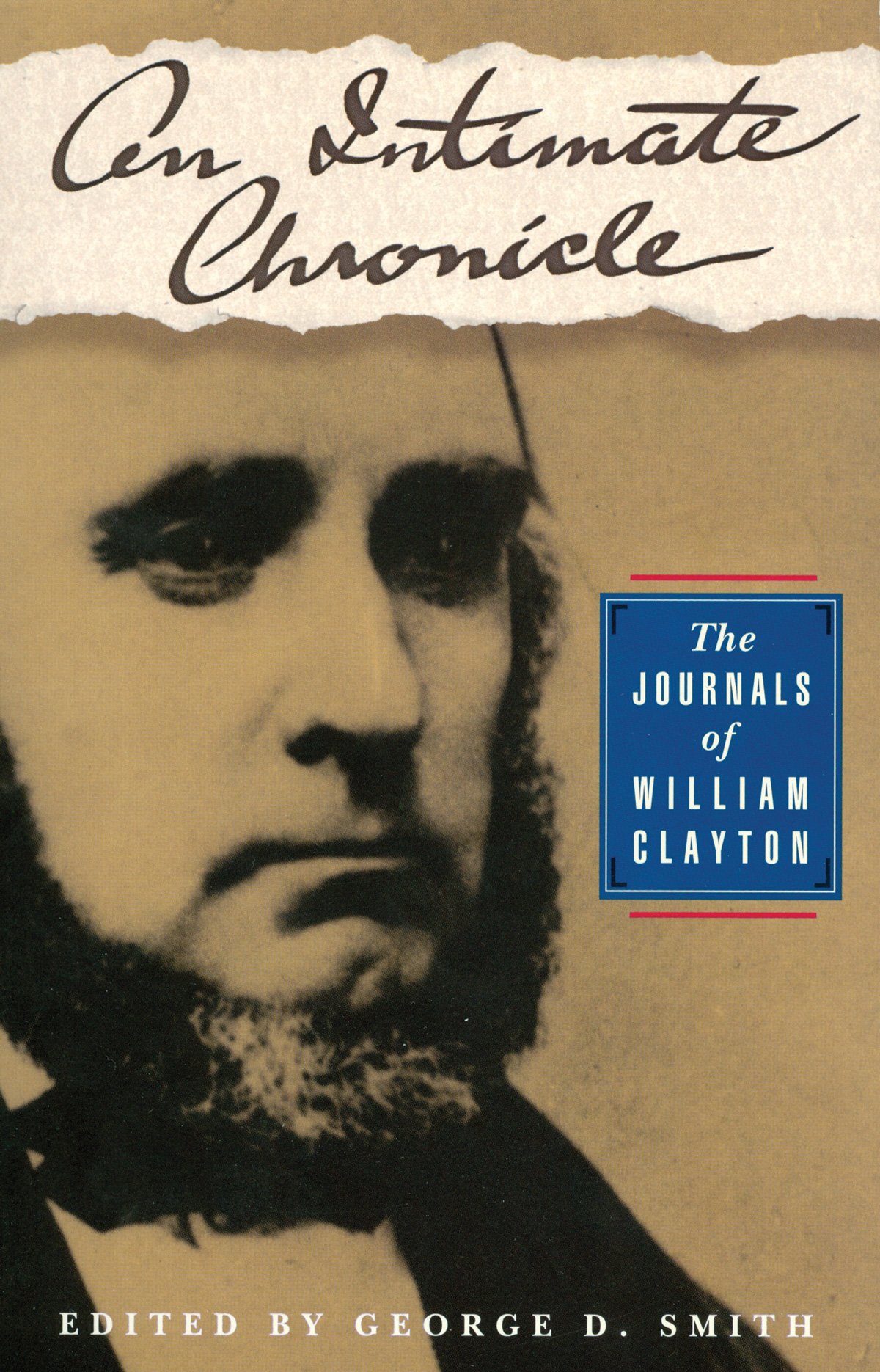
An Intimate Chronicle: The Journals of William Clayton (Volume 1)
$24.95
by George D. Smith



William Clayton is best remembered today for his hymns, especially “Come, Come Ye Saints.” But as one of the earliest Latter-day Saint scribes, he made intellectual as well as artistic contributions to his church, and his records have been silently incorporated into official Mormon scripture and history. Of equal significance are his personal impressions of day-to-day activities, which describe a social and religious world largely unfamiliar to modern readers. In ministering to the sick, for instance, Clayton anointed with perfumed oil and rum. He performed baptisms to heal the sick. Church services, held irregularly, were referred to as “going to meeting” and seemed to be elective. He testifies of people speaking in tongues and of others “almost speaking in tongues.” When introduced to plural marriage, he was reluctant but eventually became one of its most enthusiastic proponents, marrying ten women and fathering forty-two children. Since polygamy was initially secret, Clayton spent much of his time putting out the fires of innuendo and discontent. He caught his first plural wife rendezvousing with her former fiancé; later, when she became pregnant, her mother–his unaware mother-in-law–was so overwrought that she attempted suicide. Joseph Smith reassured him: “Just keep her at home and brook it and if they raise trouble about it and bring you before me I will give you an awful scourging and probably cut you off from the church and then I will set you ahead as good as ever.” Clayton was also the object of Emma Smith’s attentions, allegedly part of a jealous wife’s plan to make a cuckold of her errant husband. The collection of journals kept between 1840 and 1853 by William Clayton, personal secretary to Joseph Smith (founder of the Mormon Church), which was originally published amid some controversy as a limited edition in 1991, is here made available for the first time as a one-volume trade edition. Clayton was a meticulous diarist (probably too meticulous for the taste of most general readers) who was close to Joseph Smith and Brigham Young at the beginning of the polygamy controversy, and he accompanied Young on the westward expedition from Nauvoo, Illinois, that blazed the Mormon trail to Salt Lake City. The journals, along with the editor's excellent historical introduction and extensive notes, will be particularly relevant to readers with a specific interest in Mormon Church history, but they also provide a fascinating glimpse into nineteenth-century frontier life that may merit a broader readership. Steve Schroeder George D. Smith is a graduate of Stanford and New York University. He is the author of Nauvoo Polygamy: “… but we called it celestial marraige”and is the editor of the landmark frontier diaries of one of the most prominent Mormon pioneers (An Intimate Chronicle: The Journals of William Clayton) and, among other books, Religion, Feminism, and Freedom of Conscience . He has published on historical and religious topics in Dialogue: A Journal of Mormon Thought , Free Inquiry , Journal of Mormon History, John Whitmer Historical Journal , Sunstone,and elsewhere. He has served on the boards of the Kenyon Review, the Leakey Foundation , and National Public Radio. He is a founder and current publisher of Signature Books. Journal Three Nauvoo Temple 1845-1846 On the day temple ordinances begin, Heber C. Kimball asks William Clayton to help him keep a record of Nauvoo temple-related activities. Clayton describes how the Saints hurry to perform the necessary rites prior to their departure for the west. [December 10, 1845. Wednesday.]1 This morning went up to the Temple in company with my wife and sister [Sarah Ann] Whitney.2 The morning very fine and pleasant but cold. I arrived at 10 o clock and found a number of the brethren already present and some of their wives. President [Brigham] Young engaged himself, by fixing the curtains on the East Window. I assisted him with Sisters Kimball, Pratt and Whitney. About half after 10 o clock it was reported that priest [Hamilton] Tucker (Catholic) and his associates were below waiting an interview with the Twelve and Council. At 11 1/4 Mr. [Hamilton] Tucker and Mr. [] Hamilton were admitted into the upper room of the Temple accompanied by Bishop Joseph L. Heywood who gave the gentlemen an introduction to those present. The propositions of the council in regard to the sale of our property were presented to Mr. Tucker in writing who read them over and then handed them to Mr. Hamilton who also read them. The gentlemen were then invited into President Youngs room with myself, President Young, Willard Richards, Orson Hyde, John Taylor, Amasa Lyman, John E. Page, George A. Smith, P[arley] P. Pratt, George Miller, John M. Bernhisel, Joseph L. Heywood, W[illia]m Clayton. Mr. Tucker made some observations respecting the two Main Rooms of the Temple. He thought they were so high it would be difficult for a speaker. President Young replied and explained in rega